VIP Reconstitution Calculator
Enter the amount you want to measure. The vial buttons will highlight which vial strengths create cleaner syringe-unit measurements.
What amount do you need?
Type the target amount, then choose mg or mcg. Example: 2mg or 500mcg.
Syringe size:
Possible vial strengths:
Best Match
Good Match
Usable
Harder to Measure
Example VIP Titration Schedule
| Protocol Item | Guidance (Source Summary) |
|---|---|
| Dose | 100–500 mcg per dose |
| Cycling / Use Pattern | Commonly used on an as-needed basis |
| Frequency Notes | Dosing frequency and intensity depend on individual response and condition |
| Timing Notes | Described as fast-acting with a short half-life (~2 minutes) |
| Goal / Principle | The goal is not to become dependent on the compound |
Possible vial strengths:
What Is It?
VIP
Vasoactive intestinal peptide.
Bacteriostatic Water
Sterile water containing a bacteriostatic preservative, commonly used when preparing multi-use research vials.
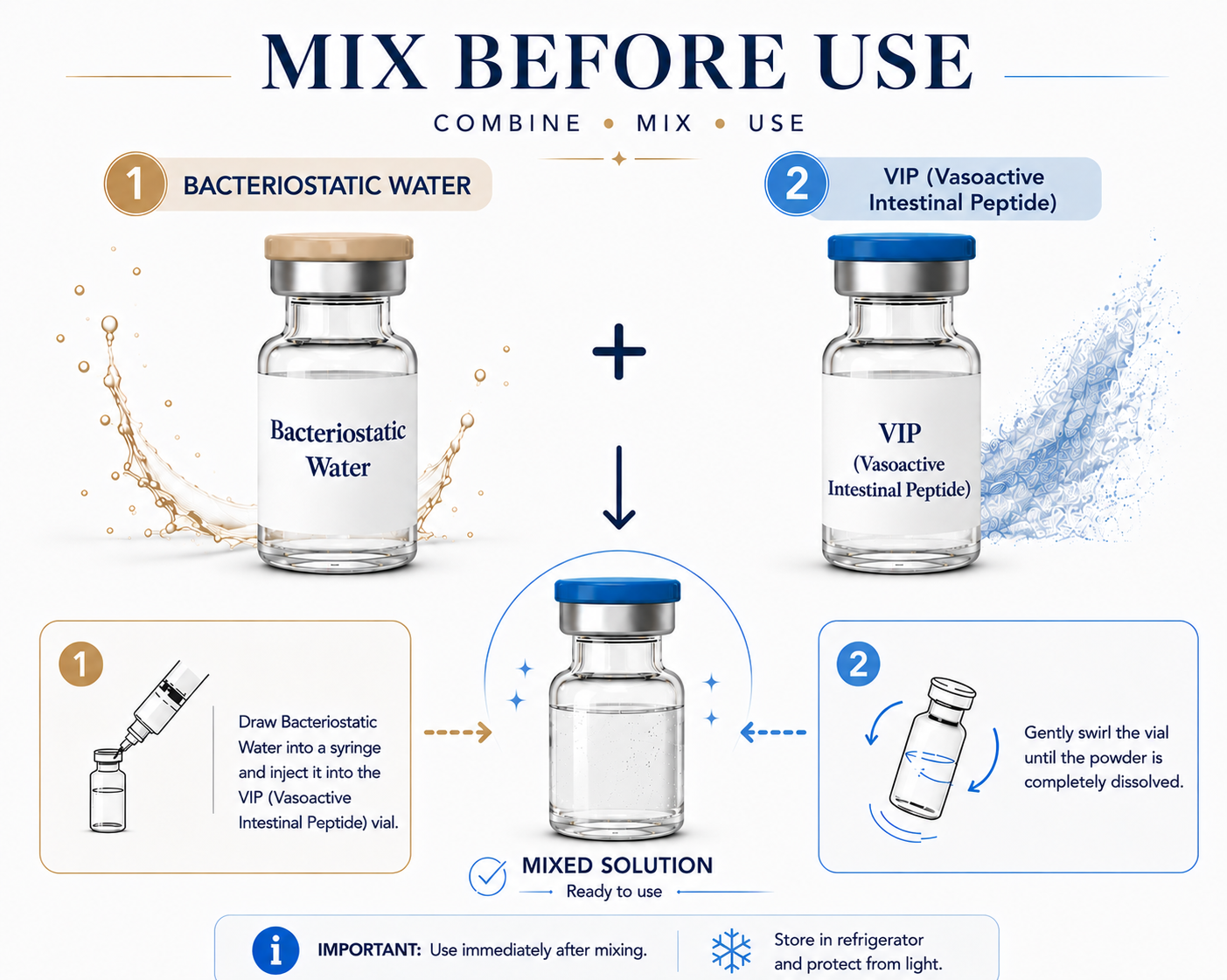
How To Mix VIP
1
CleanUse alcohol swabs to clean the tops of both vials.
2
Draw BAC WaterDraw the selected amount of bacteriostatic water.
3
Inject SlowlyAdd the liquid slowly down the side of the vial.
4
Swirl GentlyDo not shake. Swirl gently until dissolved.
5
Store ProperlyStore as directed and protect from heat and light.
Best Practices & Common Mistakes
Best Practices
- Use sterile technique.
- Protect from light and heat.
- Store refrigerated when appropriate.
- Use clean syringe-unit math before measuring.
Common Mistakes
- Confusing milligrams with milliliters.
- Choosing an option with awkward decimal units.
- Using too little liquid for very small measurements.
- Shaking the vial aggressively.
VIP Storage & Handling
Lyophilized Powder: −20°C (−4°F) for long-term storage (up to 24 months). Refrigeration 2–8°C (36–46°F) for short-term use (up to ~3 months). Original sealed vial in the freezer is safest.
Reconstituted Solution: 2–8°C (36–46°F), use within ~7–14 days. Keep sealed, avoid light, and do not repeat freeze-thaw cycles.
Reconstituted Solution: 2–8°C (36–46°F), use within ~7–14 days. Keep sealed, avoid light, and do not repeat freeze-thaw cycles.
Frequently Asked Questions
Your calculator assumes the peptide stays in the body, but VIP is eliminated extremely quickly. Its initial half-life in plasma is just one minute, with a biphasic elimination of 2 and 21 minutes. This means peptide breaks down practically within minutes after entering the bloodstream. A single subcutaneous shot will give only a brief pulse, not sustained levels. You might need a continuous infusion pump or formulate VIP in liposomes to slow its release.
The standard minimum solubility is 100 µg/mL, and you might need to use 37°C warming or sonication to dissolve higher concentrations. If your calculator recommends a concentration over roughly 1 mg/mL without special solvents, the powder may remain partially undissolved, making your syringe draw inaccurate.
Once mixed, the solution should be stored at 2-8°C and typically used within only 2-7 days. If you don't freeze the solution in aliquots, you'll lose potency after the first week, regardless of how many doses the calculator says the vial contains.
Only indirectly. The peptide's solubility and storage properties can vary with the counter-ion. Some suppliers recommend reconstituting in 20 mM Tris-HCl, 150 mM sodium chloride (pH 8.0) for stability, while others use 10 mM PBS (pH 7.4). Bac water (pH ~5.5) may reduce stability if the salt form isn't free base.
Suppliers recommend adding a carrier protein (0.1% HSA or BSA) after reconstitution to improve stability. Without this, and without protecting the solution from light, oxidation will silently degrade your peptide, making later injections from the same vial much less potent.
Practical takeaway: If your real goal is weight or metabolic health, the most useful next step is discussing approved treatment options with a clinician rather than relying on an unapproved compound.
Important: This tool is for informational and research-reference purposes only. Not intended for human or veterinary use.