KPV Reconstitution Calculator
Enter the amount you want to measure. The vial buttons will highlight which vial strengths create cleaner syringe-unit measurements.
What amount do you need?
Type the target amount, then choose mg or mcg. Example: 2mg or 500mcg.
Syringe size:
Possible vial strengths:
Best Match
Good Match
Usable
Harder to Measure
Example KPV Titration Schedule
| Protocol Item | Guidance |
|---|---|
| Dose | 200–500 mcg per dose |
| Cycling | Typical cycles are daily for 30 days, and may be extended to 90 or 120 days, with a 30-day minimum cycle break between cycles. |
Possible vial strengths:
What Is It?
KPV
Tripeptide tail of alpha-MSH with anti-inflammatory study.
Bacteriostatic Water
Sterile water containing a bacteriostatic preservative, commonly used when preparing multi-use research vials.
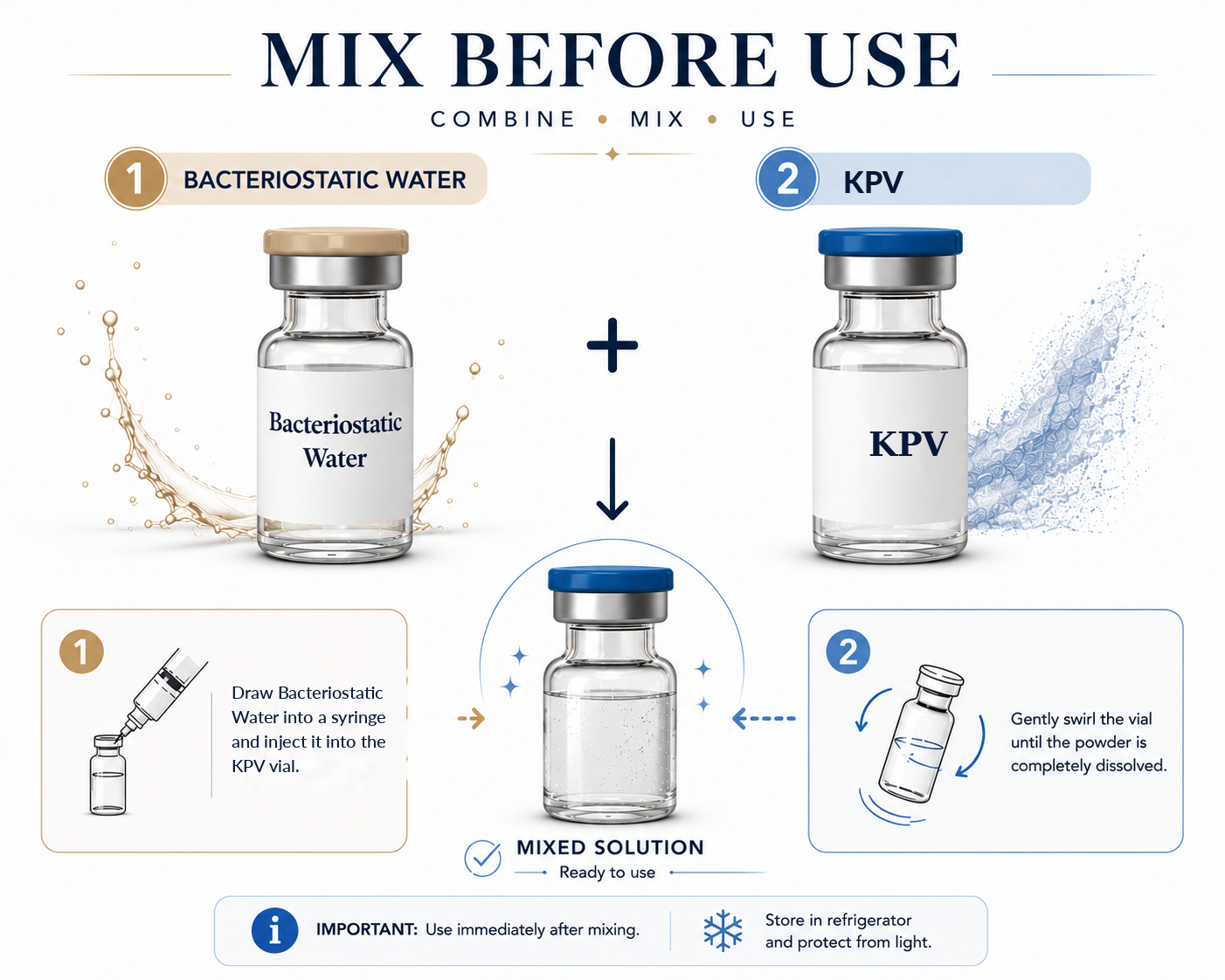
How To Mix KPV
1
CleanUse alcohol swabs to clean the tops of both vials.
2
Draw BAC WaterDraw the selected amount of bacteriostatic water.
3
Inject SlowlyAdd the liquid slowly down the side of the vial.
4
Swirl GentlyDo not shake. Swirl gently until dissolved.
5
Store ProperlyStore as directed and protect from heat and light.
Best Practices & Common Mistakes
Best Practices
- Use sterile technique.
- Protect from light and heat.
- Store refrigerated when appropriate.
- Use clean syringe-unit math before measuring.
Common Mistakes
- Confusing milligrams with milliliters.
- Choosing an option with awkward decimal units.
- Using too little liquid for very small measurements.
- Shaking the vial aggressively.
KPV Storage & Handling
Lyophilized Powder: −20°C (−4°F) for long-term storage (up to 24 months). Refrigeration 2–8°C (36–46°F) for short-term use (up to ~3 months). Original sealed vial in the freezer is safest.
Reconstituted Solution: 2–8°C (36–46°F), use within ~7–14 days. Keep sealed, avoid light, and do not repeat freeze-thaw cycles.
Reconstituted Solution: 2–8°C (36–46°F), use within ~7–14 days. Keep sealed, avoid light, and do not repeat freeze-thaw cycles.
Frequently Asked Questions
Your calculator treats all peptides uniformly, but KPV’s recommended 3.0 mL of BAC water per 10 mg vial (creating ~3.33 mg/mL) is not to improve solubility—it’s to make dosing practical. With 3 mL, 1 unit (0.01 mL) equals ~33 mcg on a U‑100 syringe. If you follow your calculator’s 1 mL suggestion, 1 unit would equal ~100 mcg, making fine adjustments for the 200–500 mcg daily range impossible. The calculator’s “Best” match for 1 mL may be mathematically cleaner, but 3 mL is the pharmacologically optimal choice for this peptide.
Your calculator only knows the mass you enter; it does not know the intended model. The 50 μg/mL study was performed on human HaCaT keratinocytes in culture. A subcutaneous injection enters systemic circulation, is diluted in blood, and only a tiny fraction reaches target cells. The typical 200‑500 mcg daily dose reflects the need to overcome first‑pass dilution, while 50 μg/mL is a final applied concentration in a dish. To translate in‑vitro data, you would need to calculate the injection dose that achieves a comparable interstitial fluid concentration—a task well beyond your calculator’s scope.
Your calculator’s BAC water and unit display are irrelevant for oral administration, but its concentration math remains valid. In a murine colitis study, KPV was added directly to drinking water. If you want to prepare a 0.5 mg/mL drinking solution for animals, your calculator can help: entering vial mass (e.g., 10 mg) and desired final volume (e.g., 20 mL) gives the correct amount of reconstituted peptide to add to the water. However, the calculator’s assumption of BAC water and syringe units does not apply—use sterile water instead and ignore the “units” output.
Could a researcher misuse your calculator by assuming receptor‑dependent dosing?
Contrary to intuition, KPV’s anti‑inflammatory effect in animal models is not blocked by melanocortin receptor antagonists. It is more likely to act through direct inhibition of IL‑1β functions, independent of MC‑R pathways. This means dose‑response relationships from alpha‑MSH studies do not apply. If a researcher uses your calculator to increase the dose expecting a melanocortin‑type graded response, they may be chasing a receptor that KPV does not meaningfully engage. The calculator cannot warn about this; the biology must be considered separately.
Contrary to intuition, KPV’s anti‑inflammatory effect in animal models is not blocked by melanocortin receptor antagonists. It is more likely to act through direct inhibition of IL‑1β functions, independent of MC‑R pathways. This means dose‑response relationships from alpha‑MSH studies do not apply. If a researcher uses your calculator to increase the dose expecting a melanocortin‑type graded response, they may be chasing a receptor that KPV does not meaningfully engage. The calculator cannot warn about this; the biology must be considered separately.
After reconstitution with bacteriostatic water, KPV can be stored at 2–8 °C and used for up to 30 days. For a 10 mg vial reconstituted with 3 mL BAC, the maximum number of 300‑mcg doses is about 33. If you inject once daily, you will only use about 30 doses within the 30‑day safe window. The “doses per vial” display might show a higher number with smaller doses, but discarding the vial after 30 days (even if doses remain) is necessary to prevent microbial growth. This is a safety limitation that your calculator cannot represent.
Practical takeaway: If your real goal is weight or metabolic health, the most useful next step is discussing approved treatment options with a clinician rather than relying on an unapproved compound.
Important: This tool is for informational and research-reference purposes only. Not intended for human or veterinary use.