LL-37 (CAP-18) Reconstitution Calculator
Enter the amount you want to measure. The vial buttons will highlight which vial strengths create cleaner syringe-unit measurements.
What amount do you need?
Type the target amount, then choose mg or mcg. Example: 2mg or 500mcg.
Syringe size:
Possible vial strengths:
Best Match
Good Match
Usable
Harder to Measure
Example LL-37 (CAP-18) Titration Schedule
| Protocol Item | Guidance |
|---|---|
| Dose | 100–500 mcg per dose |
| Cycling | Daily for 30 days; may be extended to 60 or 90 days with a 30-day minimum cycle break between cycles |
| How to Adjust | Cycle length and intensity depend on response and goal |
Possible vial strengths:
What Is It?
LL-37 (CAP-18)
Cathelicidin antimicrobial peptide.
Bacteriostatic Water
Sterile water containing a bacteriostatic preservative, commonly used when preparing multi-use research vials.
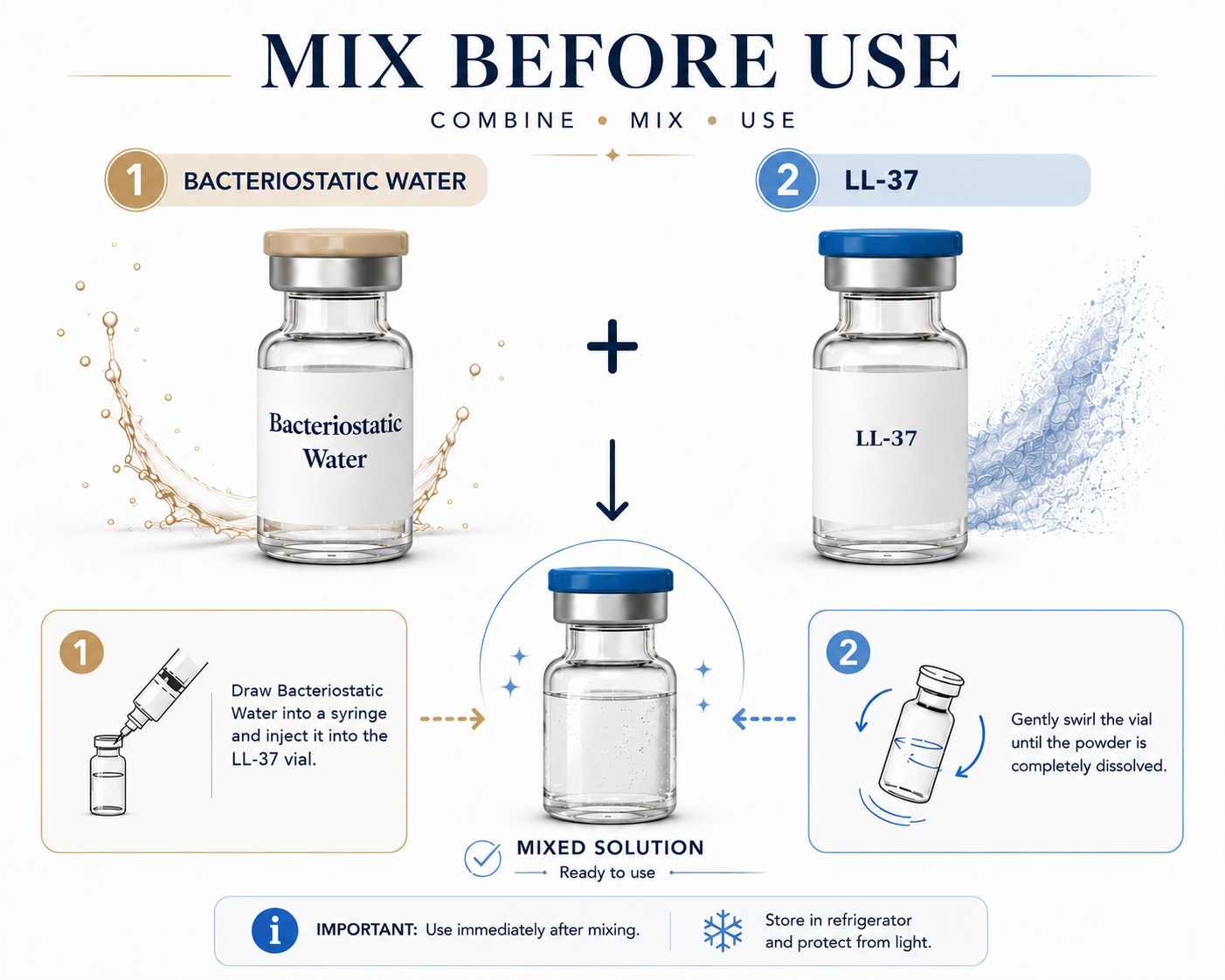
How To Mix LL-37 (CAP-18)
1
CleanUse alcohol swabs to clean the tops of both vials.
2
Draw BAC WaterDraw the selected amount of bacteriostatic water.
3
Inject SlowlyAdd the liquid slowly down the side of the vial.
4
Swirl GentlyDo not shake. Swirl gently until dissolved.
5
Store ProperlyStore as directed and protect from heat and light.
Best Practices & Common Mistakes
Best Practices
- Use sterile technique.
- Protect from light and heat.
- Store refrigerated when appropriate.
- Use clean syringe-unit math before measuring.
Common Mistakes
- Confusing milligrams with milliliters.
- Choosing an option with awkward decimal units.
- Using too little liquid for very small measurements.
- Shaking the vial aggressively.
LL-37 (CAP-18) Storage & Handling
Lyophilized Powder: −20°C (−4°F) for long-term storage (up to 24 months). Refrigeration 2–8°C (36–46°F) for short-term use (up to ~3 months). Original sealed vial in the freezer is safest.
Reconstituted Solution: 2–8°C (36–46°F), use within ~7–14 days. Keep sealed, avoid light, and do not repeat freeze-thaw cycles.
Reconstituted Solution: 2–8°C (36–46°F), use within ~7–14 days. Keep sealed, avoid light, and do not repeat freeze-thaw cycles.
Frequently Asked Questions
Your calculator assumes complete dissolution in plain BAC water, but LL‑37 is known to be insoluble in water. For consistent and complete solubility, the peptide must first be dissolved in 10% acetonitrile with 0.1% trifluoroacetic acid (TFA), and only then diluted with your desired buffer. If you rely solely on BAC water, the powder will not fully dissolve, your calculated concentration will be incorrect, and the final solution will be unusable for research. Always use the 10% ACN / 0.1% TFA mixture as the initial solvent, then dilute to your target concentration.
LL‑37 in lyophilised form is stable when stored below -18 °C. However, once reconstituted, the solution can be stored at 4 °C for only 2‑7 days before significant degradation occurs. For longer storage, the solution must be aliquoted immediately and frozen at below -18 °C for up to 3 months. Furthermore, at physiological temperature (37 °C), the peptide is rapidly degraded by the serine proteinase trypsin, with complete degradation observed after just 6 hours of incubation. Therefore, the “doses per vial” number from your calculator is only a theoretical maximum; for a multi‑day protocol, you must either prepare fresh solution daily or freeze single‑use aliquots.
The α‑helical LL‑37 monomer actively self‑assembles into supramolecular fibrils under certain conditions. This process is driven by its amphipathic nature and positive charge, which also allows it to interact strongly with negatively charged surfaces and membranes. At the high concentrations your calculator might recommend for small BAC volumes (e.g., 50 mg/mL), LL‑37 is prone to forming these fibrils, leading to a viscous or cloudy solution and inaccurate dosing. To minimise aggregation, reconstitute LL‑37 at a much lower concentration (e.g., 1‑2 mg/mL) and avoid vigorous shaking, which can promote fibrillation.
When administered intravenously as a non‑formulated peptide, a dose of just over 20 µg is rapidly cleared from the blood, with the bulk of the dose accumulating in the liver and an appreciable fraction temporarily distributing to the lungs. Over a 48‑hour period, approximately 85 % of the peptide dose is cleared from the lungs alone. This rapid elimination means that a single daily injection may produce only a transient effect. Researchers often administer LL‑37 in divided doses or use encapsulation technology to prolong its presence. Your calculator will accurately compute the volume for each dose, but the “doses per vial” number will be misleading if you need to inject multiple times per day to maintain effective levels.
Your calculator is a neutral dilution tool, but LL‑37 is known to cause mild injection site irritation as a common side effect, and in a case study of intra‑tumoral injections for melanoma, dermatologic toxicity was reported. All skin lesions resolved within 2 months after cessation of the injections. When using the calculator to plan multiple injections from a single vial, you should assume that some irritation may occur, and the reaction may be dose‑ or frequency‑dependent. The calculator cannot warn you about this. If you are designing a long‑term protocol, consider using a lower concentration (larger BAC volume) to reduce local irritation, and inspect the injection site regularly, even though the calculator’s outputs appear mathematically correct.
Practical takeaway: If your real goal is weight or metabolic health, the most useful next step is discussing approved treatment options with a clinician rather than relying on an unapproved compound.
Important: This tool is for informational and research-reference purposes only. Not intended for human or veterinary use.