GHK-Cu (Copper Peptide) Reconstitution Calculator
Enter the amount you want to measure. The vial buttons will highlight which vial strengths create cleaner syringe-unit measurements.
What amount do you need?
Type the target amount, then choose mg or mcg. Example: 2mg or 500mcg.
Syringe size:
Possible vial strengths:
Best Match
Good Match
Usable
Harder to Measure
Example GHK-Cu (Copper Peptide) Titration Schedule
| Protocol Item | Guidance |
|---|---|
| Dose | 1–5 mg per dose |
| Cycling | Daily, for 6 weeks, with a 30-day minimum cycle break between |
| Annual Frequency | Can be cycled 3–4× per year |
Possible vial strengths:
What Is It?
GHK-Cu (Copper Peptide)
Copper-bound GHK studied in skin and wound research.
Bacteriostatic Water
Sterile water containing a bacteriostatic preservative, commonly used when preparing multi-use research vials.
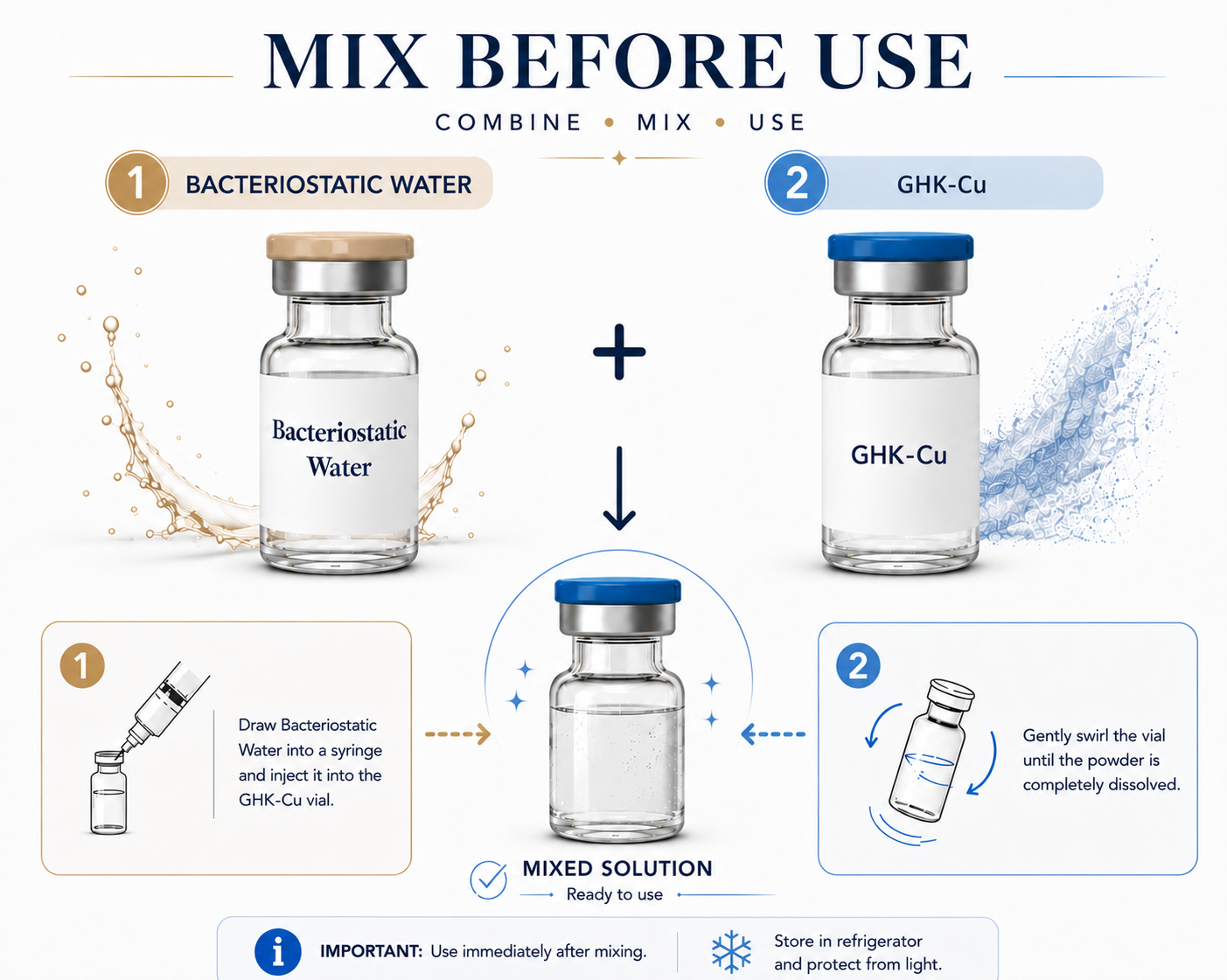
How To Mix GHK-Cu (Copper Peptide)
1
CleanUse alcohol swabs to clean the tops of both vials.
2
Draw BAC WaterDraw the selected amount of bacteriostatic water.
3
Inject SlowlyAdd the liquid slowly down the side of the vial.
4
Swirl GentlyDo not shake. Swirl gently until dissolved.
5
Store ProperlyStore as directed and protect from heat and light.
Best Practices & Common Mistakes
Best Practices
- Use sterile technique.
- Protect from light and heat.
- Store refrigerated when appropriate.
- Use clean syringe-unit math before measuring.
Common Mistakes
- Confusing milligrams with milliliters.
- Choosing an option with awkward decimal units.
- Using too little liquid for very small measurements.
- Shaking the vial aggressively.
GHK-Cu (Copper Peptide) Storage & Handling
Lyophilized Powder: −20°C (−4°F) for long-term storage (up to 24 months). Refrigeration 2–8°C (36–46°F) for short-term use (up to ~3 months). Original sealed vial in the freezer is safest.
Reconstituted Solution: 2–8°C (36–46°F), use within ~7–14 days. Keep sealed, avoid light, and do not repeat freeze-thaw cycles.
Reconstituted Solution: 2–8°C (36–46°F), use within ~7–14 days. Keep sealed, avoid light, and do not repeat freeze-thaw cycles.
Frequently Asked Questions
Yes, the colour matters. GHK‑Cu has a characteristic blue hue in solution, linked to its copper‑bound structure. A pale or muddy colour can indicate metal contamination, chelation, or degradation, especially if it changes after a few days. The calculator does not detect colour changes, so use colour as a quick visual check: for example, if a previously blue solution fades to nearly clear before you finish the vial, potency may be compromised.
The calculator only performs dilution math—it does not account for chemical stability. Benzyl alcohol (the preservative in BAC water) can degrade GHK‑Cu more quickly. With your calculator, you can still use BAC water, but be aware of a shorter shelf life (3‑5 days of near‑full activity). Alternatively, use sterile water for reconstitution (not in your calculator’s presets) and finish the vial in 7‑10 days. The calculator’s “Doses per vial” assumes full potency until the last drop—adjust your expectations accordingly.
No, your calculator assumes a single peptide in the vial. For a blend (e.g., 50 mg GHK‑Cu + 10 mg TB‑500 + 10 mg BPC‑157), the total mass is 70 mg. However, a desired dose of 1.5 mg GHK‑Cu is specific to that component only. Your calculator would misinterpret the vial as containing only one peptide. For blends, calculate each peptide’s concentration separately based on its individual mass, or use the calculator for the GHK‑Cu component alone and be aware that the other two will be co‑delivered in a fixed ratio.
The calculator is only for dilution math—it doesn’t track supplements. GHK‑Cu binds and delivers copper, which can deplete zinc levels in the body. While your calculator helps you measure your peptide dose precisely, it does not warn about this interaction or remind you to take zinc. Consider keeping a separate log for zinc intake (e.g., 10‑20 mg daily) to avoid deficiency.
Yes, indirectly. Pain is linked to high concentration and small injection volume. Your calculator allows you to increase BAC water volume (e.g., from 1 mL to 5 mL), which lowers the concentration and increases the draw volume. For example, a 50 mg vial with 5 mL BAC gives 10 mg/mL. For a 1 mg dose, you draw 0.1 mL (10 units) instead of 0.02 mL (2 units) with 1 mL BAC. The calculator may show “Best” for smaller volumes, but you can override to a larger BAC volume for comfort, even if the colour coding suggests a “Good” instead of “Best” match.
Practical takeaway: If your real goal is weight or metabolic health, the most useful next step is discussing approved treatment options with a clinician rather than relying on an unapproved compound.
Important: This tool is for informational and research-reference purposes only. Not intended for human or veterinary use.