Enter the amount you want to measure. The vial buttons will highlight which vial strengths create cleaner syringe-unit measurements.
⚠ Use acetic acid — not bacteriostatic water
TB-500 is insoluble or unstable in standard BAC water. Manufacturer protocols require reconstitution in dilute acetic acid (0.1%) — or, for IGF-1 variants, 50 mM acetic acid. Volumes shown below refer to acetic acid, not water.
What amount do you need?
Type the target amount, then choose mg or mcg. Example: 2mg or 500mcg.
Syringe size:
Possible vial strengths:
Best Match Good Match Usable Harder to Measure
Example TB-500 Titration Schedule
Protocol Item
Guidance
Standard Dose Range
300–1000 mcg per dose
Higher-Dose Note
2–3 mg has been used in severe injuries (reported positive effects)
Frequency
Daily
Typical Cycle Length
30 days (can be extended up to 90 days)
Minimum Cycle Break
30-day minimum break between cycles
Adjustment Note
Cycle length and intensity depend on response and goal
Possible vial strengths:
What Is It?
TB-500
Synthetic thymosin beta-4 fragment.
Acetic Acid (0.1%)
A dilute solution of acetic acid (typically 0.1% for most peptides, or 50 mM for IGF-1 variants) used to reconstitute peptides that are insoluble or unstable in standard bacteriostatic water. TB-500 requires an acidic carrier to dissolve fully and remain stable — plain BAC water will not work and may damage the peptide.
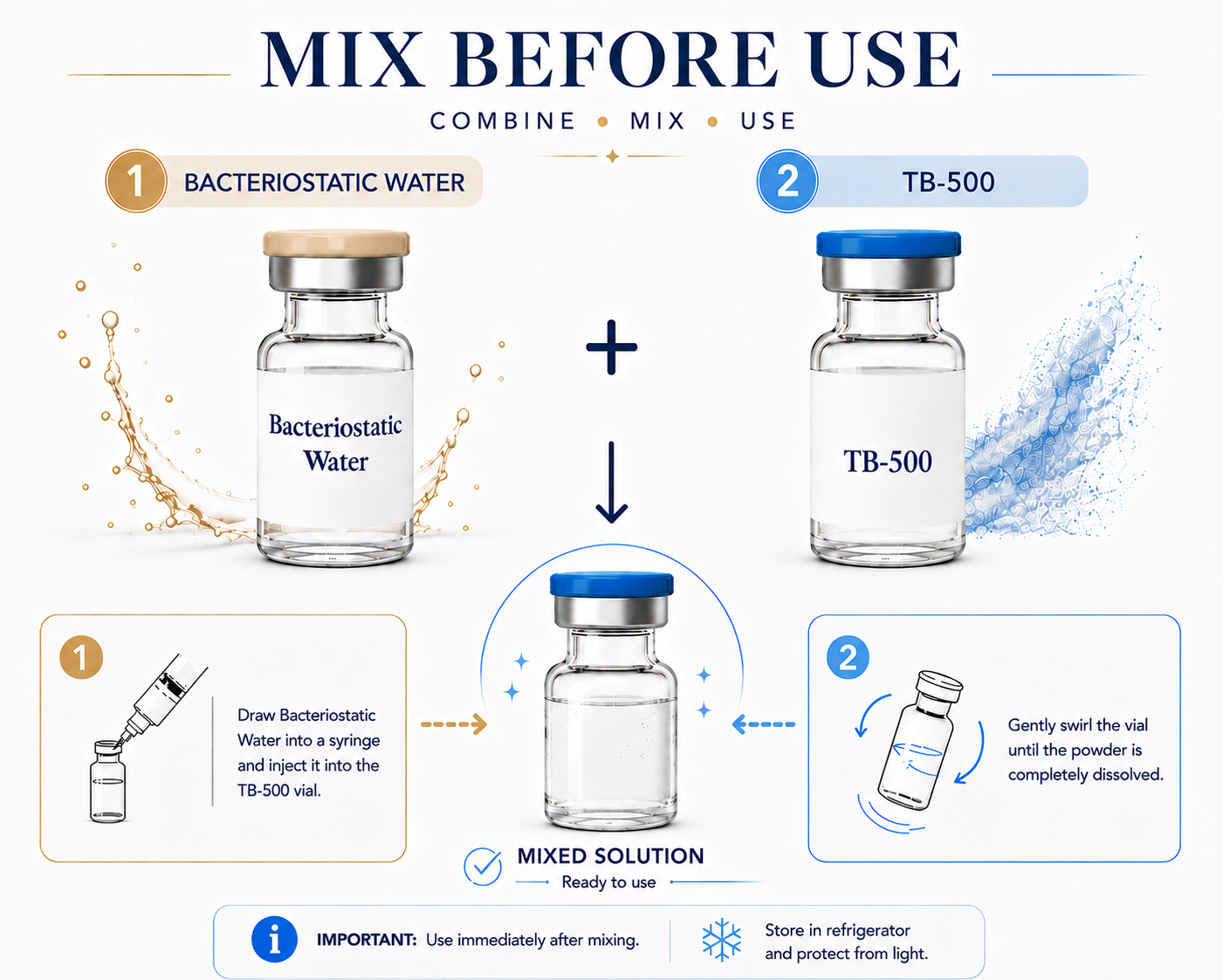
How To Mix TB-500
1
Clean
Use alcohol swabs to clean the tops of both vials.
2
Draw Acetic Acid
Draw the selected amount of 0.1% acetic acid.
3
Inject Slowly
Add the liquid slowly down the side of the vial.
4
Swirl Gently
Do not shake. Swirl gently until dissolved.
5
Store Properly
Store as directed and protect from heat and light.
Best Practices & Common Mistakes
Best Practices
Use sterile technique.
Protect from light and heat.
Store refrigerated when appropriate.
Use clean syringe-unit math before measuring.
Common Mistakes
Confusing milligrams with milliliters.
Choosing an option with awkward decimal units.
Using too little liquid for very small measurements.
Shaking the vial aggressively.
TB-500 Storage & Handling
Lyophilized Powder: −20°C (−4°F) for long-term storage (up to 24 months). Refrigeration 2–8°C (36–46°F) for short-term use (up to ~3 months). Original sealed vial in the freezer is safest.
Reconstituted Solution: 2–8°C (36–46°F), use within ~7–14 days. Keep sealed, avoid light, and do not repeat freeze-thaw cycles.
Frequently Asked Questions
Not necessarily. Your calculator aims for neat mathematical solutions. However, TB‑500 is a large, sticky peptide (fragment of thymosin β‑4). The max solubility is typically 10‑25 mg/mL, not 50 mg/mL. Trying to exceed that limit just makes the solution cloudy. This is a case where you must override your calculator — use more water to get a lower but perfectly stable concentration.
Yes. The calculator assumes your vial stays potent until empty, but TB‑500 is unstable in solution. After reconstitution, it should be used within 2‑7 days. Even when refrigerated, it has a very short shelf life. Long-term storage is only possible by immediately freezing aliquots at ‑20 °C, but repeated freeze-thaw cycles will degrade the peptide.
Its half-life is widely debated — ranging from 30‑60 minutes in plasma to 2‑3 days in systemic tissue. This pharmacological ambiguity is beyond your calculator's scope. To maintain therapeutic levels, most research protocols use 2‑3 doses per week. Relying on the calculator's single "Doses per vial" count without adjusting for this schedule will likely lead to underdosing.
Blends typically contain equal parts: e.g., a 5 mg TB‑500 + 5 mg BPC‑157 in a 10 mg total vial. When you reconstitute with 3.0 mL of water, the calculator's "Total concentration" will be 3.33 mg/mL. However, the concentration of TB‑500 itself is only 1.67 mg/mL. If you rely on the total concentration, you will draw the wrong volume and underdose the TB‑500. Always track individual components.
Yes. If your vial is labeled TB‑500 Acetate, you have a salt form where the molecular weight is higher than the base peptide (e.g., 889 g/mol vs. 775.91 g/mol). This is a blind spot for your calculator, which assumes 100% of the mass is peptide. The inert acetate counter‑ion takes up space, so a 5 mg vial of the acetate form may only contain ~4.5 mg of actual TB‑500 (the active part). This difference matters for molarity and high-dose protocols.
Practical takeaway: If your real goal is weight or metabolic health, the most useful next step is discussing approved treatment options with a clinician rather than relying on an unapproved compound.