Vilon Reconstitution Calculator
Enter the amount you want to measure. The vial buttons will highlight which vial strengths create cleaner syringe-unit measurements.
What amount do you need?
Type the target amount, then choose mg or mcg. Example: 2mg or 500mcg.
Syringe size:
Possible vial strengths:
Best Match
Good Match
Usable
Harder to Measure
Example Vilon Titration Schedule
| Protocol Item | Guidance |
|---|---|
| Dose | 1–5 mg per dose |
| Cycling Note | Bio-regulators are typically cycled as periodic doses rather than continuous daily consumption. |
| Loading Phase — Year 1 (Month 1) | Daily |
| Loading Phase — Year 1 (Months 2–3) | Daily for 10–20 days at the start of each month |
| Loading Phase — Year 1 (Months 4–12) | Off |
| Maintenance Phase — Year 2+ | 10–20 day cycles, about 3× per year spread out evenly |
Possible vial strengths:
What Is It?
Vilon
Dipeptide bioregulator studied for immune signaling.
Bacteriostatic Water
Sterile water containing a bacteriostatic preservative, commonly used when preparing multi-use research vials.
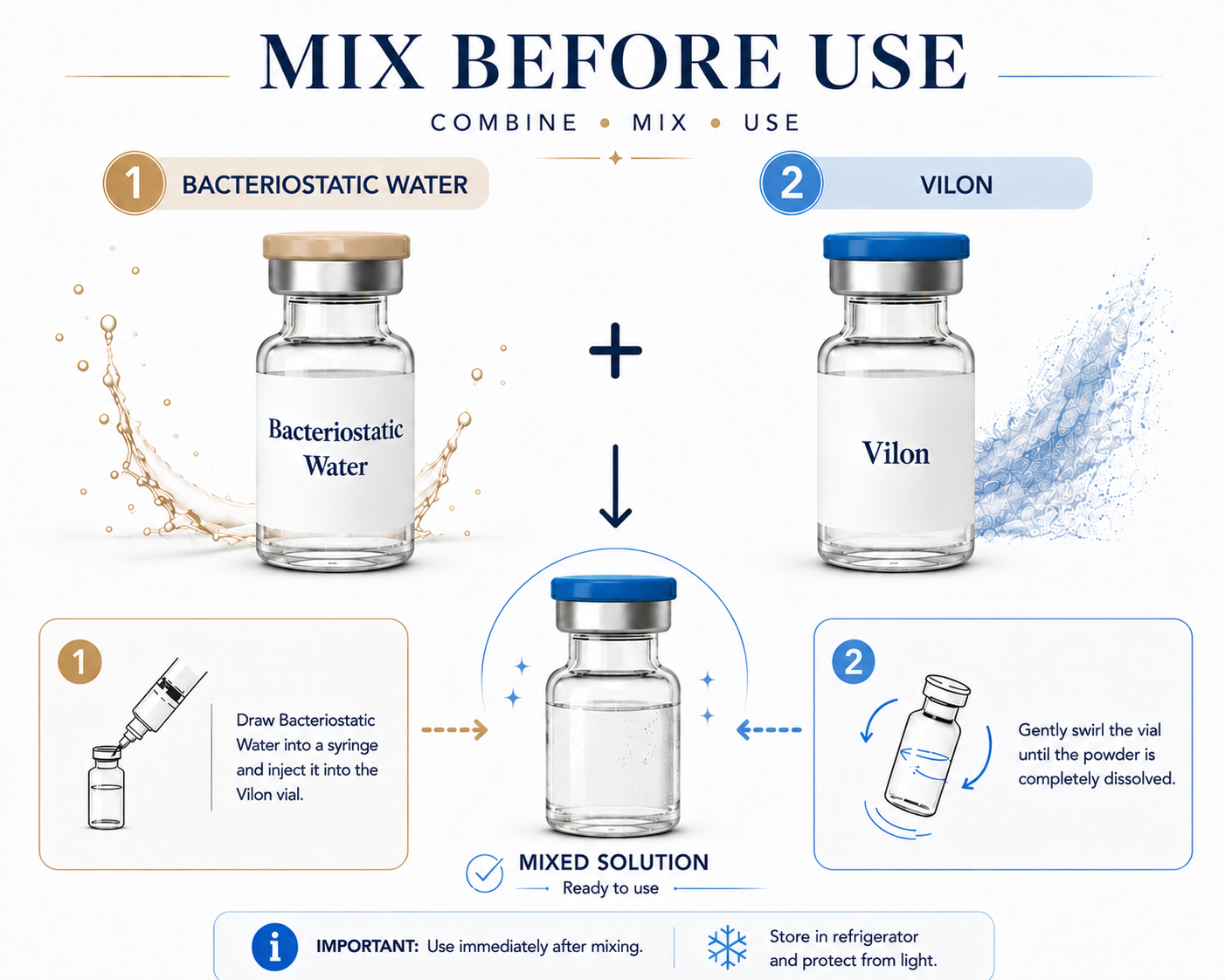
How To Mix Vilon
1
CleanUse alcohol swabs to clean the tops of both vials.
2
Draw BAC WaterDraw the selected amount of bacteriostatic water.
3
Inject SlowlyAdd the liquid slowly down the side of the vial.
4
Swirl GentlyDo not shake. Swirl gently until dissolved.
5
Store ProperlyStore as directed and protect from heat and light.
Best Practices & Common Mistakes
Best Practices
- Use sterile technique.
- Protect from light and heat.
- Store refrigerated when appropriate.
- Use clean syringe-unit math before measuring.
Common Mistakes
- Confusing milligrams with milliliters.
- Choosing an option with awkward decimal units.
- Using too little liquid for very small measurements.
- Shaking the vial aggressively.
Vilon Storage & Handling
Lyophilized Powder: −20°C (−4°F) for long-term storage (up to 24 months). Refrigeration 2–8°C (36–46°F) for short-term use (up to ~3 months). Original sealed vial in the freezer is safest.
Reconstituted Solution: 2–8°C (36–46°F), use within ~7–14 days. Keep sealed, avoid light, and do not repeat freeze-thaw cycles.
Reconstituted Solution: 2–8°C (36–46°F), use within ~7–14 days. Keep sealed, avoid light, and do not repeat freeze-thaw cycles.
Frequently Asked Questions
Yes. Many Khavinson‑class bioregulators are supplied with no excipients. The vial contains only the dry dipeptide. The total mg you enter (e.g., 20 mg) is the active peptide mass. Your calculator does not need to subtract filler weight.
The pulsing schedule is standard: daily for 5 consecutive days, then rest for the remainder of a 4‑week cycle. The calculator’s “Doses per vial” is a raw count. You must divide that by 5 to get the number of monthly cycles one vial can provide.
One manufacturer specifically warns to bring both the lyophilised peptide and the solvent to ambient temperature before mixing, because a cold vial can cause incomplete dissolution. A cold vial may also condense moisture from the air as it warms up, potentially affecting peptide stability. The calculator does not include this handling note.
No. The storage guidance says: lyophilised powder at ‑20 °C; reconstituted solution at 4 °C, do not freeze. Freezing the reconstituted solution can damage the peptide structure. The calculator’s “Doses per vial” number is a mathematical maximum; in practice, use the vial within the 28‑day window under refrigeration.
What about oral use?
Oral data is limited. The approved research form for systemic absorption is subcutaneous injection. Some capsule products exist, but the bioavailability and effective oral dose have not been established. For injectable use, the standard reconstitution for a 20 mg vial is 3 mL of bacteriostatic water, giving about 6.67 mg/mL. Your calculator works for the injectable route; oral use is not yet standardized.
Oral data is limited. The approved research form for systemic absorption is subcutaneous injection. Some capsule products exist, but the bioavailability and effective oral dose have not been established. For injectable use, the standard reconstitution for a 20 mg vial is 3 mL of bacteriostatic water, giving about 6.67 mg/mL. Your calculator works for the injectable route; oral use is not yet standardized.
Practical takeaway: If your real goal is weight or metabolic health, the most useful next step is discussing approved treatment options with a clinician rather than relying on an unapproved compound.
Important: This tool is for informational and research-reference purposes only. Not intended for human or veterinary use.