Vesugen Reconstitution Calculator
Enter the amount you want to measure. The vial buttons will highlight which vial strengths create cleaner syringe-unit measurements.
What amount do you need?
Type the target amount, then choose mg or mcg. Example: 2mg or 500mcg.
Syringe size:
Possible vial strengths:
Best Match
Good Match
Usable
Harder to Measure
Example Vesugen Titration Schedule
| Protocol Item | Guidance |
|---|---|
| Dose | 1–5 mg per dose |
| Cycling Style | Bioregulators are typically cycled as periodic doses (not continuous daily consumption) |
| Loading Phase (Year 1) | Month 1: Daily |
| Maintenance Phase (Year 2+) | 10–20 day cycles, repeated 3× per year (spread out evenly) |
Possible vial strengths:
What Is It?
Vesugen
Vascular peptide bioregulator.
Bacteriostatic Water
Sterile water containing a bacteriostatic preservative, commonly used when preparing multi-use research vials.
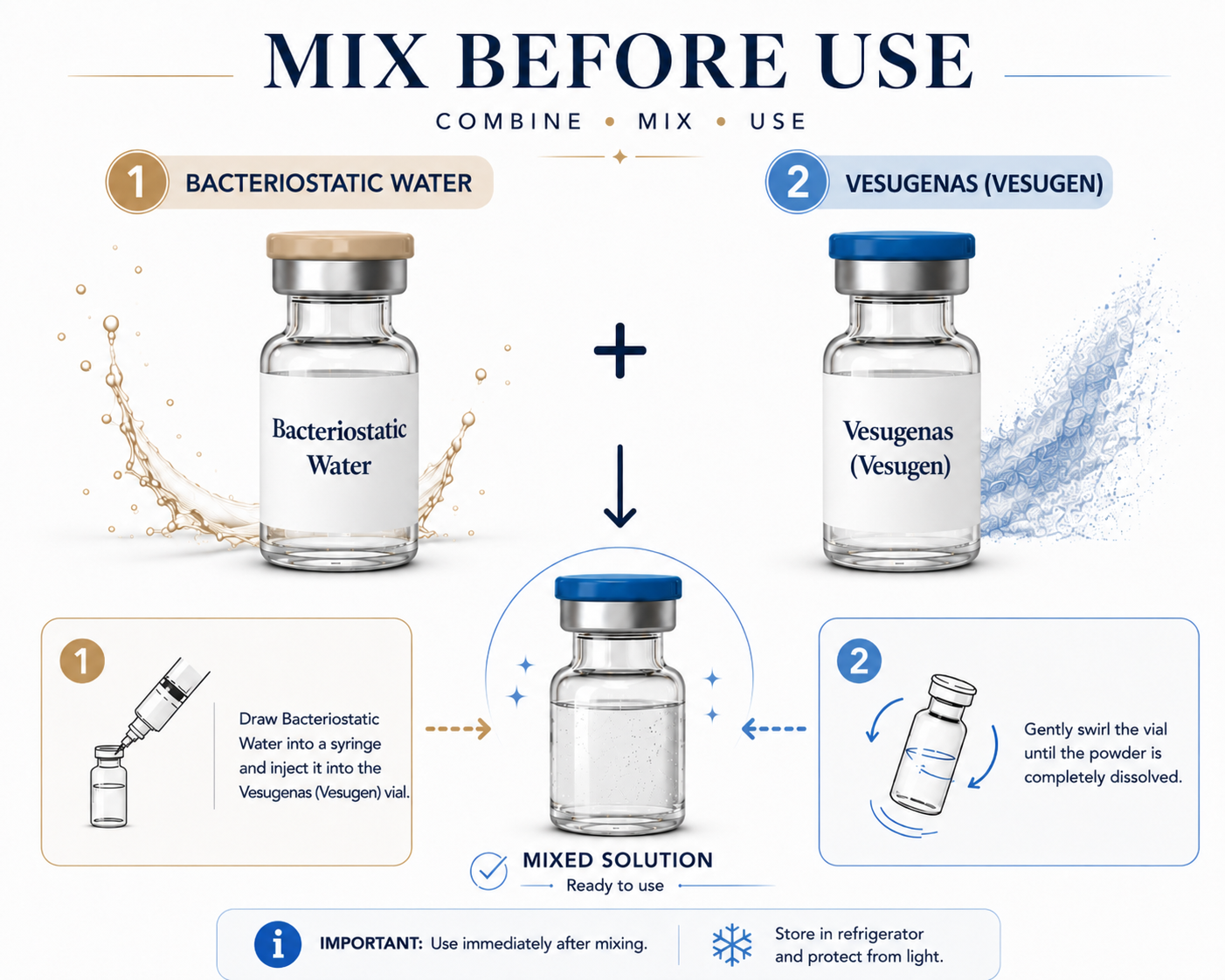
How To Mix Vesugen
1
CleanUse alcohol swabs to clean the tops of both vials.
2
Draw BAC WaterDraw the selected amount of bacteriostatic water.
3
Inject SlowlyAdd the liquid slowly down the side of the vial.
4
Swirl GentlyDo not shake. Swirl gently until dissolved.
5
Store ProperlyStore as directed and protect from heat and light.
Best Practices & Common Mistakes
Best Practices
- Use sterile technique.
- Protect from light and heat.
- Store refrigerated when appropriate.
- Use clean syringe-unit math before measuring.
Common Mistakes
- Confusing milligrams with milliliters.
- Choosing an option with awkward decimal units.
- Using too little liquid for very small measurements.
- Shaking the vial aggressively.
Vesugen Storage & Handling
Lyophilized Powder: −20°C (−4°F) for long-term storage (up to 24 months). Refrigeration 2–8°C (36–46°F) for short-term use (up to ~3 months). Original sealed vial in the freezer is safest.
Reconstituted Solution: 2–8°C (36–46°F), use within ~7–14 days. Keep sealed, avoid light, and do not repeat freeze-thaw cycles.
Reconstituted Solution: 2–8°C (36–46°F), use within ~7–14 days. Keep sealed, avoid light, and do not repeat freeze-thaw cycles.
Frequently Asked Questions
The calculator sees mass, not biology. Vesugen's mechanism is to penetrate cells and epigenetically regulate the Ki-67 gene, which promotes endothelial proliferation and vascular repair. A short pulse (e.g., 20 days) can trigger biological effects lasting months, independent of the peptide's physical half-life. The "doses per vial" count will underestimate how long a single course may be active.
Khavinson-class bioregulator vials (20 mg) are typically reconstituted with 3.0 mL to 5.0 mL of water. For example, 20 mg + 5 mL = 4 mg/mL. Most of these supplements are taken orally (capsules 1-3/day). If you are using your calculator to prepare an injectable version for research, follow the exact volumes from your supplier to ensure proper stability, regardless of what your calculator marks as "Best".
Your calculator assumes an injection route. Vesugen is commonly administered orally, with recommended doses of 1-3 capsules 2-3 times a day for 10-30 days. To use your calculator for oral administration, ignore the syringe output and only use the concentration math. It will help you make a stable stock solution.
Suppliers list Vesugen as soluble in suitable laboratory agents. A 20 mg vial is often mixed with 5 mL of BAC water, creating a concentration of 4 mg/mL. If your calculator suggests a smaller volume (e.g., 1 mL = 20 mg/mL) to get clean unit numbers, the peptide may not dissolve completely, leading to inaccurate syringe draws.
Proper storage conditions for Vesugen require temperatures of 2°C to 8°C. For reconstituted vials, 28 days is a common benchmark if handled aseptically. However, because Vesugen is stable when dry, you should freeze any unused reconstituted solution in single-use aliquots to prevent repeated freezing and thawing.
Practical takeaway: If your real goal is weight or metabolic health, the most useful next step is discussing approved treatment options with a clinician rather than relying on an unapproved compound.
Important: This tool is for informational and research-reference purposes only. Not intended for human or veterinary use.