Vesilute Reconstitution Calculator
Enter the amount you want to measure. The vial buttons will highlight which vial strengths create cleaner syringe-unit measurements.
What amount do you need?
Type the target amount, then choose mg or mcg. Example: 2mg or 500mcg.
Syringe size:
Possible vial strengths:
Best Match
Good Match
Usable
Harder to Measure
Example Vesilute Titration Schedule
| Protocol Item | Guidance |
|---|---|
| Dose | 1–5 mg per dose |
| Cycle Note | Bioregulators are typically cycled as periodic doses rather than continuous daily consumption |
| Loading Phase (Year 1) — Month 1 | Daily |
| Loading Phase (Year 1) — Months 2–3 | Daily for 10–20 days at the start of each month |
| Loading Phase (Year 1) — Months 4–12 | Off |
| Maintenance Phase (Year 2+) | 10–20 day cycles, approximately 3× per year (spread out evenly) |
Possible vial strengths:
What Is It?
Vesilute
Bladder-targeted peptide bioregulator.
Bacteriostatic Water
Sterile water containing a bacteriostatic preservative, commonly used when preparing multi-use research vials.
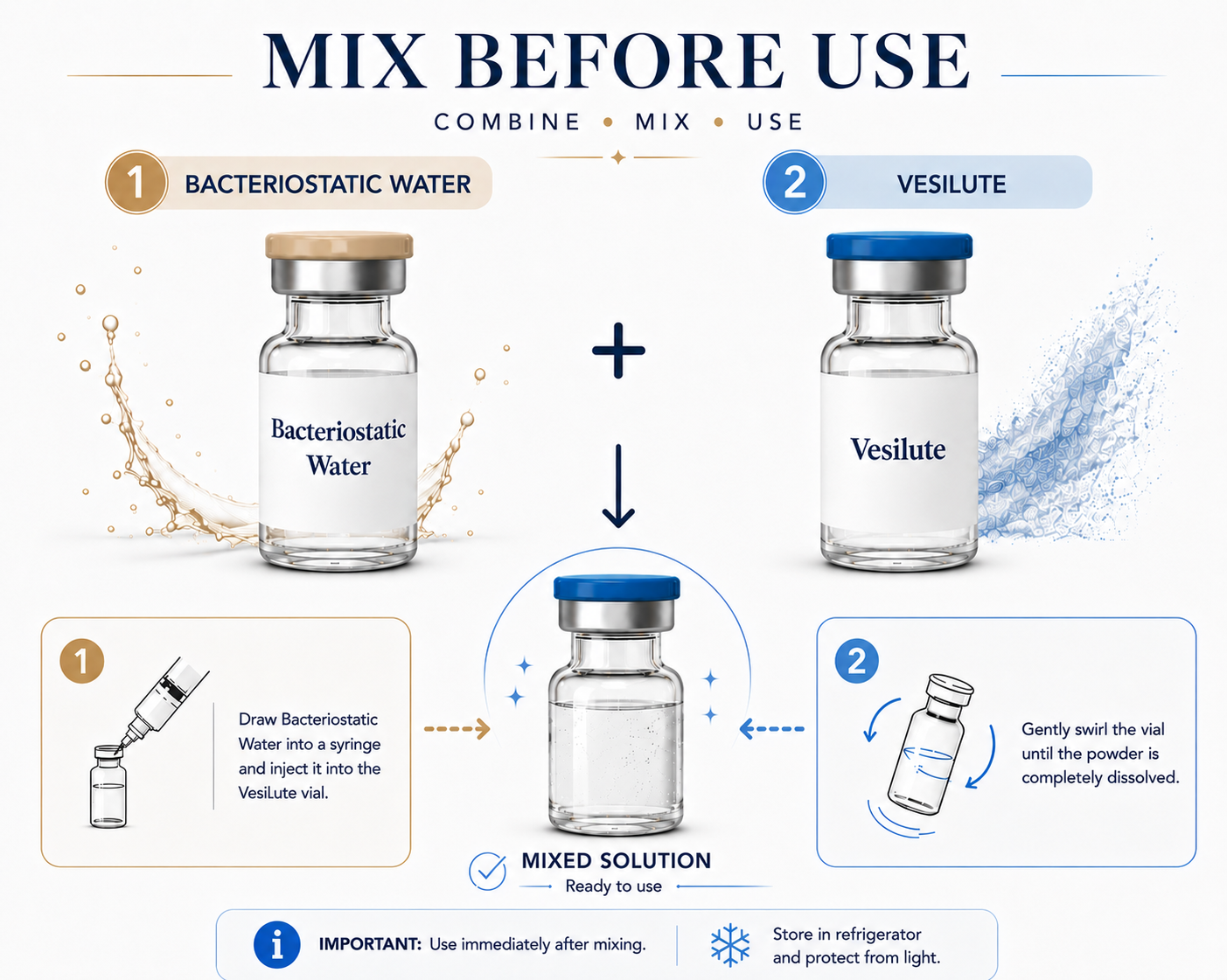
How To Mix Vesilute
1
CleanUse alcohol swabs to clean the tops of both vials.
2
Draw BAC WaterDraw the selected amount of bacteriostatic water.
3
Inject SlowlyAdd the liquid slowly down the side of the vial.
4
Swirl GentlyDo not shake. Swirl gently until dissolved.
5
Store ProperlyStore as directed and protect from heat and light.
Best Practices & Common Mistakes
Best Practices
- Use sterile technique.
- Protect from light and heat.
- Store refrigerated when appropriate.
- Use clean syringe-unit math before measuring.
Common Mistakes
- Confusing milligrams with milliliters.
- Choosing an option with awkward decimal units.
- Using too little liquid for very small measurements.
- Shaking the vial aggressively.
Vesilute Storage & Handling
Lyophilized Powder: −20°C (−4°F) for long-term storage (up to 24 months). Refrigeration 2–8°C (36–46°F) for short-term use (up to ~3 months). Original sealed vial in the freezer is safest.
Reconstituted Solution: 2–8°C (36–46°F), use within ~7–14 days. Keep sealed, avoid light, and do not repeat freeze-thaw cycles.
Reconstituted Solution: 2–8°C (36–46°F), use within ~7–14 days. Keep sealed, avoid light, and do not repeat freeze-thaw cycles.
Frequently Asked Questions
With a molecular weight of only 262.2 g/mol (C₉H₁₄N₂O₇), Vesilute is much smaller than many research peptides. Your calculator only works with mass (mg). For molarity-based work, 1 mg of Vesilute represents many more molecules than 1 mg of a larger peptide. You must convert manually if your protocol requires a specific molar concentration.
This is a known naming confusion. Some vendors market a different peptide under the same "Vesilute" name for vascular research, with different molecular data. The original Khavinson-class Vesilute (Glu-Asp) is a bioregulator studied for urinary tract, prostate, and bladder function. Always verify the amino acid sequence (Glu-Asp) and molecular weight against your Certificate of Analysis (CoA) before entering data into your calculator.
For a standard 20 mg lyophilised vial, an appropriate volume is 2–5 mL of bacteriostatic water. For example, 20 mg + 4 mL BAC water = 5 mg/mL. Your calculator's "Best" match for "unit roundness" may suggest a smaller volume. However, for a bladder-targeting peptide, many researchers administer it orally, not via injection, rendering the syringe-unit output irrelevant.
The established capsule form is taken orally (1–2 capsules 1–2 times daily for 1 month), meaning injection data is minimal. If you are using your calculator to prepare an injectable solution from powder, you are entering an exploratory research route, not a standard protocol. Your calculator's outputs are purely mathematical in this case.
Under sterile conditions, the reconstituted solution is stable for up to 28 days at 2–8 °C. The lyophilised powder should be stored at –20 °C and allowed to reach room temperature before reconstitution to help maintain structural integrity. Your calculator's "Doses per vial" number is a mathematical maximum, not a guarantee of full activity beyond this period.
Practical takeaway: If your real goal is weight or metabolic health, the most useful next step is discussing approved treatment options with a clinician rather than relying on an unapproved compound.
Important: This tool is for informational and research-reference purposes only. Not intended for human or veterinary use.