Thyrotropin (TRH) Reconstitution Calculator
Enter the amount you want to measure. The vial buttons will highlight which vial strengths create cleaner syringe-unit measurements.
What amount do you need?
Type the target amount, then choose mg or mcg. Example: 2mg or 500mcg.
Syringe size:
Possible vial strengths:
Best Match
Good Match
Usable
Harder to Measure
Example Thyrotropin (TRH) Titration Schedule
| Week | Daily Dose (mcg) | Injection Volume (mL / Units) |
|---|---|---|
| Weeks 1–2 | 200 mcg (0.200 mg) | 0.06 mL (6 units) |
| Weeks 3–4 | 300 mcg (0.300 mg) | 0.09 mL (9 units) |
| Weeks 5–6 | 400 mcg (0.400 mg) | 0.12 mL (12 units) |
| Weeks 7–12 | 500 mcg (0.500 mg) | 0.15 mL (15 units) |
Possible vial strengths:
What Is It?
Thyrotropin (TRH)
Thyrotropin-releasing hormone.
Bacteriostatic Water
Sterile water containing a bacteriostatic preservative, commonly used when preparing multi-use research vials.
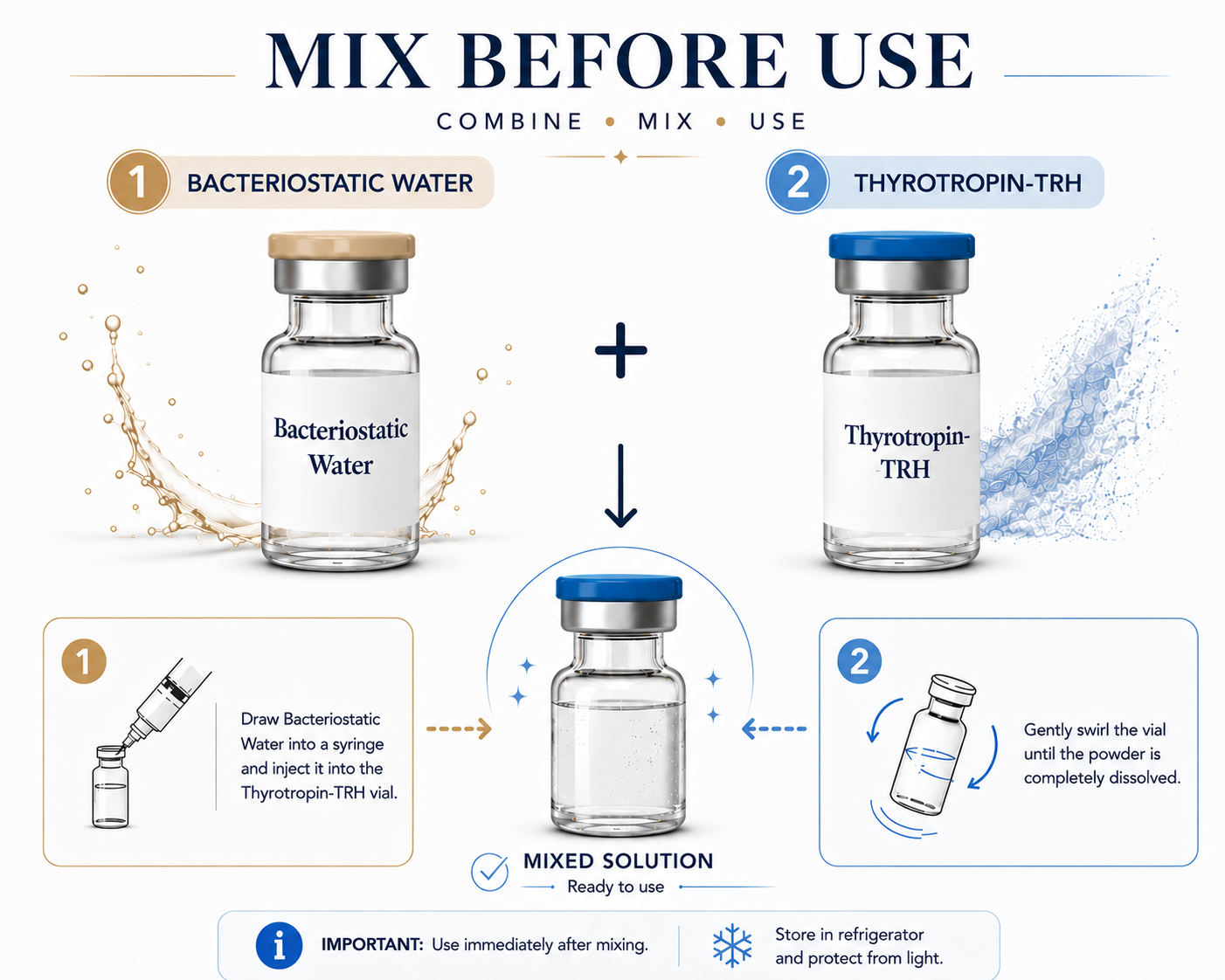
How To Mix Thyrotropin (TRH)
1
CleanUse alcohol swabs to clean the tops of both vials.
2
Draw BAC WaterDraw the selected amount of bacteriostatic water.
3
Inject SlowlyAdd the liquid slowly down the side of the vial.
4
Swirl GentlyDo not shake. Swirl gently until dissolved.
5
Store ProperlyStore as directed and protect from heat and light.
Best Practices & Common Mistakes
Best Practices
- Use sterile technique.
- Protect from light and heat.
- Store refrigerated when appropriate.
- Use clean syringe-unit math before measuring.
Common Mistakes
- Confusing milligrams with milliliters.
- Choosing an option with awkward decimal units.
- Using too little liquid for very small measurements.
- Shaking the vial aggressively.
Thyrotropin (TRH) Storage & Handling
Lyophilized Powder: −20°C (−4°F) for long-term storage (up to 24 months). Refrigeration 2–8°C (36–46°F) for short-term use (up to ~3 months). Original sealed vial in the freezer is safest.
Reconstituted Solution: 2–8°C (36–46°F), use within ~7–14 days. Keep sealed, avoid light, and do not repeat freeze-thaw cycles.
Reconstituted Solution: 2–8°C (36–46°F), use within ~7–14 days. Keep sealed, avoid light, and do not repeat freeze-thaw cycles.
Frequently Asked Questions
TRH is a trigger, not a sustained agonist. It releases TSH from two pituitary pools — a quick burst from pre‑made hormone, then a slower second phase from new synthesis. Your calculator’s “Doses per vial” count is correct, but the peptide itself is gone within an hour; its effect comes from the TSH it releases.
500 mcg is the standard adult diagnostic dose, given IV as a bolus. If your calculator says “Best” for a different concentration, ignore it. For a 500 mcg dose, the simplest is to reconstitute a 500 mcg vial with 1 mL BAC water → 50 units on a U‑100 syringe.
Yes. Free base TRH (CAS 24305‑27‑9) has MW 362.4; the acetate salt (CAS 120876‑23‑5) has MW 422.4. If your vial is acetate, the active peptide content is lower. Your calculator doesn’t know this — check the CoA.
TRH is highly soluble. One datasheet gives 64 mg/mL in water, another says 50 mg/mL with sonication. A concentration up to 50 mg/mL is safe. Use enough BAC water to get a clear solution; the calculator’s “Best” ratio is not the solubility limit.
No. Once mixed, TRH should be stored at ≤ −20 °C in sealed, dry conditions and aliquoted to avoid repeated freeze‑thaw. The calculator’s “Doses per vial” is a mathematical maximum; in practice, use the vial within a few days if kept refrigerated, or freeze single‑use aliquots immediately.
Practical takeaway: If your real goal is weight or metabolic health, the most useful next step is discussing approved treatment options with a clinician rather than relying on an unapproved compound.
Important: This tool is for informational and research-reference purposes only. Not intended for human or veterinary use.