Thymulin Reconstitution Calculator
Enter the amount you want to measure. The vial buttons will highlight which vial strengths create cleaner syringe-unit measurements.
What amount do you need?
Type the target amount, then choose mg or mcg. Example: 2mg or 500mcg.
Syringe size:
Possible vial strengths:
Best Match
Good Match
Usable
Harder to Measure
Example Thymulin Titration Schedule
| Parameter | Details |
|---|---|
| Dosage | Research: 0.5–2 µg/kg (or ~5 mg/day in some protocols) |
| Route | Subcutaneous (SC) |
| Frequency | Daily (20‑day course) or 2–3 times weekly |
| Cycle Length | Up to 4 weeks |
| Half‑life | ~10 minutes in serum |
| Reconstitution | Sterile bacteriostatic water or saline (e.g., 10 mL per 100 mg vial) |
Possible vial strengths:
What Is It?
Thymulin
Zinc-bound thymic peptide hormone.
Bacteriostatic Water
Sterile water containing a bacteriostatic preservative, commonly used when preparing multi-use research vials.
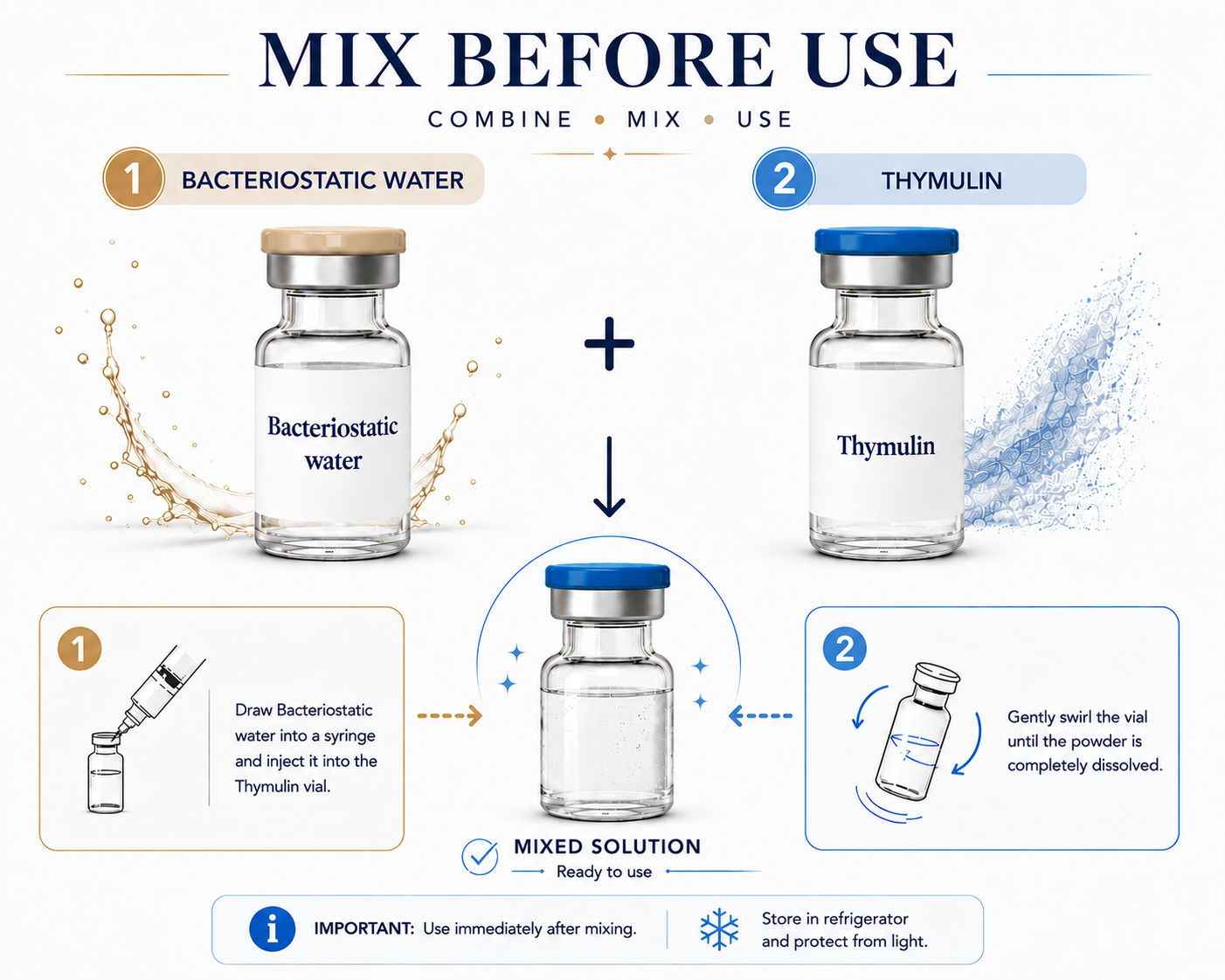
How To Mix Thymulin
1
CleanUse alcohol swabs to clean the tops of both vials.
2
Draw BAC WaterDraw the selected amount of bacteriostatic water.
3
Inject SlowlyAdd the liquid slowly down the side of the vial.
4
Swirl GentlyDo not shake. Swirl gently until dissolved.
5
Store ProperlyStore as directed and protect from heat and light.
Best Practices & Common Mistakes
Best Practices
- Use sterile technique.
- Protect from light and heat.
- Store refrigerated when appropriate.
- Use clean syringe-unit math before measuring.
Common Mistakes
- Confusing milligrams with milliliters.
- Choosing an option with awkward decimal units.
- Using too little liquid for very small measurements.
- Shaking the vial aggressively.
Thymulin Storage & Handling
Lyophilized Powder: −20°C (−4°F) for long-term storage (up to 24 months). Refrigeration 2–8°C (36–46°F) for short-term use (up to ~3 months). Original sealed vial in the freezer is safest.
Reconstituted Solution: 2–8°C (36–46°F), use within ~7–14 days. Keep sealed, avoid light, and do not repeat freeze-thaw cycles.
Reconstituted Solution: 2–8°C (36–46°F), use within ~7–14 days. Keep sealed, avoid light, and do not repeat freeze-thaw cycles.
Frequently Asked Questions
Yes. Thymulin has no biological activity without zinc (Zn²⁺). The nonapeptide by itself is inactive; it must form a 1:1 complex with zinc to become "thymulin" (FTS‑Zn). Your calculator cannot tell you that you need to supplement with zinc. If your injection is prepared in plain water, you are injecting an inactive peptide. This must be done in a solution containing zinc, or co‑administered with a zinc supplement, to achieve any effect.
It will likely remain cloudy or form particles, leading to inaccurate dosing. The manufacturer's guideline recommends reconstituting the powder in sterile water at a minimum concentration of 100 µg/mL. If your calculator suggests a concentration higher than 0.1 mg/mL (e.g., 1 mg in 1 mL of water), you will be attempting a concentration that exceeds the peptide's solubility limit. You must use a sufficiently large volume of water, even if the calculator marks it as "Good" or "Usable" instead of "Best".
Your calculator assumes a once‑daily schedule, but the plasma half‑life is only 0.88 to 2.26 hours (mean ~1.5 hours). A single daily injection will leave most of the day with sub‑therapeutic levels. For sustained exposure, you need to inject multiple times per day, such as twice daily (BID), or the peptide will be cleared from the bloodstream long before your next dose.
No. For a solution, the manufacturer's data sheet states that it should be stored at -20°C and used within 1 month to prevent loss of potency. Refrigeration (2‑8°C) is only safe for one month for BSA‑conjugated forms, but for standard peptide solutions, the temperature must be -20°C or below, and the solution must be aliquoted immediately to avoid repeated freeze‑thaw cycles. Your calculator's "refrigerator is fine" assumption is not correct for this peptide.
Yes. The free base of Thymulin has a molecular weight of 858.85 g/mol. The acetate salt, which is the commercial research form, has a molecular weight of 918.91 g/mol. If you enter the total mg of the acetate powder, you will be overestimating the amount of active peptide by about 7‑8%. Your calculator cannot correct for the counter‑ion mass. Always check the Certificate of Analysis (CoA) for the exact peptide content and adjust the entered mass accordingly.
Practical takeaway: If your real goal is weight or metabolic health, the most useful next step is discussing approved treatment options with a clinician rather than relying on an unapproved compound.
Important: This tool is for informational and research-reference purposes only. Not intended for human or veterinary use.