Enter the amount you want to measure. The vial buttons will highlight which vial strengths create cleaner syringe-unit measurements.
⚠ Use acetic acid — not bacteriostatic water
Thymosin Beta-4 is insoluble or unstable in standard BAC water. Manufacturer protocols require reconstitution in dilute acetic acid (0.1%) — or, for IGF-1 variants, 50 mM acetic acid. Volumes shown below refer to acetic acid, not water.
What amount do you need?
Type the target amount, then choose mg or mcg. Example: 2mg or 500mcg.
Syringe size:
Possible vial strengths:
Best Match Good Match Usable Harder to Measure
Example Thymosin Beta-4 Titration Schedule
Parameter
Details
Typical Dosage (Loading)
2‑5 mg, twice weekly, for 4‑6 weeks
Typical Dosage (Maintenance)
2‑2.5 mg, once weekly, for 4‑8 weeks
Route
Subcutaneous (SC) injection
Frequency
Twice weekly (loading) → once weekly (maintenance)
Cycle Length
8‑12 weeks total (4‑6 weeks loading + 4‑8 weeks maintenance), then a rest of 4‑12 weeks
Half‑life
2‑4 days
Reconstitution
Sterile water or 0.1% BSA buffer, to 0.1‑1.0 mg/mL
Possible vial strengths:
What Is It?
Thymosin Beta-4
Full-length thymosin β-4 peptide.
Acetic Acid (0.1%)
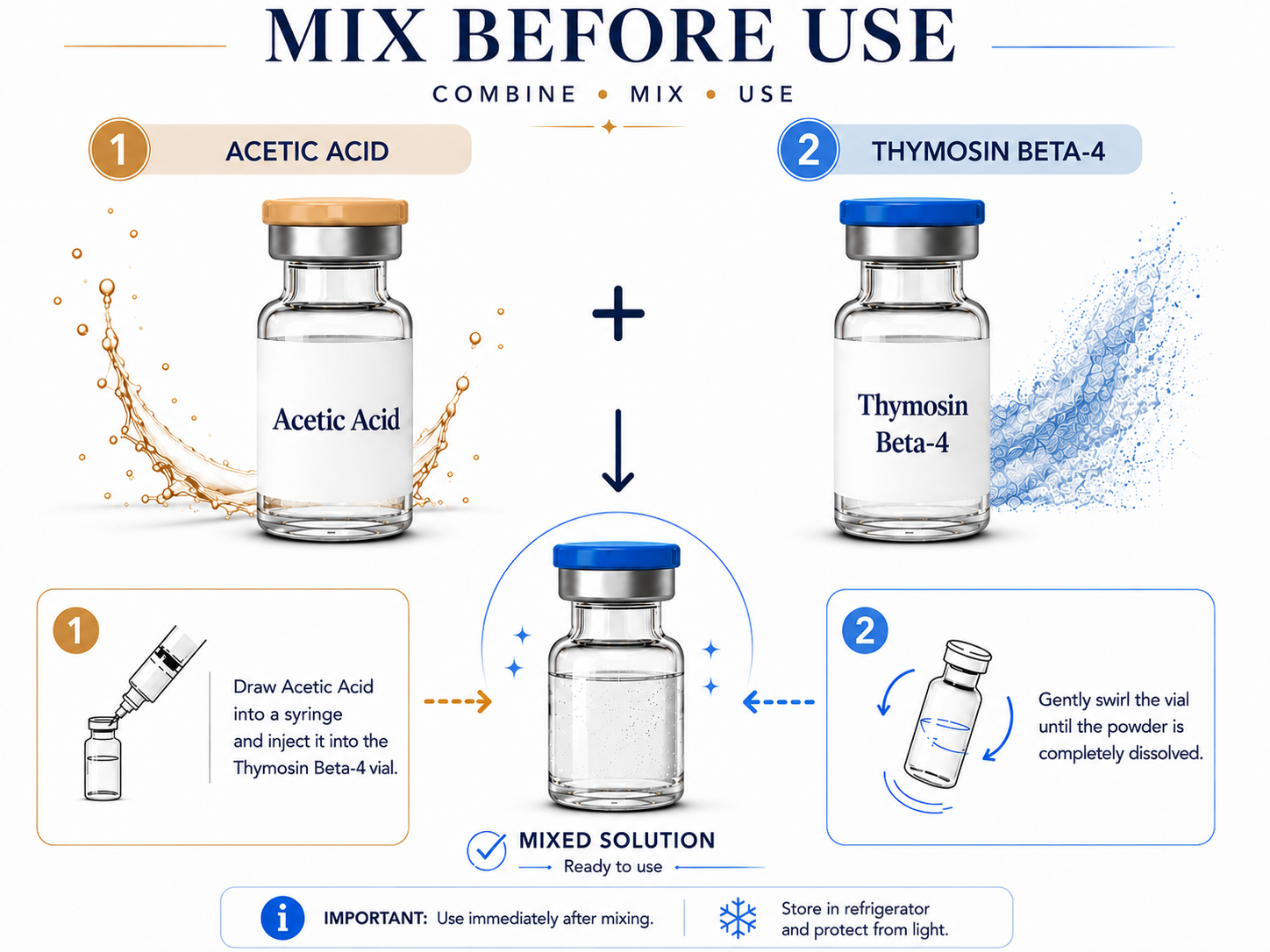
A dilute solution of acetic acid (typically 0.1% for most peptides, or 50 mM for IGF-1 variants) used to reconstitute peptides that are insoluble or unstable in standard bacteriostatic water. Thymosin Beta-4 requires an acidic carrier to dissolve fully and remain stable — plain BAC water will not work and may damage the peptide.
How To Mix Thymosin Beta-4
1
Clean
Use alcohol swabs to clean the tops of both vials.
2
Draw Acetic Acid
Draw the selected amount of 0.1% acetic acid.
3
Inject Slowly
Add the liquid slowly down the side of the vial.
4
Swirl Gently
Do not shake. Swirl gently until dissolved.
5
Store Properly
Store as directed and protect from heat and light.
Best Practices & Common Mistakes
Best Practices
Use sterile technique.
Protect from light and heat.
Store refrigerated when appropriate.
Use clean syringe-unit math before measuring.
Common Mistakes
Confusing milligrams with milliliters.
Choosing an option with awkward decimal units.
Using too little liquid for very small measurements.
Shaking the vial aggressively.
Thymosin Beta-4 Storage & Handling
Lyophilized Powder: −20°C (−4°F) for long-term storage (up to 24 months). Refrigeration 2–8°C (36–46°F) for short-term use (up to ~3 months). Original sealed vial in the freezer is safest.
Reconstituted Solution: 2–8°C (36–46°F), use within ~7–14 days. Keep sealed, avoid light, and do not repeat freeze-thaw cycles.
Frequently Asked Questions
Manufacturer datasheets for Thymosin Beta‑4 (Tβ4) consistently advise reconstituting the lyophilized powder in sterile 18MΩ·cm distilled water, not bacteriostatic water. The recommended starting concentration is ≥100 µg/mL; after complete dissolution, the solution can be diluted further in other aqueous buffers for research use. A neutral‑pH vehicle such as 1×PBS can also be used, but the presence of benzyl alcohol in BAC water serves no advantage here and is absent from every official protocol.
Once reconstituted, Tβ4 is stable at 2–4 °C for only 1 week (some sources specify 2‑7 days). For long‑term storage, the solution must be aliquoted and frozen at −20 °C to −80 °C; freezing is strongly recommended to prevent repeated freeze‑thaw cycles. For extended preservation, a carrier protein (0.1 % HSA or BSA) can be added as a stabilizer, though this may introduce endotoxins depending on the application. The dry powder itself is stable for ≥2 years at −20 °C.
Tβ4 contains a methionine residue at position 6 in its 43‑amino‑acid sequence. Methionine is highly susceptible to oxidation, especially in the presence of air or light. If the peptide oxidizes, the active mass entering the syringe decreases even though the physical volume stays the same. Therefore, strict adherence to the recommended storage conditions—aliquoting and freezing immediately after reconstitution—is crucial to preserve full potency for every dose the calculator displays.
In a mouse biodistribution study, after administration of 400 µg of Tβ4, a significant increase in serum levels was detected starting 2 minutes after injection and lasting for only 40 minutes (average: 2.34 ± 0.54 µg/mL). Of the 400 µg administered, 83 % was recovered by the end of the study—44.6 % in urine and only 1.4 % remaining in serum. This extremely short plasma half‑life means Tβ4 is cleared from the body within an hour. Consequently, many research protocols administer the peptide 2‑3 times per week, not daily as a generic calculator might assume.
Inside cells, Tβ4 is the main G‑actin sequestering peptide, preventing actin polymerization and controlling the cytoskeleton. Extracellularly, Tβ4 contributes to angiogenesis, wound healing, inflammation regulation, endothelial cell migration, and corneal repair. A single injection, once reconstituted, simultaneously exerts both intracellular and extracellular effects; the calculator's output cannot separate these two pathways, so the entered dose must be chosen based on the specific outcome being studied.
Practical takeaway: If your real goal is weight or metabolic health, the most useful next step is discussing approved treatment options with a clinician rather than relying on an unapproved compound.