Prostamax Reconstitution Calculator
Enter the amount you want to measure. The vial buttons will highlight which vial strengths create cleaner syringe-unit measurements.
What amount do you need?
Type the target amount, then choose mg or mcg. Example: 2mg or 500mcg.
Syringe size:
Possible vial strengths:
Best Match
Good Match
Usable
Harder to Measure
Example Prostamax Titration Schedule
| Protocol Item | Guidance |
|---|---|
| Dose | 1–5 mg per dose |
| Loading Phase (Year 1) | |
| Maintenance Phase (Year 2+) |
Possible vial strengths:
What Is It?
Prostamax
Prostate-targeted peptide bioregulator.
Bacteriostatic Water
Sterile water containing a bacteriostatic preservative, commonly used when preparing multi-use research vials.
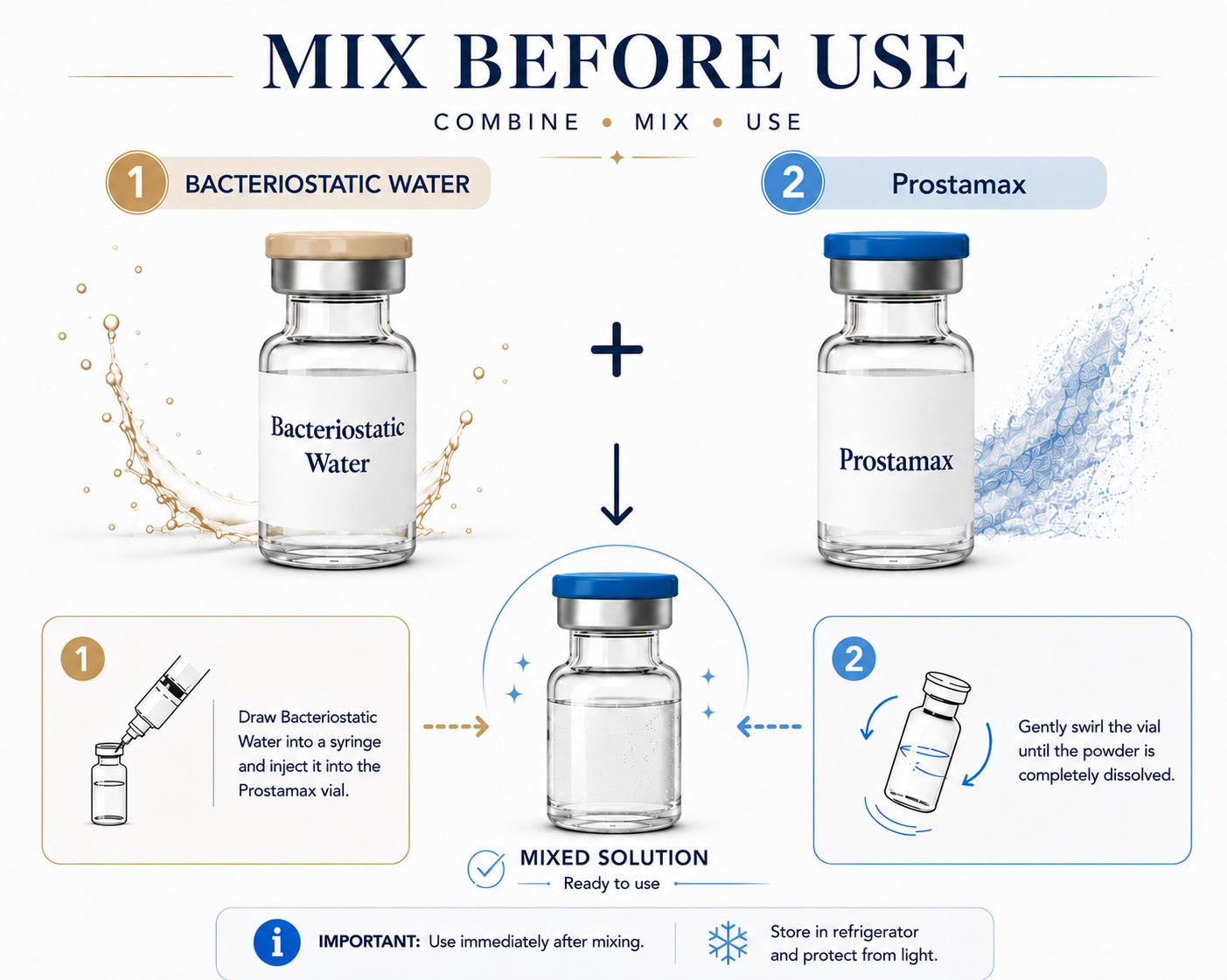
How To Mix Prostamax
1
CleanUse alcohol swabs to clean the tops of both vials.
2
Draw BAC WaterDraw the selected amount of bacteriostatic water.
3
Inject SlowlyAdd the liquid slowly down the side of the vial.
4
Swirl GentlyDo not shake. Swirl gently until dissolved.
5
Store ProperlyStore as directed and protect from heat and light.
Best Practices & Common Mistakes
Best Practices
- Use sterile technique.
- Protect from light and heat.
- Store refrigerated when appropriate.
- Use clean syringe-unit math before measuring.
Common Mistakes
- Confusing milligrams with milliliters.
- Choosing an option with awkward decimal units.
- Using too little liquid for very small measurements.
- Shaking the vial aggressively.
Prostamax Storage & Handling
Lyophilized Powder: −20°C (−4°F) for long-term storage (up to 24 months). Refrigeration 2–8°C (36–46°F) for short-term use (up to ~3 months). Original sealed vial in the freezer is safest.
Reconstituted Solution: 2–8°C (36–46°F), use within ~7–14 days. Keep sealed, avoid light, and do not repeat freeze-thaw cycles.
Reconstituted Solution: 2–8°C (36–46°F), use within ~7–14 days. Keep sealed, avoid light, and do not repeat freeze-thaw cycles.
Frequently Asked Questions
The calculator assumes that the peptide will have systemic effects and simply adds a fixed mass to the total body pool. However, Prostamax is described as a prostatotropic bioregulator, indicating a specific predilection for prostate tissue in experimental models. The KEDP tetrapeptide does not simply float around the body; it is designed to exert targeted effects on prostate cell signaling and chromatin structure in that specific organ. Therefore, the same mg dose calculated by your tool could produce a very different biological outcome in a prostate-focused study compared to a study on general immune function, a nuance the calculator cannot capture.
The small size and the presence of a proline residue provide conformational rigidity, which generally enhances stability. However, the standard reconstitution protocol for Prostamax is to add 2.5 mL of BAC water to a 20 mg vial, which yields a concentration of 8 mg/mL. Using this concentration, a standard research dose of, say, 2 mg would require 0.25 mL (25 units). The calculator's default "Best" match might suggest an even smaller volume (e.g., 1 mL) for mathematical neatness, but this would produce a highly concentrated solution (20 mg/mL) which, while possible, may not be optimal for solubility and injection comfort for this specific molecule. The empirical protocol uses a more dilute solution for practical handling.
Research protocols show a wide dosing range. A 20 mg vial can be reconstituted with 2.5 mL of BAC water, resulting in a concentration of 8 mg/mL. For a low dose of 0.5 mg, the injection volume would be 0.0625 mL (approx. 6.25 units). For a higher dose of 3 mg, the volume would be 0.375 mL (approx. 37.5 units). The calculator will show these volumes, but it cannot warn you that for very low doses (e.g., below 0.5 mg), the resulting volume on a standard 1 mL syringe may be so small that it leads to significant dosing errors. The calculator's "Doses per vial" display should be used with the understanding that the effective dose is determined by tissue-specific response, not a linear scale.
The calculator's colour coding is based purely on mathematical neatness for the specific mg dose you entered. The standard Prostamax protocol uses 3.0 mL of BAC water to create a concentration of 6.67 mg/mL. At this concentration, a U-100 insulin syringe has a simple relationship: 1 unit = 0.01 mL ≈ 66.7 mcg. This makes it easy to dial up a dose: a 500 mcg dose is 7.5 units, a 1 mg dose is 15 units, and a 2 mg dose is 30 units. The calculator may rate a 1 mL reconstitution as "Best" for some doses, but 1 mL creates a much higher concentration and smaller draw volumes. The 3.0 mL protocol is designed for practical, clear syringe conversions across a wide titration range, and you should prioritise this empirically validated volume over the calculator's aesthetic ranking.
The calculator's "Doses per vial" is a pure mathematical count based on mass. The lyophilised powder can be stored for up to 24 months at -20°C without significant degradation. However, once reconstituted with bacteriostatic water, the solution should be stored at 2–8°C and used within a 28-day window for optimal sterility and potency. If the calculator shows 40 "doses per vial" for a low-dose protocol, you will never be able to use all 40 doses from a single vial because the solution will exceed its safe 28-day usage period. You must align your protocol so that the total volume you reconstitute is fully used within 28 days, regardless of the theoretical "doses per vial" number.
Practical takeaway: If your real goal is weight or metabolic health, the most useful next step is discussing approved treatment options with a clinician rather than relying on an unapproved compound.
Important: This tool is for informational and research-reference purposes only. Not intended for human or veterinary use.