PEG-BPC-157 Reconstitution Calculator
Enter the amount you want to measure. The vial buttons will highlight which vial strengths create cleaner syringe-unit measurements.
What amount do you need?
Type the target amount, then choose mg or mcg. Example: 2mg or 500mcg.
Syringe size:
Possible vial strengths:
Best Match
Good Match
Usable
Harder to Measure
Example PEG-BPC-157 Titration Schedule
| Parameter | Details |
|---|---|
| Typical Dosage | 250–500 mcg per day (extrapolated from standard BPC-157) |
| Route | Subcutaneous (SC) or Intramuscular (IM) |
| Frequency | 1–2 times daily |
| Cycle Length | 4–8 weeks |
| Half‑life | Not established; expected to be longer than BPC-157 (<30 min) |
| Reconstitution | Bacteriostatic water (2–3 mL per 5 mg vial) |
Possible vial strengths:
What Is It?
PEG-BPC-157
Pegylated long-acting BPC-157 variant.
Bacteriostatic Water
Sterile water containing a bacteriostatic preservative, commonly used when preparing multi-use research vials.
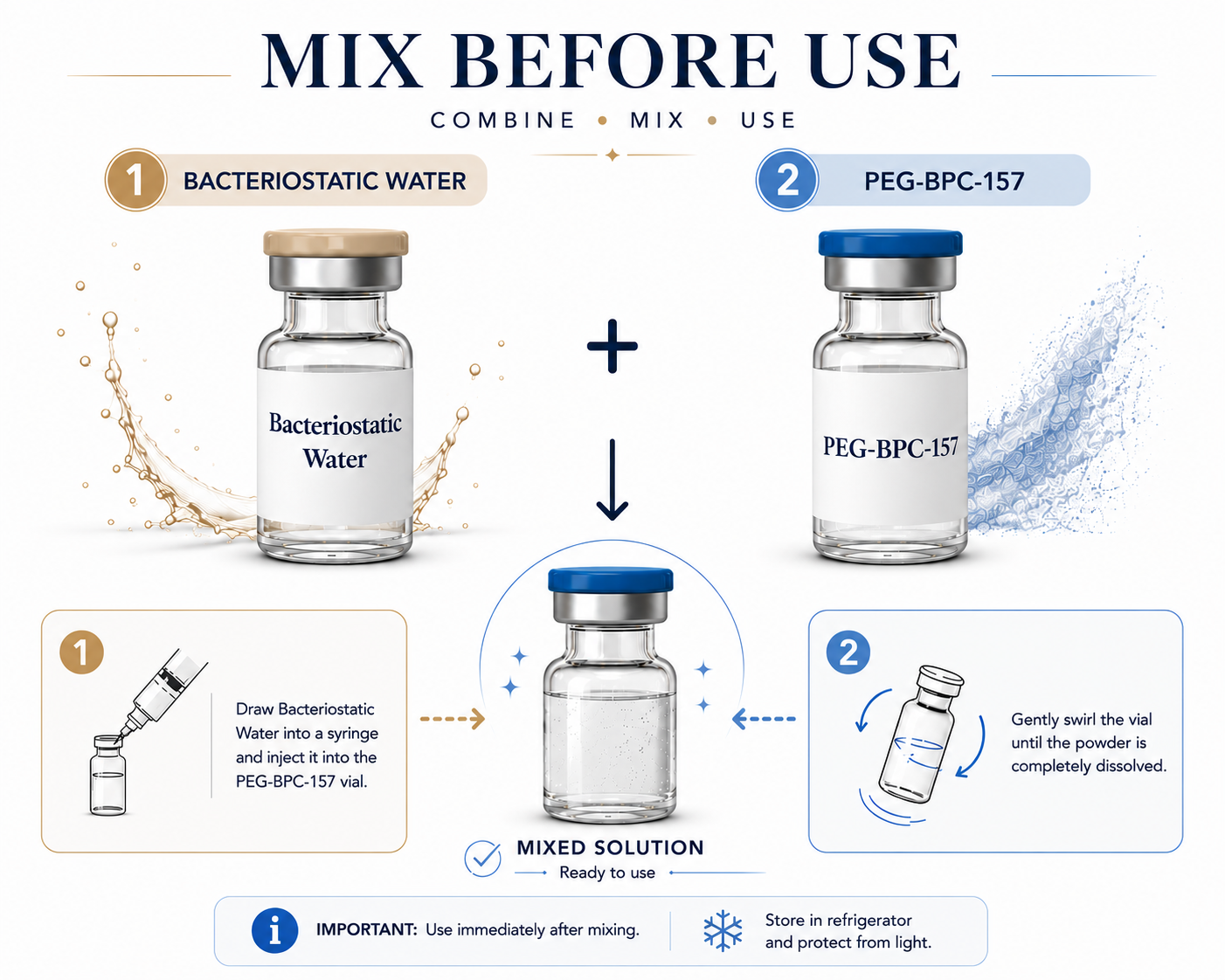
How To Mix PEG-BPC-157
1
CleanUse alcohol swabs to clean the tops of both vials.
2
Draw BAC WaterDraw the selected amount of bacteriostatic water.
3
Inject SlowlyAdd the liquid slowly down the side of the vial.
4
Swirl GentlyDo not shake. Swirl gently until dissolved.
5
Store ProperlyStore as directed and protect from heat and light.
Best Practices & Common Mistakes
Best Practices
- Use sterile technique.
- Protect from light and heat.
- Store refrigerated when appropriate.
- Use clean syringe-unit math before measuring.
Common Mistakes
- Confusing milligrams with milliliters.
- Choosing an option with awkward decimal units.
- Using too little liquid for very small measurements.
- Shaking the vial aggressively.
PEG-BPC-157 Storage & Handling
Lyophilized Powder: −20°C (−4°F) for long-term storage (up to 24 months). Refrigeration 2–8°C (36–46°F) for short-term use (up to ~3 months). Original sealed vial in the freezer is safest.
Reconstituted Solution: 2–8°C (36–46°F), use within ~7–14 days. Keep sealed, avoid light, and do not repeat freeze-thaw cycles.
Reconstituted Solution: 2–8°C (36–46°F), use within ~7–14 days. Keep sealed, avoid light, and do not repeat freeze-thaw cycles.
Frequently Asked Questions
PEGylation significantly extends the half-life. Standard BPC-157 is cleared rapidly from blood plasma, with a half-life of about 15 minutes. Because it breaks down so quickly, it requires frequent injections (often twice daily) to maintain effective levels. The PEGylated version is designed for one daily injection. Your calculator should therefore show roughly double the number of doses per vial compared to standard BPC-157, assuming the total amount of peptide in the vial is the same.
The added PEG chain makes the molecule both larger and more hydrophilic, which can increase the viscosity of the resulting solution. While standard BPC-157 is freely soluble in water at normal pH values, PEGylated peptides sometimes tend to dissolve more slowly and can produce a thicker, more viscous solution. If your calculator originally recommended a concentration of 2.5 mg/mL (10 mg of peptide in 4 mL of water), this PEG-BPC-157 solution may be too thick to be drawn up easily into a 31G insulin syringe.
BPC-157 in lyophilized form is very stable and can be stored for 36 months at -20°C. However, once reconstituted (dissolved) and kept refrigerated, standard BPC-157 has a reported stability of about 28 days. For PEGylated peptides, by contrast, the common recommendation is to use a refrigerated (4°C) solution for only 2–7 days. To preserve potency for longer, PEG-BPC-157 aliquots must be frozen at -20°C immediately after reconstitution.
For standard BPC-157, a concentration of 2.5 mg/mL is common and achievable by dissolving 5 mg of peptide in 2 mL of water. PEG-BPC-157 has a lower solubility ceiling; 2.5 mg/mL may still be possible, but concentrations above this can become cloudy or too viscous. If your calculator recommends a very high concentration to achieve "perfectly" rounded units — for example, 10 mg of peptide in just 1 mL of water (10 mg/mL) — this may exceed the solubility limit of the PEGylated version. In this case, using a higher dilution volume (e.g., 4 mL of water) to reach a concentration of 2.5 mg/mL will ensure full dissolution and accurate dosing, even if the calculator does not classify it as "best".
BPC-157 is generally well tolerated with low reported toxicity. However, the presence of the PEG chain in PEG-BPC-157 can in some cases cause low-grade local reactions. These may include mild irritation, redness, or a palpable lump at the injection site. This is because the PEG molecule itself, although biocompatible, can be recognized by the body's immune cells in certain formulations and trigger a local response. This is a safety aspect that your calculator does not account for and that you must be aware of.
Practical takeaway: If your real goal is weight or metabolic health, the most useful next step is discussing approved treatment options with a clinician rather than relying on an unapproved compound.
Important: This tool is for informational and research-reference purposes only. Not intended for human or veterinary use.