Pancragen Reconstitution Calculator
Enter the amount you want to measure. The vial buttons will highlight which vial strengths create cleaner syringe-unit measurements.
What amount do you need?
Type the target amount, then choose mg or mcg. Example: 2mg or 500mcg.
Syringe size:
Possible vial strengths:
Best Match
Good Match
Usable
Harder to Measure
Example Pancragen Titration Schedule
| Protocol Item | Guidance |
|---|---|
| Dose | 1–5 mg per dose |
| Cycling (General) | Typically cycled as periodic doses rather than continuous daily consumption |
| Phase | Timing |
| Loading Phase | Year 1 |
| Maintenance Phase | Year 2+ |
Possible vial strengths:
What Is It?
Pancragen
Pancreatic short peptide bioregulator.
Bacteriostatic Water
Sterile water containing a bacteriostatic preservative, commonly used when preparing multi-use research vials.
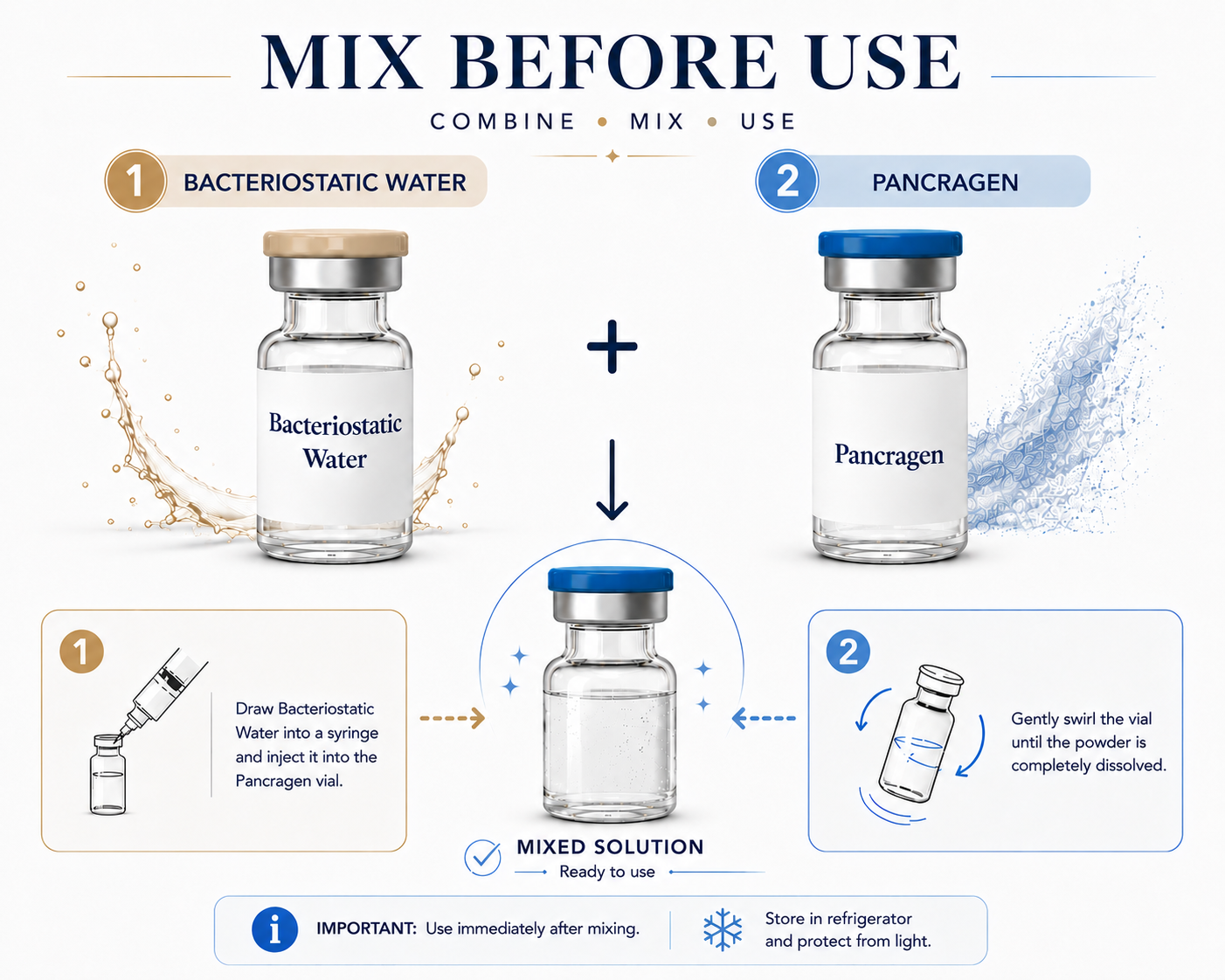
How To Mix Pancragen
1
CleanUse alcohol swabs to clean the tops of both vials.
2
Draw BAC WaterDraw the selected amount of bacteriostatic water.
3
Inject SlowlyAdd the liquid slowly down the side of the vial.
4
Swirl GentlyDo not shake. Swirl gently until dissolved.
5
Store ProperlyStore as directed and protect from heat and light.
Best Practices & Common Mistakes
Best Practices
- Use sterile technique.
- Protect from light and heat.
- Store refrigerated when appropriate.
- Use clean syringe-unit math before measuring.
Common Mistakes
- Confusing milligrams with milliliters.
- Choosing an option with awkward decimal units.
- Using too little liquid for very small measurements.
- Shaking the vial aggressively.
Pancragen Storage & Handling
Lyophilized Powder: −20°C (−4°F) for long-term storage (up to 24 months). Refrigeration 2–8°C (36–46°F) for short-term use (up to ~3 months). Original sealed vial in the freezer is safest.
Reconstituted Solution: 2–8°C (36–46°F), use within ~7–14 days. Keep sealed, avoid light, and do not repeat freeze-thaw cycles.
Reconstituted Solution: 2–8°C (36–46°F), use within ~7–14 days. Keep sealed, avoid light, and do not repeat freeze-thaw cycles.
Frequently Asked Questions
The calculator uses a generic model that assumes all peptides degrade at a similar rate in solution. The technical data for a 20 mg lyophilised peptide states that it is stable for up to 28 days at 2‑8 °C under sterile conditions. In practice, after adding 2.5 mL of BAC water to a 10 mg vial (final concentration ~4 mg/mL), a 500 mcg dose would require 0.125 mL (12.5 units), and the “Doses per vial” number (~20) is a reliable guide for a month‑long experiment, as the solution will remain chemically stable for that entire duration.
A 1 mL reconstitution volume would produce a highly concentrated solution that may be near or at the peptide’s solubility limits, leading to incomplete dissolution or unpredictable dosing. Additionally, high concentrations have been linked to increased local irritation at the injection site. The technical solubility advice for Pancragen states that the lyophilised powder is readily soluble in water, PBS buffer, or DMSO. For long‑term storage, a more dilute solution (e.g., 2.5 mL for a 10 mg vial) should be prepared, then aliquoted and frozen in a deep freezer, avoiding multiple freeze‑thaw cycles.
The calculator assumes a linear relationship between dose and effect. However, a 10‑day intramuscular course of 50 μg/day in old monkeys not only normalised glucose and insulin dynamics but also maintained partial recovery for three weeks after the last injection. For a 10 mg vial with a daily dose of 500 mcg, the “Doses per vial” (~20) could treat two full 10‑day cycles across two months, as the epigenetic effects persist long after the peptide is gone.
The calculator standardises all peptides into a single protocol, assuming cold diluent is always safe. The handling note for Pancragen advises to “allow both the peptide and chosen solvent to reach ambient laboratory temperature before reconstitution” because cold liquid can reduce the solubility of certain peptides and cause aggregation. If a researcher follows the calculator and injects cold BAC water directly into the vial, the powder may not fully dissolve, and the calculated dose will be inaccurate.
The calculator assumes all peptides must be injected and cannot be given orally. However, in a rat model of streptozotocin‑induced diabetes, oral Pancragen produced a pronounced hypoglycemic effect during treatment, without significant degradation. It is believed that Pancragen’s tetrapeptide structure and positive charge may protect it from enzymatic degradation in the gastrointestinal tract. If you are using an oral liquid formulation, the calculator’s normal syringe outputs are irrelevant, but the total mass needed can be determined: for a target concentration of 0.5 mg/mL in drinking water, a 10 mg vial would be reconstituted with 20 mL of sterile water, a calculation the calculator can perform even though it was designed for injectables.
Practical takeaway: If your real goal is weight or metabolic health, the most useful next step is discussing approved treatment options with a clinician rather than relying on an unapproved compound.
Important: This tool is for informational and research-reference purposes only. Not intended for human or veterinary use.