Oxytocin Reconstitution Calculator
Enter the amount you want to measure. The vial buttons will highlight which vial strengths create cleaner syringe-unit measurements.
What amount do you need?
Type the target amount, then choose mg or mcg. Example: 2mg or 500mcg.
Syringe size:
Possible vial strengths:
Best Match
Good Match
Usable
Harder to Measure
Example Oxytocin Titration Schedule
| Protocol Item | Guidance |
|---|---|
| Dose | 10–200 IUs per dose |
| Frequency | Dosing may be daily or multiple times per week, depending on the goal. |
| Cycling | Cycles may run for weeks to months, followed by a break to assess response and maintain efficacy. |
| Modified Versions (Acetate/Amidate) | The source notes limited research on dosing/cycling for modified versions; similar schemes to the original compound are commonly used. Often recommended to start with a more conservative dosing and cycling approach when researching more potent compounds. |
Possible vial strengths:
What Is It?
Oxytocin
Posterior pituitary nonapeptide.
Bacteriostatic Water
Sterile water containing a bacteriostatic preservative, commonly used when preparing multi-use research vials.
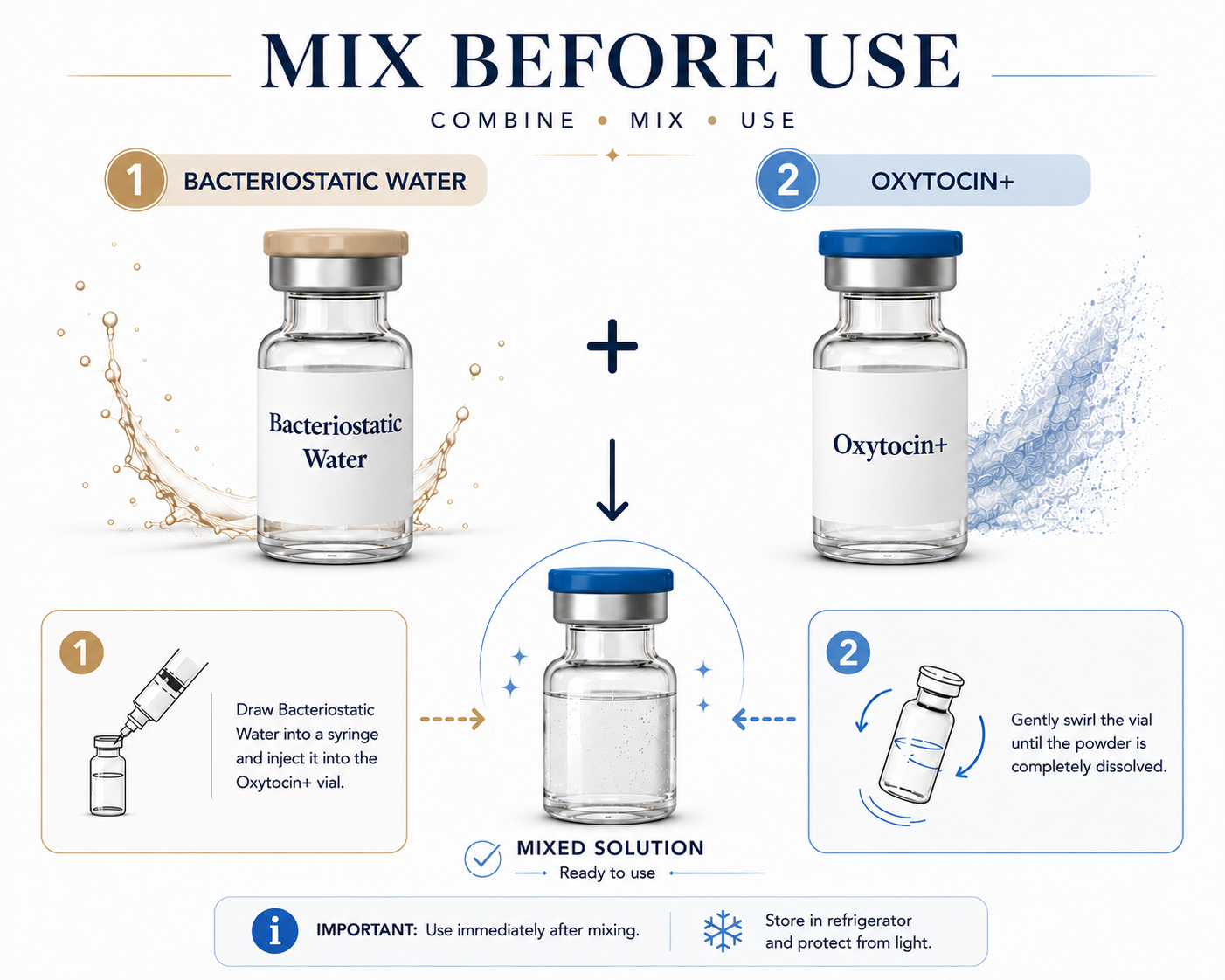
How To Mix Oxytocin
1
CleanUse alcohol swabs to clean the tops of both vials.
2
Draw BAC WaterDraw the selected amount of bacteriostatic water.
3
Inject SlowlyAdd the liquid slowly down the side of the vial.
4
Swirl GentlyDo not shake. Swirl gently until dissolved.
5
Store ProperlyStore as directed and protect from heat and light.
Best Practices & Common Mistakes
Best Practices
- Use sterile technique.
- Protect from light and heat.
- Store refrigerated when appropriate.
- Use clean syringe-unit math before measuring.
Common Mistakes
- Confusing milligrams with milliliters.
- Choosing an option with awkward decimal units.
- Using too little liquid for very small measurements.
- Shaking the vial aggressively.
Oxytocin Storage & Handling
Lyophilized Powder: −20°C (−4°F) for long-term storage (up to 24 months). Refrigeration 2–8°C (36–46°F) for short-term use (up to ~3 months). Original sealed vial in the freezer is safest.
Reconstituted Solution: 2–8°C (36–46°F), use within ~7–14 days. Keep sealed, avoid light, and do not repeat freeze-thaw cycles.
Reconstituted Solution: 2–8°C (36–46°F), use within ~7–14 days. Keep sealed, avoid light, and do not repeat freeze-thaw cycles.
Frequently Asked Questions
The calculator is a generic dilution tool that does not account for specific chemical interactions. Sources warn that oxytocin is one of several peptides that should not be reconstituted with bacteriostatic water because the 0.9% benzyl alcohol preservative can cause degradation of oxytocin, reducing its effectiveness. Instead, oxytocin should be reconstituted with sterile water or saline solution for optimal stability. If you follow the calculator's default suggestion to use BAC water, you may inadvertently compromise the peptide's activity even if the calculated concentration is mathematically correct.
The calculator is a pure mathematical tool and does not warn about chemical instability. Multiple manufacturer data sheets state that after reconstitution, oxytocin should be stored at 4°C for between 2–7 days, and for future use it must be frozen below -18°C. Furthermore, the reconstituted solution is so unstable that it degrades rapidly at room temperature and cannot tolerate being stored at 30°C for more than one month or 2 weeks at 40°C. Therefore, the calculator's "Doses per vial" number is not a practical guide for multi‑week protocols unless you immediately aliquot and freeze the solution, adding a carrier protein (0.1% HSA or BSA) for long‑term storage.
The calculator will linearly increase the volume shown for a larger entered dose, but a clinical review explicitly states that oxytocin does not have a predictable dose response. The pharmacologic effects must be titrated based on physiological parameters (e.g., uterine contraction amplitude and frequency), not on a fixed mass calculation. In a mouse model of anxiety and depression, a 0.1 mg/kg dose of oxytocin blocked stress‑induced behaviours, but the 1 mg/kg dose did not. If you use the calculator to increase the dose, you may overshoot the effective window and reduce efficacy—an outcome the calculator cannot anticipate.
The calculator will output a specific volume for a single subcutaneous injection. But the intravenous half‑life is so short that a single bolus may produce only a transient effect. In a clinical setting, oxytocin is often given as a continuous infusion where at least 3 half‑lives must elapse before a steady‑state effect is established. If you use the calculator to prepare a vial for a "once‑daily" injection, the peptide may be cleared from the body within minutes, rendering the calculated mass irrelevant to the actual duration of action.
Your calculator does not and cannot warn about safety. Oxytocin has serious documented adverse effects including cardiac arrhythmias, seizures, confusion, hallucinations, a sudden brief sensation of heat, hypotension, and anaphylaxis. In sensitive individuals, it can cause uterine hypertonicity, spasm, tetanic contraction, or rupture. A study on neonatal pain even reported that repeated daily oxytocin treatment diminished body weight gain in neonatal pups, a major side effect observed throughout the neonatal week. These risks are not trivial: when used in error, oxytocin can cause patient harm, highlighting the importance of precise administration using infusion pumps. The calculator will output a volume, but you are entirely responsible for understanding the profound physiological effects that even a "correctly" calculated dose can produce.
Practical takeaway: If your real goal is weight or metabolic health, the most useful next step is discussing approved treatment options with a clinician rather than relying on an unapproved compound.
Important: This tool is for informational and research-reference purposes only. Not intended for human or veterinary use.