Ovagen Reconstitution Calculator
Enter the amount you want to measure. The vial buttons will highlight which vial strengths create cleaner syringe-unit measurements.
What amount do you need?
Type the target amount, then choose mg or mcg. Example: 2mg or 500mcg.
Syringe size:
Possible vial strengths:
Best Match
Good Match
Usable
Harder to Measure
Example Ovagen Titration Schedule
| Protocol Item | Guidance |
|---|---|
| Dose | 1–5 mg per dose |
| Cycling Style | Bio-regulators are typically cycled as periodic doses rather than continuous daily consumption. |
| Phase | Schedule |
| Loading Phase (Year 1) | |
| Maintenance Phase (Year 2+) |
Possible vial strengths:
What Is It?
Ovagen
Liver bioregulator peptide.
Bacteriostatic Water
Sterile water containing a bacteriostatic preservative, commonly used when preparing multi-use research vials.
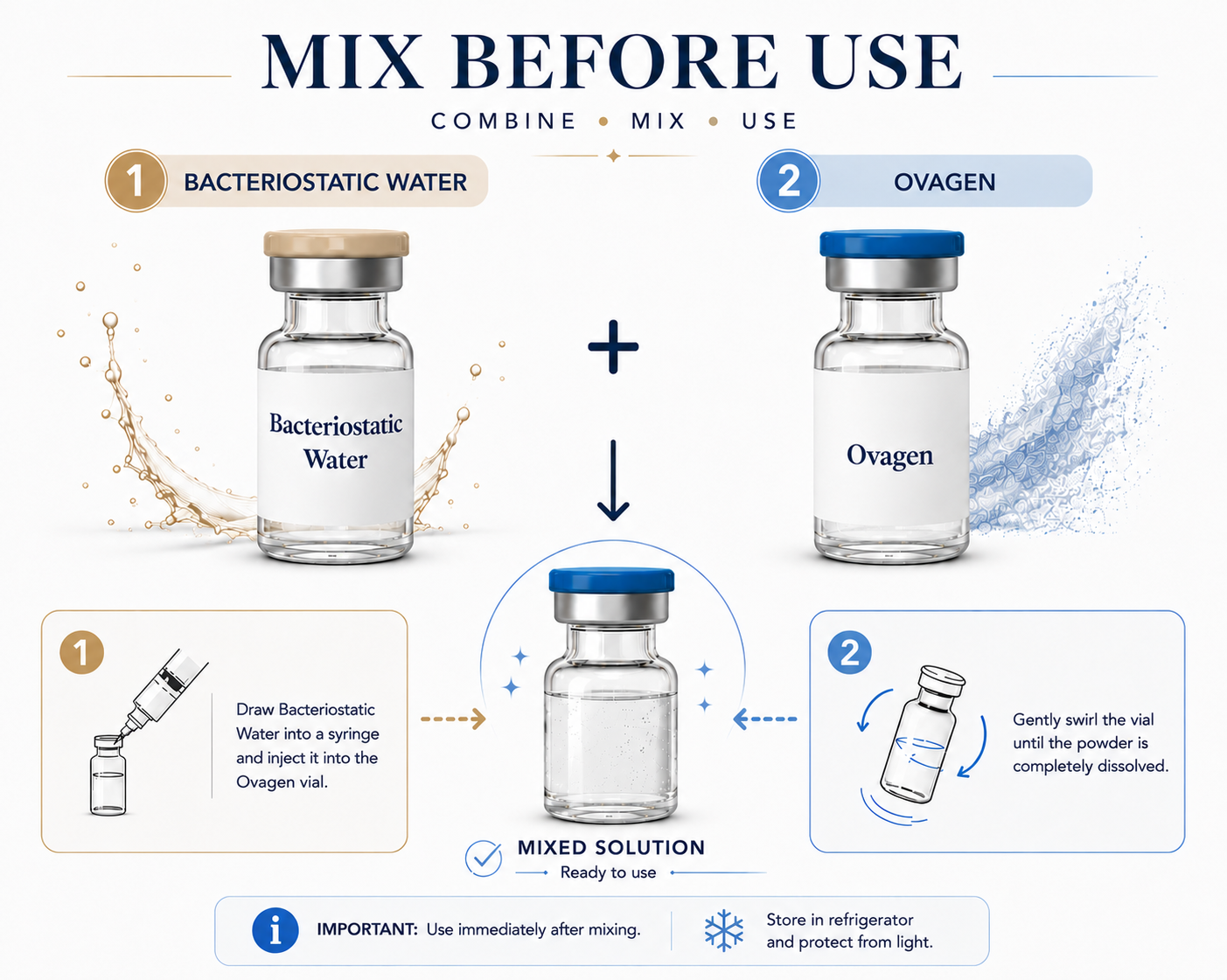
How To Mix Ovagen
1
CleanUse alcohol swabs to clean the tops of both vials.
2
Draw BAC WaterDraw the selected amount of bacteriostatic water.
3
Inject SlowlyAdd the liquid slowly down the side of the vial.
4
Swirl GentlyDo not shake. Swirl gently until dissolved.
5
Store ProperlyStore as directed and protect from heat and light.
Best Practices & Common Mistakes
Best Practices
- Use sterile technique.
- Protect from light and heat.
- Store refrigerated when appropriate.
- Use clean syringe-unit math before measuring.
Common Mistakes
- Confusing milligrams with milliliters.
- Choosing an option with awkward decimal units.
- Using too little liquid for very small measurements.
- Shaking the vial aggressively.
Ovagen Storage & Handling
Lyophilized Powder: −20°C (−4°F) for long-term storage (up to 24 months). Refrigeration 2–8°C (36–46°F) for short-term use (up to ~3 months). Original sealed vial in the freezer is safest.
Reconstituted Solution: 2–8°C (36–46°F), use within ~7–14 days. Keep sealed, avoid light, and do not repeat freeze-thaw cycles.
Reconstituted Solution: 2–8°C (36–46°F), use within ~7–14 days. Keep sealed, avoid light, and do not repeat freeze-thaw cycles.
Frequently Asked Questions
Your calculator only works with mass (mg). For a tripeptide this small, the same mg dose contains many more molecules than a larger peptide. For Ovagen, 1 mg corresponds to approximately 2.66 µmol (using the free acid MW 375.37). If your research protocol is based on molar concentrations (e.g., a cell culture study at 0.05 ng/mL), entering the equivalent mass into the calculator will not automatically give you the correct molarity. You must manually calculate the molar concentration of your solution and adjust the entered mg dose accordingly.
The calculator’s colour coding is driven purely by mathematical neatness. The standard Ovagen protocol calls for adding 3.0 mL of BAC water to a 20 mg vial, yielding a concentration of approximately 6.67 mg/mL and making syringe calculations simple for the recommended 800–2000 mcg (0.8–2 mg) daily dose range. If the 3 mL option results in unit values that are not perfect multiples of 5 on your chosen syringe, the calculator may demote it to “Good” or “Usable”. For Ovagen, you should prioritise the empirically validated protocol and override the calculator’s colour‑coded suggestion.
As an acidic tripeptide, Ovagen has a high overall polarity. While it is generally soluble in water, the acidity of the molecule means that solubility can be further enhanced by using a volatile basic buffer. Standard peptide solubility guidelines recommend, for peptides containing many acidic amino acids (such as Asp and Glu), using a 1‑10% aqueous ammonia solution to aid dissolution. If your calculator‑suggested concentration leaves the powder only partially dissolved or the solution appears cloudy, you should consider adding a small amount of 1‑10% ammonium hydroxide, not just more BAC water. The calculator does not warn about the need for a basic solvent for this specific peptide.
Your calculator is a neutral dilution tool; it does not know which research model you are using. In a kidney cell culture study, the effective concentration of Ovagen was as low as 0.05 ng/mL. In a study on ovarian function, the dose range might be 800‑2000 mcg (0.8‑2 mg) daily. In HIV‑1 protease inhibition research, the tripeptide EDL itself is structurally documented as binding an enzymatic active site, illustrating sequence‑specific bioactivity that is not dose‑dependent in a simple linear way. The calculator will correctly reconstitute any mass you enter, but you must first determine the correct dose for your specific research domain from the literature.
The 28‑day chemical stability window is longer than the 25‑day usage period, so from a chemical degradation standpoint, the later doses should still be potent. However, repeated puncturing of the vial over 25 days significantly increases the risk of microbial contamination, even with the benzyl alcohol preservative in BAC water. General sterility guidelines for multi‑dose vials recommend discarding the vial after 28 days regardless of remaining volume. For a 25‑day protocol that aligns with this window, you must use rigorous sterile technique: always wipe the rubber septum with 70% alcohol before each draw and visually inspect the solution for turbidity or particles. The calculator’s “Doses per vial” number is a practical guide in this case, but it requires strict adherence to aseptic handling.
Practical takeaway: If your real goal is weight or metabolic health, the most useful next step is discussing approved treatment options with a clinician rather than relying on an unapproved compound.
Important: This tool is for informational and research-reference purposes only. Not intended for human or veterinary use.