Kisspeptin-10 Reconstitution Calculator
Enter the amount you want to measure. The vial buttons will highlight which vial strengths create cleaner syringe-unit measurements.
What amount do you need?
Type the target amount, then choose mg or mcg. Example: 2mg or 500mcg.
Syringe size:
Possible vial strengths:
Best Match
Good Match
Usable
Harder to Measure
Example Kisspeptin-10 Titration Schedule
| Protocol Item | Guidance |
|---|---|
| Dose | 100–500 mcg per dose |
| Frequency | 2–3× per week, over several months |
| Cycle Break | Minimum 1 month off between cycles |
| Timing Note | Described as best taken when LH/FSH naturally peak—typically in the morning |
| Female Cycle Note | Typically cycled around conception; for females, particularly during the follicular phase leading up to ovulation, then discontinued after |
Possible vial strengths:
What Is It?
Kisspeptin-10
Kisspeptin fragment studied in reproductive signaling.
Bacteriostatic Water
Sterile water containing a bacteriostatic preservative, commonly used when preparing multi-use research vials.
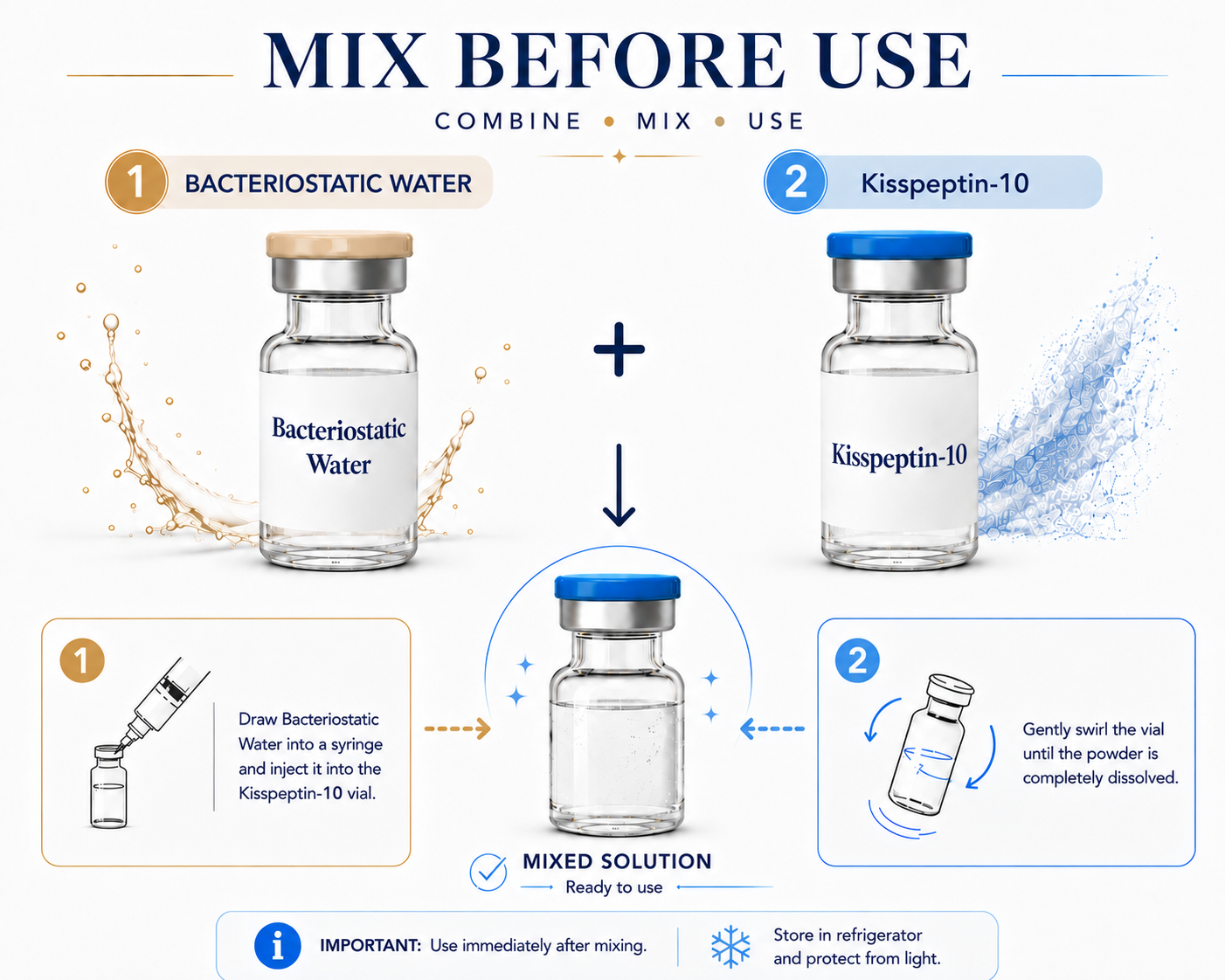
How To Mix Kisspeptin-10
1
CleanUse alcohol swabs to clean the tops of both vials.
2
Draw BAC WaterDraw the selected amount of bacteriostatic water.
3
Inject SlowlyAdd the liquid slowly down the side of the vial.
4
Swirl GentlyDo not shake. Swirl gently until dissolved.
5
Store ProperlyStore as directed and protect from heat and light.
Best Practices & Common Mistakes
Best Practices
- Use sterile technique.
- Protect from light and heat.
- Store refrigerated when appropriate.
- Use clean syringe-unit math before measuring.
Common Mistakes
- Confusing milligrams with milliliters.
- Choosing an option with awkward decimal units.
- Using too little liquid for very small measurements.
- Shaking the vial aggressively.
Kisspeptin-10 Storage & Handling
Lyophilized Powder: −20°C (−4°F) for long-term storage (up to 24 months). Refrigeration 2–8°C (36–46°F) for short-term use (up to ~3 months). Original sealed vial in the freezer is safest.
Reconstituted Solution: 2–8°C (36–46°F), use within ~7–14 days. Keep sealed, avoid light, and do not repeat freeze-thaw cycles.
Reconstituted Solution: 2–8°C (36–46°F), use within ~7–14 days. Keep sealed, avoid light, and do not repeat freeze-thaw cycles.
Frequently Asked Questions
The calculator's "doses per vial" is a pure mathematical count and is not a guide to the peptide's biological stability after reconstitution. The decomposition half-life of Kisspeptin-10 is 6.8 min at 4 °C (in a fridge) and only 1.7 min at 37 °C (body temperature). This means the peptide starts degrading the moment it is mixed. Therefore, you should ignore the calculator's Doses per vial number as a plan for long-term use. Use it to calculate your dose concentration, then immediately aliquot the entire reconstituted solution into single‑use vials and freeze them at -80 °C, where they can be stable for up to 6 months, to preserve potency for multiple injections.
Kisspeptin‑10 has an extremely short blood half-life of only about 4 minutes. The longer, endogenous form, Kisspeptin‑54 (KP‑54), is significantly more stable, with a half-life of approximately 32 minutes. Because of this short half-life, research protocols often require repeated injections of Kisspeptin‑10 every 10 minutes to maintain biological activity. If you use your calculator to prepare a vial for a twice-daily injection schedule, you will effectively get no biological effect after the first few minutes. Your calculated dose is correct, but your injection frequency must be far higher.
Unlike many peptides where "more is better", Kisspeptin‑10 has a specific dose-response curve that is not linear. While low doses (e.g., 1 µg/kg) effectively stimulate LH and FSH release, animal studies have shown that higher doses can lead to a paradoxical reduction in plasma LH and testosterone. You cannot simply increase the mg value in your calculator to get a stronger effect. You must first determine the correct µg/kg dose for your specific research model (e.g., from 0.01 to 3.0 µg/kg in humans), convert it to mg, and use the calculator to accurately measure that precise amount.
Your calculator assumes you will use BAC water. However, depending on the salt form (e.g., acetate or TFA), Kisspeptin‑10 is only soluble to about 1‑2.5 mg/mL in pure water. If you use your calculator to instruct a user to add just 1 mL of BAC water to a 5 mg vial, the requested concentration of 5 mg/mL would exceed the peptide's solubility limit, resulting in a cloudy solution and inaccurate dosing. You must ensure the final concentration is at or below 2.5 mg/mL. For a 5 mg vial, this means using at least 2 mL of diluent (a concentration of 2.5 mg/mL) and checking that the solution is clear.
Your calculator is a neutral tool, but the biology is not. In a maturing rat model, 12 days of Kisspeptin administration led to dose‑dependent degenerative changes in the testes, with significant reductions in sperm production at certain doses. If you use the calculator to plan a long-term study with daily injections, the calculated "doses per vial" might imply that repeated administration is safe. However, you must be aware that this peptide can be gonadotoxic with repeated use. Consult your specific research literature to determine the maximum safe duration of treatment, and do not exceed it, regardless of how many doses the calculator suggests remain in the vial.
Practical takeaway: If your real goal is weight or metabolic health, the most useful next step is discussing approved treatment options with a clinician rather than relying on an unapproved compound.
Important: This tool is for informational and research-reference purposes only. Not intended for human or veterinary use.