Chonluten Reconstitution Calculator
Enter the amount you want to measure. The vial buttons will highlight which vial strengths create cleaner syringe-unit measurements.
What amount do you need?
Type the target amount, then choose mg or mcg. Example: 2mg or 500mcg.
Syringe size:
Possible vial strengths:
Best Match
Good Match
Usable
Harder to Measure
Example Chonluten Titration Schedule
| Week | Daily Dose | Injection Volume |
|---|---|---|
| Weeks 1–2 | 250 mcg (0.25 mg) | 3.75 units (0.0375 mL) |
| Weeks 3–4 | 500 mcg (0.5 mg) | 7.5 units (0.075 mL) |
| Weeks 5–6 | 1,000 mcg (1 mg) | 15 units (0.15 mL) |
| Weeks 7–8 | 1,500 mcg (1.5 mg) | 22.5 units (0.225 mL) |
| Weeks 9–10 | 2,000 mcg (2 mg) | 30 units (0.30 mL) |
| Weeks 11–12 | 3,000 mcg (3 mg) | 45 units (0.45 mL) |
| Weeks 13–14 | 4,000 mcg (4 mg) | 60 units (0.60 mL) |
| Weeks 15–16 | 4,000 mcg (4 mg) | 60 units (0.60 mL) |
Possible vial strengths:
What Is It?
Chonluten
Bronchial bioregulator peptide.
Bacteriostatic Water
Sterile water containing a bacteriostatic preservative, commonly used when preparing multi-use research vials.
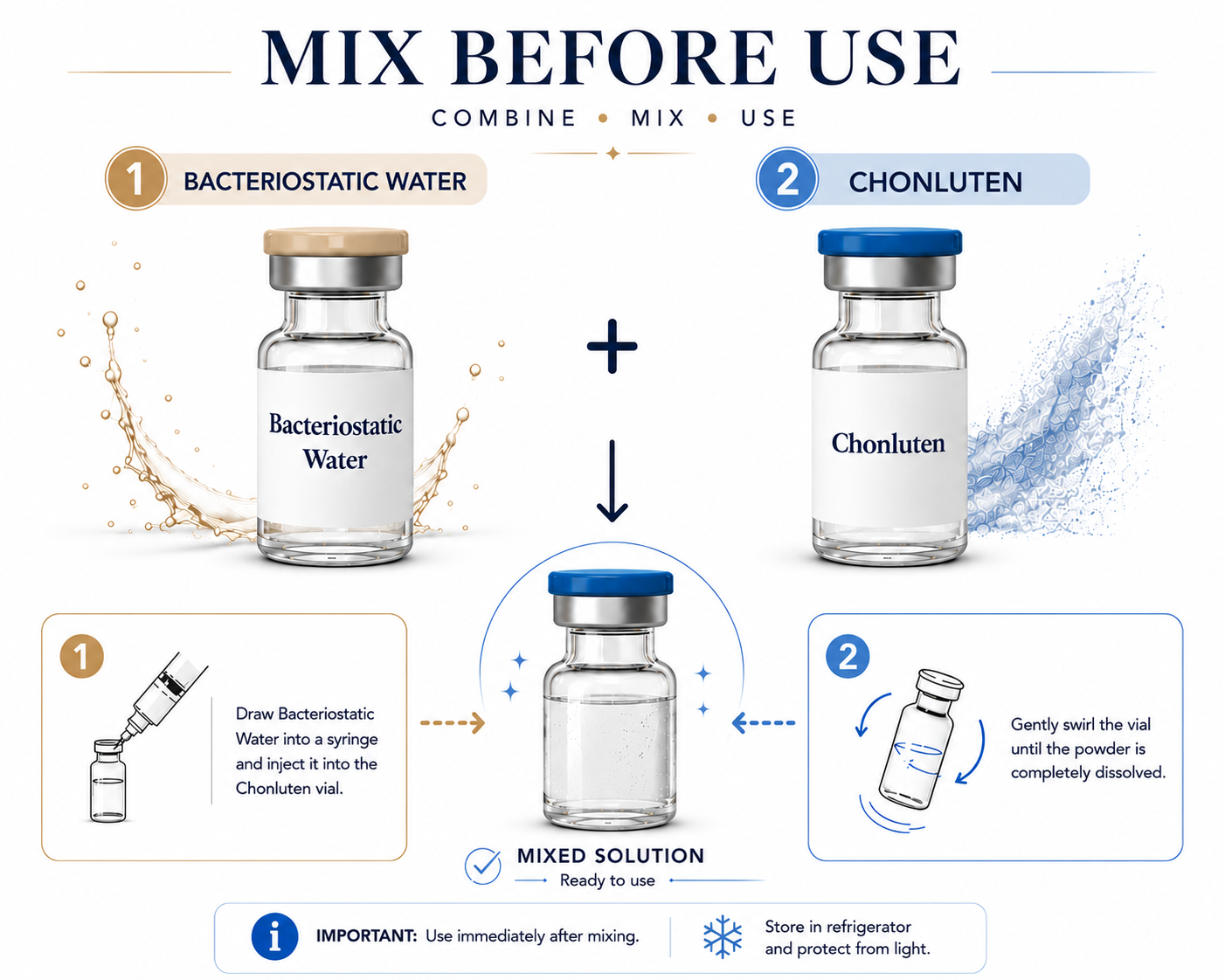
How To Mix Chonluten
1
CleanUse alcohol swabs to clean the tops of both vials.
2
Draw BAC WaterDraw the selected amount of bacteriostatic water.
3
Inject SlowlyAdd the liquid slowly down the side of the vial.
4
Swirl GentlyDo not shake. Swirl gently until dissolved.
5
Store ProperlyStore as directed and protect from heat and light.
Best Practices & Common Mistakes
Best Practices
- Use sterile technique.
- Protect from light and heat.
- Store refrigerated when appropriate.
- Use clean syringe-unit math before measuring.
Common Mistakes
- Confusing milligrams with milliliters.
- Choosing an option with awkward decimal units.
- Using too little liquid for very small measurements.
- Shaking the vial aggressively.
Chonluten Storage & Handling
Lyophilized Powder: −20°C (−4°F) for long-term storage (up to 24 months). Refrigeration 2–8°C (36–46°F) for short-term use (up to ~3 months). Original sealed vial in the freezer is safest.
Reconstituted Solution: 2–8°C (36–46°F), use within ~7–14 days. Keep sealed, avoid light, and do not repeat freeze-thaw cycles.
Reconstituted Solution: 2–8°C (36–46°F), use within ~7–14 days. Keep sealed, avoid light, and do not repeat freeze-thaw cycles.
Frequently Asked Questions
Commercial supplements (e.g., CHONLUTEN® capsules) typically contain 0.1–0.2 mg of the proprietary AC‑7 peptide complex per capsule, with a standard course of 1–2 capsules 1–2 times daily lasting one month. In contrast, research‑grade 20 mg lyophilized vials are designed for subcutaneous injection, not oral use. The peptide is considered to have poor oral stability, so injected doses are much smaller. When using your calculator, you will work with the 20 mg vial mass and a desired dose in the 0.25–4 mg range. Do not try to mimic capsule mass—injectable and oral routes are not interchangeable.
Your calculator is set up for flexibility. For a 20 mg vial, the available BAC water volumes do include 3 mL in the preset options. Selecting 3 mL will calculate a concentration of 6.67 mg/mL. On a U‑100 insulin syringe, each unit then corresponds to approximately 66.67 mcg of Chonluten. This specific concentration is preferred because it results in clean, easy‑to‑measure units across a common titration range. If your protocol calls for a different volume, you can manually calculate and treat it as a custom mix.
Your calculator is designed for single‑vial calculations, not multi‑vial tracking. For an extended protocol (e.g., 8–16 weeks), you will likely need multiple 20 mg vials. For example, a 16‑week daily protocol may require 12 vials. Use your calculator per vial: reconstitute each vial with 3 mL of BAC water. Then, as you progress through the titration (e.g., weeks 1–2: 0.25 mg/day; weeks 3–4: 0.5 mg/day; weeks 5–6: 1 mg/day, etc.), simply enter the current daily dose in the "Desired dose" field. The calculator will instantly show the required units for that day. Keep a separate log of total vials used and remaining doses to manage your course effectively.
Your calculator's "Doses per vial" assumes full potency for as long as the solution is used. In reality, Chonluten has a short shelf life after reconstitution—typically a few days in the fridge. Therefore, you should only reconstitute an amount you will use within that short window. For a daily dose of, say, 0.5 mg (7.5 units at 6.67 mg/mL), a 20 mg vial could theoretically provide 40 doses. However, you would never use all 40 because the peptide would degrade. Instead, consider splitting your powder into smaller aliquots before reconstituting, or plan to use the entire vial content within the few‑day window and then discard any remaining solution. The "Doses per vial" display is a mathematical maximum, not a practical recommendation for this peptide.
Your calculator is a neutral tool: it calculates volume and units based on your inputs. It does not verify that your chosen dose is appropriate for a specific research model. The large variation in proposed research areas—from pulmonary to orthopedic to cosmetic—means that there is no single authoritative dosage guide. Your calculator will accurately tell you how many units to draw for whatever mass you enter. Therefore, you are responsible for verifying that dose from peer‑reviewed literature for your specific application. For example, a common subcutaneous injection protocol for respiratory research uses a 250–4000 mcg daily dose, while a topical formulation might have entirely different requirements. Always cross‑reference your entered dose with published protocols.
Practical takeaway: If your real goal is weight or metabolic health, the most useful next step is discussing approved treatment options with a clinician rather than relying on an unapproved compound.
Important: This tool is for informational and research-reference purposes only. Not intended for human or veterinary use.