Adamax Reconstitution Calculator
Enter the amount you want to measure. The vial buttons will highlight which vial strengths create cleaner syringe-unit measurements.
What amount do you need?
Type the target amount, then choose mg or mcg. Example: 2mg or 500mcg.
Syringe size:
Possible vial strengths:
Best Match
Good Match
Usable
Harder to Measure
Example Adamax Titration Schedule
| Parameter | Details |
|---|---|
| Dosage | 300–1000 µg once daily (gradual titration: 300 µg wk1-2 → 500 µg wk3-4 → 750 µg wk5-6 → 1000 µg wk7-8) |
| Route | Subcutaneous (SC) |
| Frequency | Once daily |
| Cycle Length | 8–16 weeks |
| Half‑life | Not established (adamantylation extends effective duration; user reports ~8‑10 hours for stimulant effects) |
| Reconstitution | Add 3.0 mL bacteriostatic water → ~3.33 mg/mL |
Possible vial strengths:
What Is It?
Adamax
Short peptide research preparation.
Bacteriostatic Water
Sterile water containing a bacteriostatic preservative, commonly used when preparing multi-use research vials.
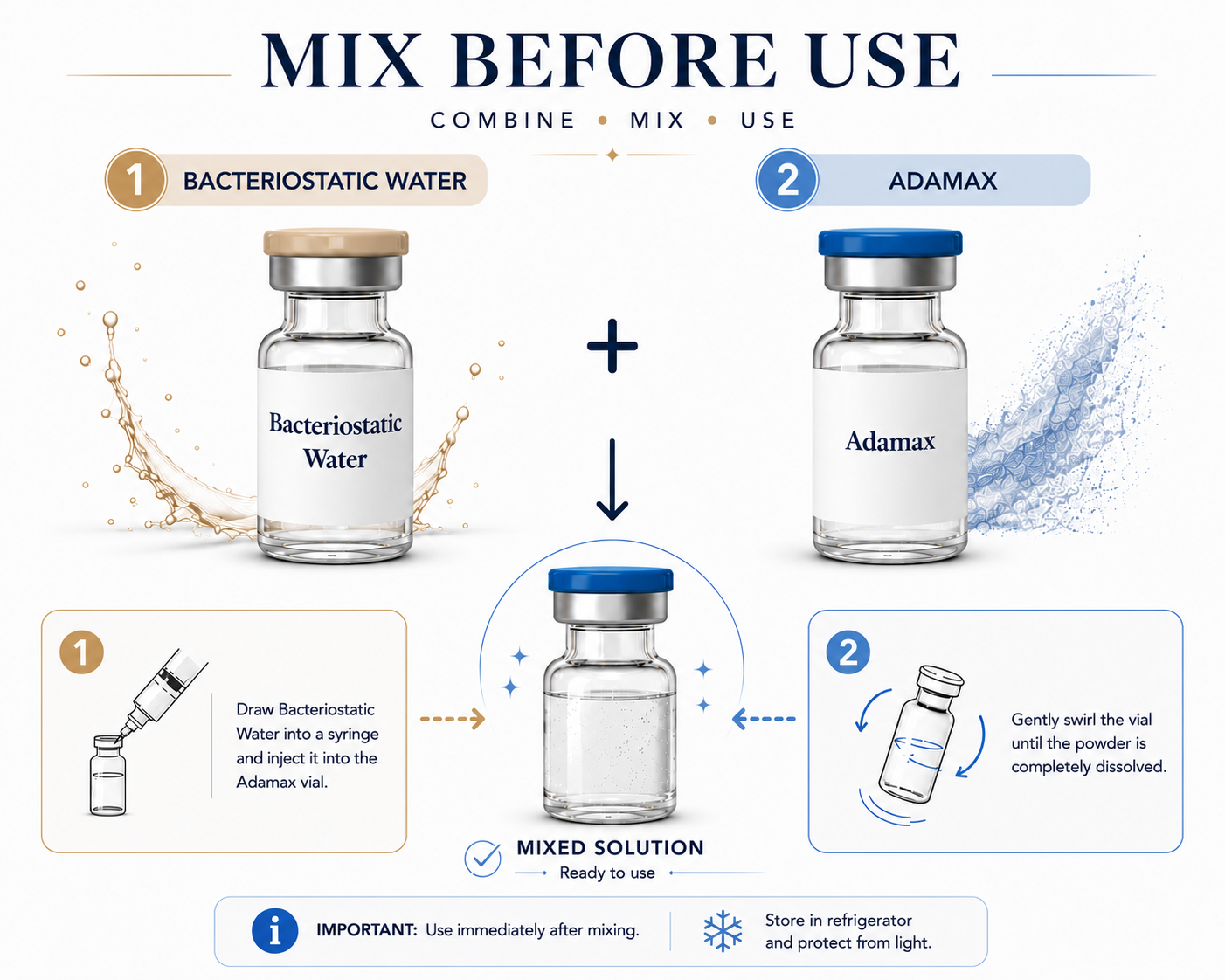
How To Mix Adamax
1
CleanUse alcohol swabs to clean the tops of both vials.
2
Draw BAC WaterDraw the selected amount of bacteriostatic water.
3
Inject SlowlyAdd the liquid slowly down the side of the vial.
4
Swirl GentlyDo not shake. Swirl gently until dissolved.
5
Store ProperlyStore as directed and protect from heat and light.
Best Practices & Common Mistakes
Best Practices
- Use sterile technique.
- Protect from light and heat.
- Store refrigerated when appropriate.
- Use clean syringe-unit math before measuring.
Common Mistakes
- Confusing milligrams with milliliters.
- Choosing an option with awkward decimal units.
- Using too little liquid for very small measurements.
- Shaking the vial aggressively.
Adamax Storage & Handling
Lyophilized Powder: −20°C (−4°F) for long-term storage (up to 24 months). Refrigeration 2–8°C (36–46°F) for short-term use (up to ~3 months). Original sealed vial in the freezer is safest.
Reconstituted Solution: 2–8°C (36–46°F), use within ~7–14 days. Keep sealed, avoid light, and do not repeat freeze-thaw cycles.
Reconstituted Solution: 2–8°C (36–46°F), use within ~7–14 days. Keep sealed, avoid light, and do not repeat freeze-thaw cycles.
Frequently Asked Questions
No. The adamantane group (adamantylglycine) is a bulky, lipophilic molecule added to the C‑terminus specifically to block enzymatic degradation by aminopeptidases and carboxypeptidases that rapidly break down standard peptides. This modification makes Adamax highly stable in blood and tissues, significantly extending its active half‑life and biological duration. Ignore generic calculator half‑life assumptions.
Yes, but with nuance. Adamax has both an N‑terminal acetyl group (Ac‑) and the adamantane group. This acetylation improves water solubility in addition to BBB permeability. Suppliers list solubility in both BAC water and sterile water. Use 3 mL BAC water for a 10 mg vial, achieving ~3.33 mg/mL, which fully dissolves and provides simple unit math. If precipitation occurs, allow both peptide and solvent to reach ambient temperature before mixing.
For short‑term storage (days to weeks), the reconstituted solution remains stable for up to 28 days at 2‑8 °C under sterile conditions. For long‑term storage, the lyophilised powder must be stored at −20 °C; avoid repeated freeze‑thaw cycles once reconstituted. Adamax should be protected from light and heat, as decomposition occurs before melting.
No. A standard research protocol for Adamax uses a gradual titration schedule over weeks: start at 300 μg/day for weeks 1‑2, then 500 μg/day for weeks 3‑4, 750 μg/day for weeks 5‑6, and up to 1000 μg/day for weeks 7‑8. This reflects its enhanced potency from the adamantane group. Using a simple fixed calculator dose could be ineffective; the escalating approach is needed for optimal results.
Yes. Adamax’s primary mechanism is upregulation of Brain‑Derived Neurotrophic Factor (BDNF) and enhanced TrkB receptor sensitivity, not direct agonism of a target receptor. Its adamantane modification enhances lipid solubility and BBB penetration for more efficient central delivery. This indirect, neurotrophic mechanism means the dose‑response relationship is gene‑expression mediated, not linear as a calculator might assume.
Practical takeaway: If your real goal is weight or metabolic health, the most useful next step is discussing approved treatment options with a clinician rather than relying on an unapproved compound.
Important: This tool is for informational and research-reference purposes only. Not intended for human or veterinary use.