Snap-8 Reconstitution Calculator
Enter the amount you want to measure. The vial buttons will highlight which vial strengths create cleaner syringe-unit measurements.
What amount do you need?
Type the target amount, then choose mg or mcg. Example: 2mg or 500mcg.
Syringe size:
Possible vial strengths:
Best Match
Good Match
Usable
Harder to Measure
Example Snap-8 Titration Schedule
| Phase | Weeks | Dose (Daily) | Frequency | Route |
|---|---|---|---|---|
| Initial Phase | 1–4 | 0.33 mg (330 mcg) | 1× daily | Subcutaneous |
| Mid-Phase | 5–8 | 0.5 mg (500 mcg) | 1× daily | Subcutaneous |
| Target Phase | 9–12 | 1.0 mg (1000 mcg) | 1× daily | Subcutaneous |
| Optional Extension | 13–16 | 1.0 mg (1000 mcg) | 1× daily | Subcutaneous |
Possible vial strengths:
What Is It?
Snap-8
Acetyl octapeptide studied for cosmetic muscle signaling.
Bacteriostatic Water
Sterile water containing a bacteriostatic preservative, commonly used when preparing multi-use research vials.
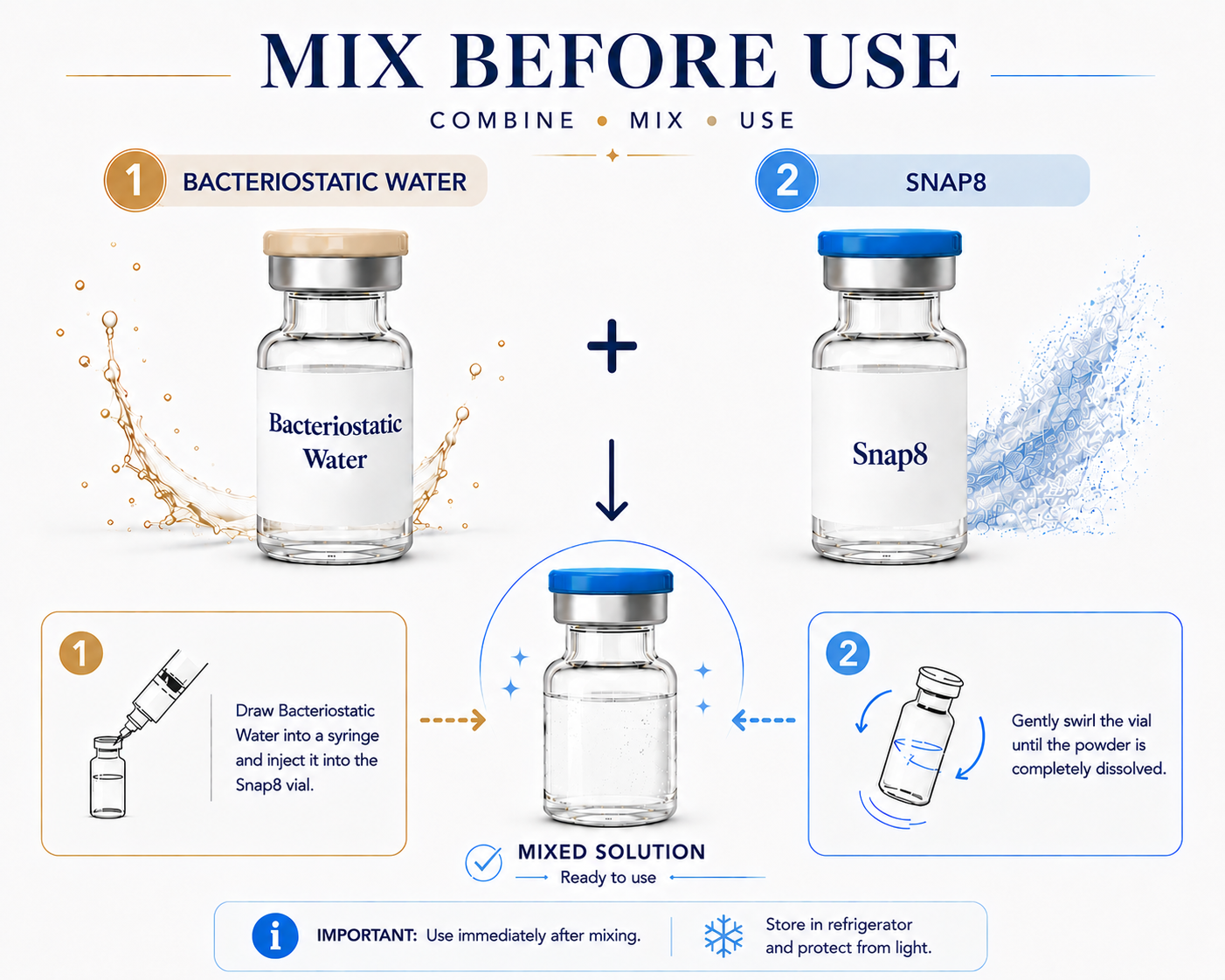
How To Mix Snap-8
1
CleanUse alcohol swabs to clean the tops of both vials.
2
Draw BAC WaterDraw the selected amount of bacteriostatic water.
3
Inject SlowlyAdd the liquid slowly down the side of the vial.
4
Swirl GentlyDo not shake. Swirl gently until dissolved.
5
Store ProperlyStore as directed and protect from heat and light.
Best Practices & Common Mistakes
Best Practices
- Use sterile technique.
- Protect from light and heat.
- Store refrigerated when appropriate.
- Use clean syringe-unit math before measuring.
Common Mistakes
- Confusing milligrams with milliliters.
- Choosing an option with awkward decimal units.
- Using too little liquid for very small measurements.
- Shaking the vial aggressively.
Snap-8 Storage & Handling
Lyophilized Powder: −20°C (−4°F) for long-term storage (up to 24 months). Refrigeration 2–8°C (36–46°F) for short-term use (up to ~3 months). Original sealed vial in the freezer is safest.
Reconstituted Solution: 2–8°C (36–46°F), use within ~7–14 days. Keep sealed, avoid light, and do not repeat freeze-thaw cycles.
Reconstituted Solution: 2–8°C (36–46°F), use within ~7–14 days. Keep sealed, avoid light, and do not repeat freeze-thaw cycles.
Frequently Asked Questions
Snap‑8 was explicitly designed as a topical alternative to botulinum toxin, with an in vivo test protocol using a cream containing 10% Snap‑8 peptide applied twice a week. Your calculator is mechanically correct: it will accurately reconstitute the powder into a sterile solution. However, an injectable route circumvents the peptide's primary safety mechanism, potentially leading to unintended systemic effects. Research suggests that injectable botulinum‑mimetic peptides may trigger local inflammatory reactions or unintended paralysis of adjacent muscle groups, as the peptide can diffuse from the injection site. In 28‑day trials, the maximum wrinkle depth reduction in the topical study was 63%. Your calculator cannot warn you that the same precise dose, when injected, might produce effects far exceeding those seen in the referenced research.
The manufacturer’s data sheet specifies that Snap‑8 exhibits superior formulation stability at pH 5‑6, remaining stable at room temperature for 1‑2 years. Your calculator’s assumption of BAC water (pH ~5.5) is therefore compatible. However, the calculator also assumes complete solubility at any concentration, which is only true within the peptide’s chemical limits. While Snap‑8 is water‑soluble ≥50 mg/mL at 25°C, using a very small BAC volume (e.g., 1 mL for a 50 mg vial) pushes the solution to that upper solubility limit. If the powder fails to dissolve completely or the solution appears cloudy, the calculated dose will be inaccurate. You must visually inspect the reconstituted solution; your calculator cannot detect precipitation at the solubility boundary.
The calculator’s “Doses per vial” count is a pure mathematical construct that assumes indefinite stability. However, the methionine residue in Snap‑8’s amino acid sequence (Ac‑EEMQRRAD‑NH₂) is prone to oxidation, which degrades the peptide over time. In solution, this degradation occurs faster than in the lyophilized state. Supplier guidelines recommend that after reconstitution, the peptide should be stored at 4°C and used within 2‑21 days. Therefore, your calculator’s calculated number of doses may be useless for extended protocols. For long‑term studies, you must freeze the reconstituted solution in single‑use aliquots at ‑18°C immediately after mixing to preserve activity for future use.
The typical research concentration of Snap‑8 is 0.01‑0.05% in cosmetic formulations. Your calculator is ill‑equipped for this, as it is designed for quantifying an absolute mass. A percentage is a ratio (e.g., 0.01% = 0.1 mg/mL). To use your calculator, you must first decide on a target volume for your experiment (e.g., 10 mL of serum). Then, multiply the desired final concentration (in mg/mL) by your chosen total volume to get the required mass. For a 10 mL serum batch at 0.05% (which is 0.5 mg/mL), you would need 5 mg of Snap‑8. This is the number you would enter into your calculator. The concentration‑to‑mg conversion is manual; your calculator does not perform it.
Unlike an agonist that produces a graded response, a competitive inhibitor has a unique dose‑response profile: its effect is determined by the ratio of inhibitor to substrate (the natural SNAP‑25 protein) rather than by the absolute concentration of the inhibitor. Therefore, doubling the dose in your calculator will not necessarily double the biological effect. Instead, the effect plateaus once the inhibitor saturates the available binding sites. The supplier’s research tested a 10% concentration in a cream, which produced a 63% maximum wrinkle reduction. Your calculator might output a mathematically correct dose for a 1% solution, but the biological effect could be negligible if insufficient inhibitor is present to compete with the endogenous SNAP‑25. The calculator cannot predict the minimum effective dose; that must be derived from cell‑free reconstitution experiments that demonstrate competitive inhibition kinetics.
Practical takeaway: If your real goal is weight or metabolic health, the most useful next step is discussing approved treatment options with a clinician rather than relying on an unapproved compound.
Important: This tool is for informational and research-reference purposes only. Not intended for human or veterinary use.