Glutathione Reconstitution Calculator
Enter the amount you want to measure. The vial buttons will highlight which vial strengths create cleaner syringe-unit measurements.
What amount do you need?
Type the target amount, then choose mg or mcg. Example: 2mg or 500mcg.
Syringe size:
Possible vial strengths:
Best Match
Good Match
Usable
Harder to Measure
Example Glutathione Titration Schedule
| Protocol Item | Guidance |
|---|---|
| Dose (per administration) | 100–600 mg per dose |
| Frequency guidance | Typically, smaller doses are used for more frequent dosing, while larger doses are used for less frequent dosing. |
| Cycling | 1–3× per week for ~1 month; can be extended up to 3–4 months, with a 1-month minimum cycle break between. |
| Adjustments | Cycle length and intensity depend on response and goal. |
Possible vial strengths:
What Is It?
Glutathione
Tripeptide antioxidant used in cosmetic research.
Bacteriostatic Water
Sterile water containing a bacteriostatic preservative, commonly used when preparing multi-use research vials.
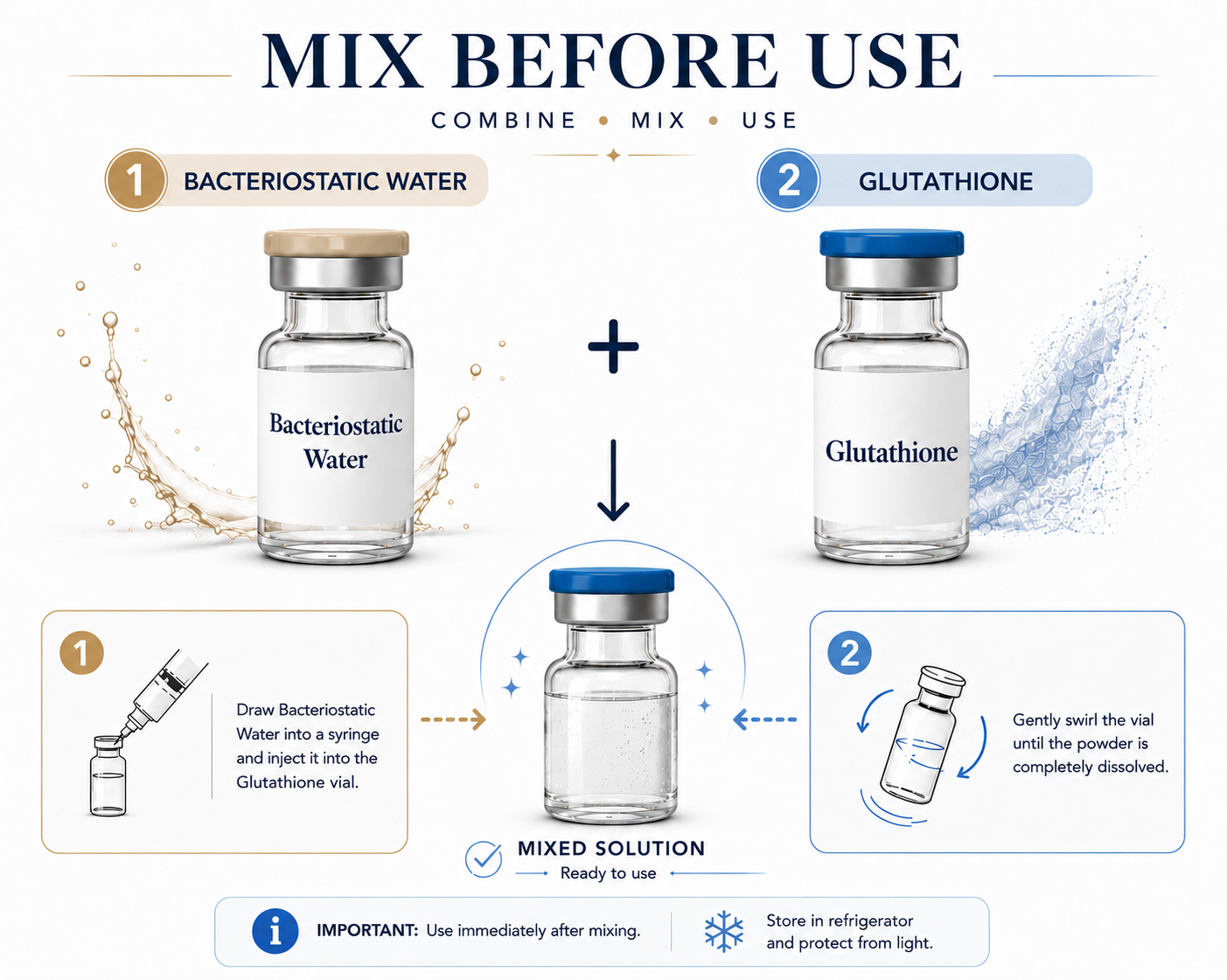
How To Mix Glutathione
1
CleanUse alcohol swabs to clean the tops of both vials.
2
Draw BAC WaterDraw the selected amount of bacteriostatic water.
3
Inject SlowlyAdd the liquid slowly down the side of the vial.
4
Swirl GentlyDo not shake. Swirl gently until dissolved.
5
Store ProperlyStore as directed and protect from heat and light.
Best Practices & Common Mistakes
Best Practices
- Use sterile technique.
- Protect from light and heat.
- Store refrigerated when appropriate.
- Use clean syringe-unit math before measuring.
Common Mistakes
- Confusing milligrams with milliliters.
- Choosing an option with awkward decimal units.
- Using too little liquid for very small measurements.
- Shaking the vial aggressively.
Glutathione Storage & Handling
Lyophilized Powder: −20°C (−4°F) for long-term storage (up to 24 months). Refrigeration 2–8°C (36–46°F) for short-term use (up to ~3 months). Original sealed vial in the freezer is safest.
Reconstituted Solution: 2–8°C (36–46°F), use within ~7–14 days. Keep sealed, avoid light, and do not repeat freeze-thaw cycles.
Reconstituted Solution: 2–8°C (36–46°F), use within ~7–14 days. Keep sealed, avoid light, and do not repeat freeze-thaw cycles.
Frequently Asked Questions
Your calculator treats all peptides as simple powders. However, GSH is the biologically active form and is easily oxidized to GSSG by air, light, or elevated pH. GSH is soluble in water, giving a clear, colourless solution, while GSSG is more stable but less active. A yellow tint or cloudiness suggests partial oxidation to GSSG, which still contributes to the total mass but has different biological activity. Your calculator will correctly compute concentration and units based on the mass you enter, but it cannot warn you about this redox chemistry. If oxidation is a concern, consider using a buffer with a pH between 5.0 and 8.0, as described in extended‑storage patents.
The calculator assumes full potency for the entire content of the vial. For glutathione, the compound is indeed “unstable in solutions,” and many suppliers advise that “freshly prepared is recommended”. In lyophilised form, glutathione can be stable for up to 36 months, but once reconstituted, it must be stored at −20 °C and used within one to three months to prevent loss of potency. If you plan to use a single vial over several days or weeks, you should aliquot the solution immediately after reconstitution and freeze the aliquots at −20 °C. The calculator’s “Doses per vial” display is a mathematical maximum, not a guarantee of full activity for that number of doses.
For a 1500 mg vial, a protocol that uses 5 mL of BAC water gives a concentration of 300 mg/mL, which is still very high but has been used with daily doses of 100–200 mg (approx. 33–67 units on a U‑100 syringe). Your calculator will allow this combination. If you use only 1 mL of water, the calculator will still show the resulting concentration, but you must verify that such a concentrated solution (1500 mg/mL) is physically manageable and does not precipitate. Glutathione has a solubility of about 41 mg/mL in water. A 1500 mg/mL concentration would far exceed this and would likely be impossible to achieve. Your calculator does not check solubility limits – you must ensure that the concentration you derive does not exceed the peptide’s known solubility.
Bacteriostatic water typically has a pH around 5.0‑5.5, which falls within the acceptable range for GSH stability. However, some research-grade glutathione preparations include sodium bicarbonate to neutralise the solution, raising the pH closer to 7.4, which may further enhance stability. The calculator is solvent‑agnostic; it only uses the volume you enter. If you wish to adjust the pH, you can do so before adding the BAC water to the vial. However, be aware that adding sodium bicarbonate will change the volume and concentration, so you must account for the added liquid.
Mannitol is a bulking agent, often included in lyophilised glutathione formulations to improve the physical structure of the freeze‑dried cake and to protect the peptide during lyophilisation. The total mass of the solid in the vial is the sum of the active peptide plus the mannitol. The manufacturer will state the active peptide mass (e.g., “1500 mg glutathione”) separately from the total fill weight. You should only enter the active peptide mass into your calculator. Adding extra mass from mannitol would incorrectly increase the calculated concentration and dose. If the label does not specify the active content, contact the supplier before using the calculator.
Practical takeaway: If your real goal is weight or metabolic health, the most useful next step is discussing approved treatment options with a clinician rather than relying on an unapproved compound.
Important: This tool is for informational and research-reference purposes only. Not intended for human or veterinary use.