Copper Tripeptide-1 Reconstitution Calculator
Enter the amount you want to measure. The vial buttons will highlight which vial strengths create cleaner syringe-unit measurements.
What amount do you need?
Type the target amount, then choose mg or mcg. Example: 2mg or 500mcg.
Syringe size:
Possible vial strengths:
Best Match
Good Match
Usable
Harder to Measure
Example Copper Tripeptide-1 Titration Schedule
| Parameter | Details |
|---|---|
| Dosage | 1–3 mg per day (typically 1–2 mg) |
| Route | Subcutaneous (SC) |
| Frequency | Daily or every other day |
| Cycle Length | 4–8 weeks, followed by 4 weeks off |
| Half‑life | 0.5–1 hour |
| Reconstitution | Use bacteriostatic water (preferred for multi-use) or sterile water; final concentration 1–10 mg/mL |
Possible vial strengths:
What Is It?
Copper Tripeptide-1
GHK-Cu cosmetic copper peptide.
Bacteriostatic Water
Sterile water containing a bacteriostatic preservative, commonly used when preparing multi-use research vials.
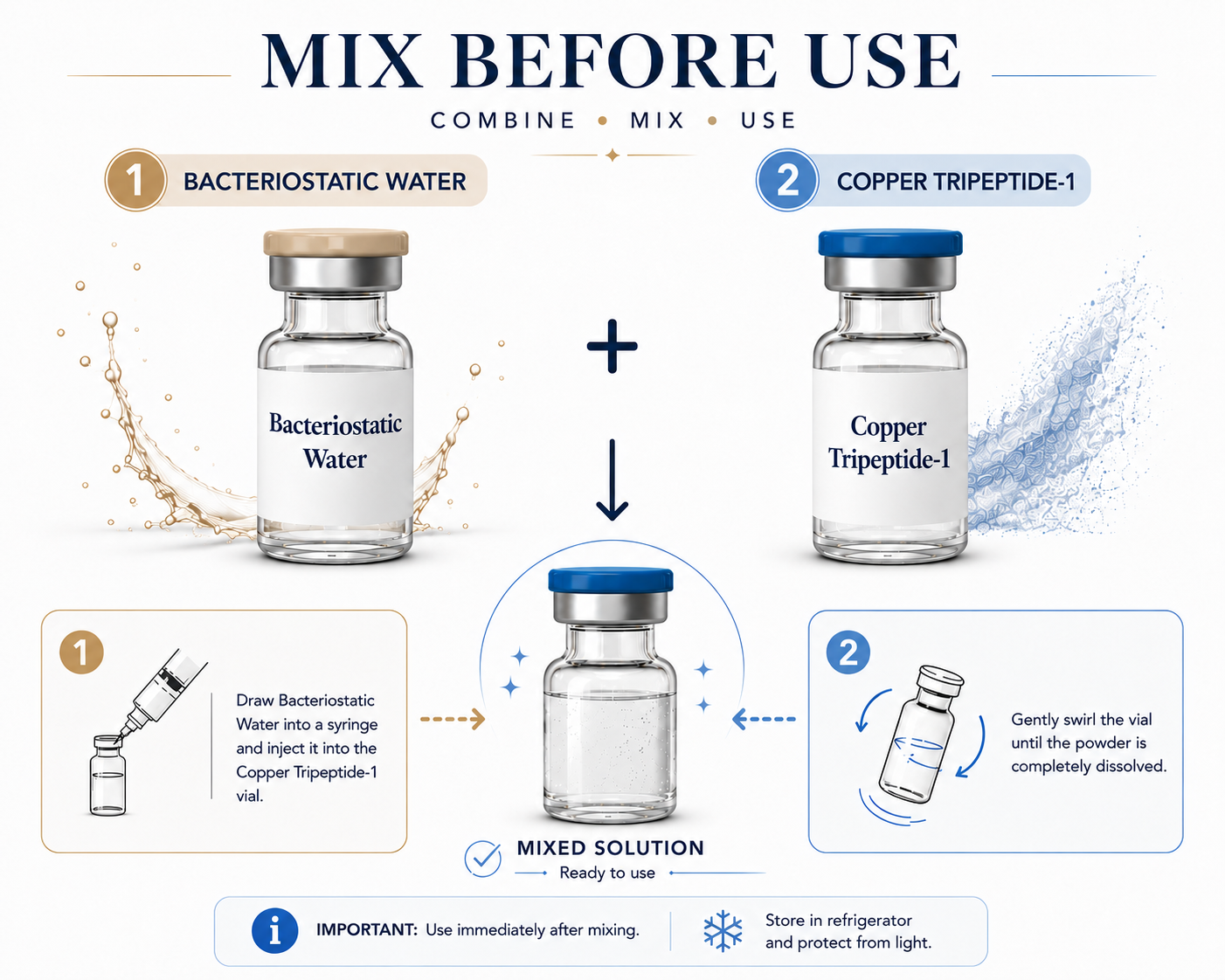
How To Mix Copper Tripeptide-1
1
CleanUse alcohol swabs to clean the tops of both vials.
2
Draw BAC WaterDraw the selected amount of bacteriostatic water.
3
Inject SlowlyAdd the liquid slowly down the side of the vial.
4
Swirl GentlyDo not shake. Swirl gently until dissolved.
5
Store ProperlyStore as directed and protect from heat and light.
Best Practices & Common Mistakes
Best Practices
- Use sterile technique.
- Protect from light and heat.
- Store refrigerated when appropriate.
- Use clean syringe-unit math before measuring.
Common Mistakes
- Confusing milligrams with milliliters.
- Choosing an option with awkward decimal units.
- Using too little liquid for very small measurements.
- Shaking the vial aggressively.
Copper Tripeptide-1 Storage & Handling
Lyophilized Powder: −20°C (−4°F) for long-term storage (up to 24 months). Refrigeration 2–8°C (36–46°F) for short-term use (up to ~3 months). Original sealed vial in the freezer is safest.
Reconstituted Solution: 2–8°C (36–46°F), use within ~7–14 days. Keep sealed, avoid light, and do not repeat freeze-thaw cycles.
Reconstituted Solution: 2–8°C (36–46°F), use within ~7–14 days. Keep sealed, avoid light, and do not repeat freeze-thaw cycles.
Frequently Asked Questions
No, the blue colour is not a defect — it's a built‑in diagnostic feature. The GHK‑Cu complex is blue because it contains copper(II) ions, and the colour serves two important practical roles. First, it confirms that the copper is still bound to the peptide; a colourless solution would indicate that the complex has degraded. Second, the intensity of the blue correlates with concentration, giving you an instant visual check of proper dissolution without needing spectrophotometry.
Because its pharmacokinetics can't be generalised. The plasma half‑life of GHK‑Cu after subcutaneous injection is roughly 1.5 hours, but biological effects on tissue remodelling take 2–4 weeks of consistent exposure to appear. This means the short half‑life drives dosing frequency, while your biological endpoint drives cycle length — two separate parameters your calculator can't predict.
Injection pain. Because the copper ion reversibly dissociates from the peptide, free copper ions directly irritate nerve endings and trigger mast cells to release histamine, causing local inflammation. Additionally, reconstituted GHK‑Cu often has a pH outside the physiological range of ~7.4. Your calculator has no knowledge of the underlying chemistry that causes this well‑documented side effect.
No, but zinc depletion is the real risk, not copper overload. Copper and zinc compete for the same absorption pathways in the body. When you increase copper levels via GHK‑Cu injection, your body naturally purges zinc to maintain equilibrium. To prevent a symptomatic zinc deficiency (metallic taste, brain fog, lethargy, lowered immunity, and even hair shedding), users must supplement with 15‑30 mg of zinc daily (zinc picolinate or glycinate, not oxide). Your calculator does not and cannot recommend co‑administration of zinc supplements.
No. The blue precipitate indicates that the copper has dissociated from the peptide and formed insoluble copper salts. This is triggered by several factors: exposure to chelators like EDTA (which has a stronger affinity for copper than the peptide does), light, oxygen, or pH drift below 4.5 or above 7.4. Your calculator's generic 28‑day refrigerator stability number is not a guarantee of chemical integrity; the GHK‑Cu complex is far more fragile in solution than many other peptides, and the appearance of any visible blue particles means the active complex has been destroyed.
Practical takeaway: If your real goal is weight or metabolic health, the most useful next step is discussing approved treatment options with a clinician rather than relying on an unapproved compound.
Important: This tool is for informational and research-reference purposes only. Not intended for human or veterinary use.