Melanotan 2 Reconstitution Calculator
Enter the amount you want to measure. The vial buttons will highlight which vial strengths create cleaner syringe-unit measurements.
What amount do you need?
Type the target amount, then choose mg or mcg. Example: 2mg or 500mcg.
Syringe size:
Possible vial strengths:
Best Match
Good Match
Usable
Harder to Measure
Example Melanotan 2 Titration Schedule
| Phase | Dose | Cycling / Frequency |
|---|---|---|
| Loading Phase | 200–300 mcg per dose | Daily until desired pigmentation (skin tone) is reached |
| Maintenance Phase | 50–100 mcg per dose | |
| Use-Pattern | Dose | Cycling / Timing |
| Metabolic Support | 50–100 mcg per dose | Daily for up to 1–4 months, with a 1-month minimum cycle break between (frequency/amount varies by goal and individual reaction) |
| Sexual Stimulation | 200–1000 mcg per dose | Ideally 30–60 minutes before intercourse |
Possible vial strengths:
What Is It?
Melanotan 2
Melanocortin agonist studied for pigmentation.
Bacteriostatic Water
Sterile water containing a bacteriostatic preservative, commonly used when preparing multi-use research vials.
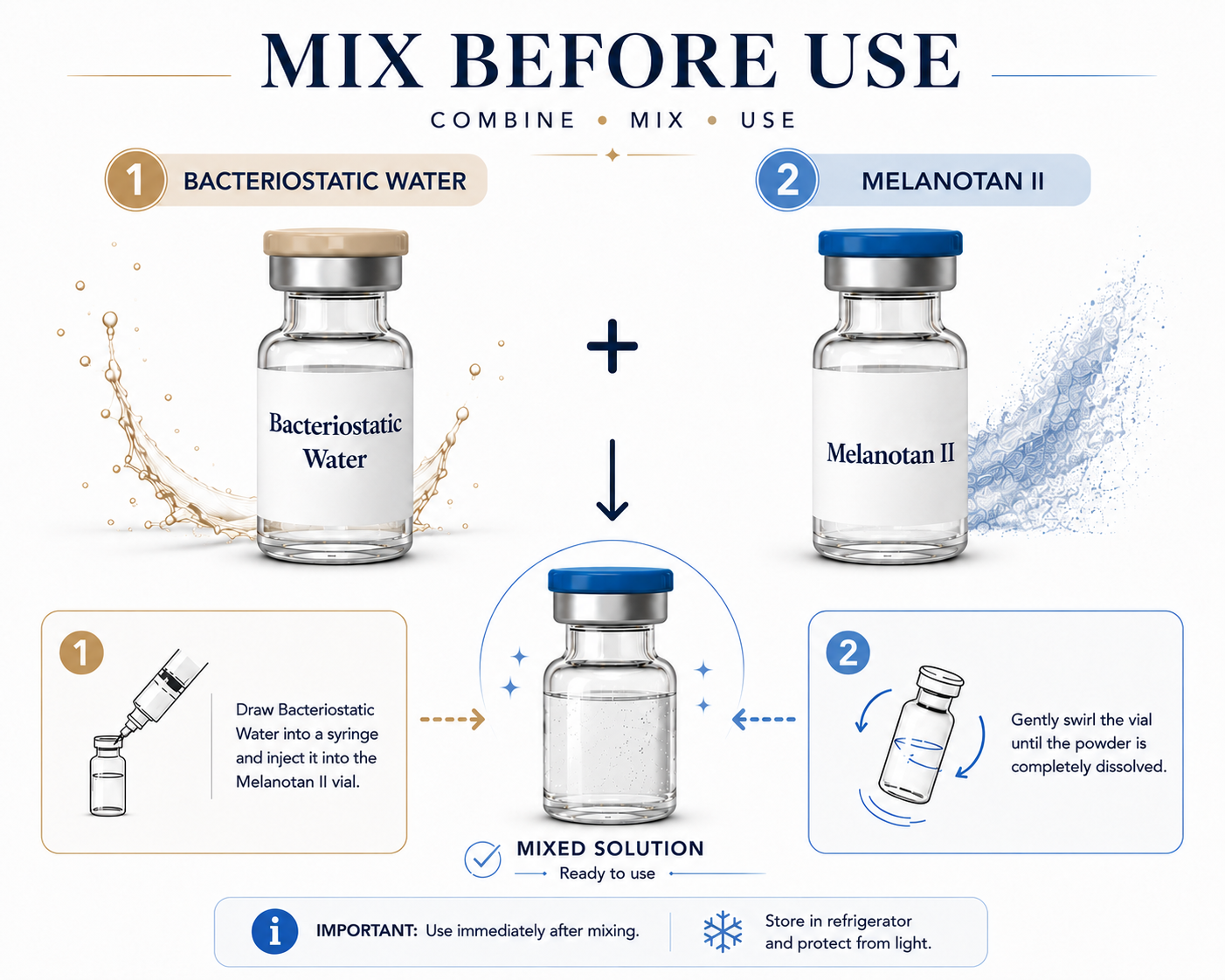
How To Mix Melanotan 2
1
CleanUse alcohol swabs to clean the tops of both vials.
2
Draw BAC WaterDraw the selected amount of bacteriostatic water.
3
Inject SlowlyAdd the liquid slowly down the side of the vial.
4
Swirl GentlyDo not shake. Swirl gently until dissolved.
5
Store ProperlyStore as directed and protect from heat and light.
Best Practices & Common Mistakes
Best Practices
- Use sterile technique.
- Protect from light and heat.
- Store refrigerated when appropriate.
- Use clean syringe-unit math before measuring.
Common Mistakes
- Confusing milligrams with milliliters.
- Choosing an option with awkward decimal units.
- Using too little liquid for very small measurements.
- Shaking the vial aggressively.
Melanotan 2 Storage & Handling
Lyophilized Powder: −20°C (−4°F) for long-term storage (up to 24 months). Refrigeration 2–8°C (36–46°F) for short-term use (up to ~3 months). Original sealed vial in the freezer is safest.
Reconstituted Solution: 2–8°C (36–46°F), use within ~7–14 days. Keep sealed, avoid light, and do not repeat freeze-thaw cycles.
Reconstituted Solution: 2–8°C (36–46°F), use within ~7–14 days. Keep sealed, avoid light, and do not repeat freeze-thaw cycles.
Frequently Asked Questions
The lactam bridge between Asp⁵ and Lys¹⁰ is a key feature of the MT‑II molecule. This cyclic structure has two direct implications when you use the calculator. First, it makes the peptide much more resistant to enzymatic degradation than linear α‑MSH analogs; studies report >99% stability in rat brain homogenate compared to the linear version. This increased stability means that your reconstituted solution is likely to remain potent for the full 2‑7 days at 4 °C, reducing the risk of active degradation as a source of error.
The general solubility guideline for Melanotan‑II is ≥100 µg/mL for full dissolution in water. Your calculator’s 5 mL volume for a 10 mg vial yields 2 mg/mL, which is 20‑fold higher than the minimum. This concentration is well above the threshold and falls squarely within the manufacturer’s "Soluble in water, 5 mg/mL" range. However, pH‑dependent solubility is not accounted for by your calculator. The peptide’s solubility drops near its pKa₁ (histidine, ~6.54), but increases sharply below this pH. The research‑confirmed method for concentrated solutions (e.g., 10‑20 mg/mL) involves first dissolving in 10% acetic acid to lower the pH. If your research protocol requires a high‑concentration solution that your calculator suggests, you must verify whether plain water will work, as your calculator makes no distinction.
Your calculator is designed for subcutaneous injection and assumes close to 100% bioavailability. If your research involves oral delivery, the required dose changes dramatically: a subcutaneous dose of 0.025 mg/kg/day might need to be increased 5‑ to 20‑fold to achieve equivalent circulating levels. Your calculator cannot adjust for this route‑specific loss. Notably, the calculated oral bioavailability of 4.6% in rats was sufficient to lead researchers to conclude that MT‑II may be a suitable candidate for oral delivery. If you enter a subcutaneous‑derived dose into your calculator but then use an oral route, you will vastly under‑dose the target.
The free‑base molecular weight of Melanotan‑II is 1024.18 g/mol, but the acetate salt’s molecular weight is higher, typically ~1084.23 g/mol. If your vial contains the acetate salt, it will include more inert mass for the same peptide content. A 10 mg vial labeled "Melanotan‑II Acetate" contains less than 10 mg of the active peptide core, roughly 0.94 mg equivalent per 1 mg. Your calculator cannot know which salt form you have. If you enter the total vial mass as if it were free base, you will systematically under‑dose the peptide. Always check the Certificate of Analysis (CoA) and, if the salt form is specified, adjust the entered mg to reflect the active peptide content.
Your calculator assumes that if you enter 40 μg/kg in the desired dose field, the effect will be roughly twice that of 20 μg/kg. In the sciatic nerve study, the 50 μg/kg dose was ineffective, while the 20 μg/kg dose was effective. This inverted U‑shaped dose‑response curve is typical for melanocortin receptor agonists, where supra‑optimal doses can be deleterious or inactive. The calculator will faithfully output a larger volume for the 50 μg/kg dose, but the biological effect will not be larger. For Melanotan‑II, you must determine the optimum dose from the literature and not rely on the calculator’s assumption that "more peptide equals more effect".
Practical takeaway: If your real goal is weight or metabolic health, the most useful next step is discussing approved treatment options with a clinician rather than relying on an unapproved compound.
Important: This tool is for informational and research-reference purposes only. Not intended for human or veterinary use.