Matrixyl Reconstitution Calculator
Enter the amount you want to measure. The vial buttons will highlight which vial strengths create cleaner syringe-unit measurements.
What amount do you need?
Type the target amount, then choose mg or mcg. Example: 2mg or 500mcg.
Syringe size:
Possible vial strengths:
Best Match
Good Match
Usable
Harder to Measure
Example Matrixyl Titration Schedule
| Parameter | Details |
|---|---|
| Typical Concentration | 3% to 8% (clinical standard is 3%) |
| Frequency | Once or twice daily |
| Cycle Length | At least 4–8 weeks; visible results typically observed after 4 weeks of consistent use |
| Route | Topical (serum, cream, or eye mask) applied to clean, dry skin |
| Stability | Reconstituted solution stable for up to 28 days when stored at 2–8°C (refrigerated) under sterile conditions; it is most stable between pH 4.0 and 7.0 |
Possible vial strengths:
What Is It?
Matrixyl
Palmitoyl pentapeptide for cosmetic research.
Bacteriostatic Water
Sterile water containing a bacteriostatic preservative, commonly used when preparing multi-use research vials.
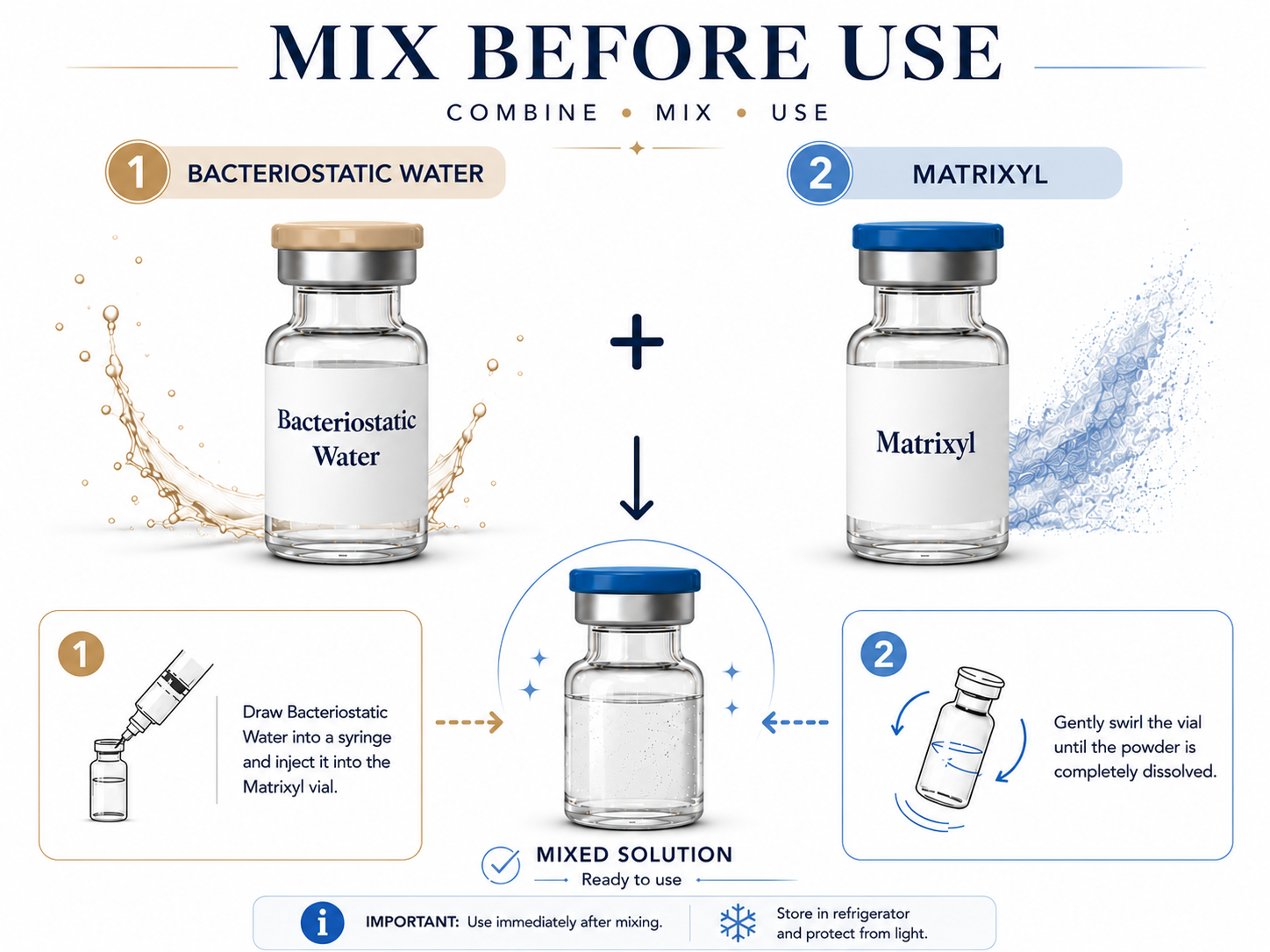
How To Mix Matrixyl
1
CleanUse alcohol swabs to clean the tops of both vials.
2
Draw BAC WaterDraw the selected amount of bacteriostatic water.
3
Inject SlowlyAdd the liquid slowly down the side of the vial.
4
Swirl GentlyDo not shake. Swirl gently until dissolved.
5
Store ProperlyStore as directed and protect from heat and light.
Best Practices & Common Mistakes
Best Practices
- Use sterile technique.
- Protect from light and heat.
- Store refrigerated when appropriate.
- Use clean syringe-unit math before measuring.
Common Mistakes
- Confusing milligrams with milliliters.
- Choosing an option with awkward decimal units.
- Using too little liquid for very small measurements.
- Shaking the vial aggressively.
Matrixyl Storage & Handling
Lyophilized Powder: −20°C (−4°F) for long-term storage (up to 24 months). Refrigeration 2–8°C (36–46°F) for short-term use (up to ~3 months). Original sealed vial in the freezer is safest.
Reconstituted Solution: 2–8°C (36–46°F), use within ~7–14 days. Keep sealed, avoid light, and do not repeat freeze-thaw cycles.
Reconstituted Solution: 2–8°C (36–46°F), use within ~7–14 days. Keep sealed, avoid light, and do not repeat freeze-thaw cycles.
Frequently Asked Questions
No. Matrixyl’s 25+ years of data are based on topical application, not injection. The palmitoyl tail is designed for skin penetration, not systemic bioavailability. Using the calculator’s injection volume for a non‑validated route is experimental and carries unknown risks.
Matrixyl contains Palmitoyl Tripeptide‑1 (MW ~463) and Palmitoyl Tetrapeptide‑7 (MW ~623). The calculator sees one mass. If you enter the total vial weight, you cannot know the individual concentration of each component, making accurate dosing for either pathway impossible.
Matrixyl is only sparingly soluble in plain water. The standard formulation is 3% in a cream vehicle, not an aqueous solution. In water, the C16 fatty acid tail causes aggregation and cloudiness. Your calculator’s solubility assumption is likely wrong.
No. The lyophilized powder is stable for years at -20°C, but once dissolved, the palmitoyl chain promotes aggregation within days. Most suppliers recommend using the solution immediately and discarding after 2–7 days at 4°C. The 28‑day default will degrade your peptide.
No. Palmitoyl Tripeptide‑1 stimulates collagen via TGF‑β, while Palmitoyl Tetrapeptide‑7 reduces IL‑6. These pathways saturate at different concentrations. The calculator’s linear scaling cannot predict when one effect plateaus while the other continues.
Practical takeaway: If your real goal is weight or metabolic health, the most useful next step is discussing approved treatment options with a clinician rather than relying on an unapproved compound.
Important: This tool is for informational and research-reference purposes only. Not intended for human or veterinary use.