Klow (Acetyl peptide blend) Reconstitution Calculator
Enter the amount you want to measure. The vial buttons will highlight which vial strengths create cleaner syringe-unit measurements.
What amount do you need?
Type the target amount, then choose mg or mcg. Example: 2mg or 500mcg.
Syringe size:
Possible vial strengths:
Best Match
Good Match
Usable
Harder to Measure
Example Klow (Acetyl peptide blend) Titration Schedule
| Protocol Option | Total Daily Dose (Blend) | Volume @ 3.0 mL (≈26.7 mg/mL) | Volume @ 4.0 mL (20 mg/mL) |
|---|---|---|---|
| Conservative start | 200–250 mcg (0.20–0.25 mg) | ~0.0075–0.0094 mL (0.75–0.94U) | 0.010–0.0125 mL (1.0–1.25U) |
| Standard range | 2.5–4.0 mg | ~0.094–0.150 mL (9.4–15U) | 0.125–0.200 mL (12.5–20U) |
| Optional loading phase* | 8.0 mg daily | ~0.300 mL (30U) | 0.400 mL (40U) |
Possible vial strengths:
What Is It?
Klow (Acetyl peptide blend)
Cosmetic peptide blend.
Bacteriostatic Water
Sterile water containing a bacteriostatic preservative, commonly used when preparing multi-use research vials.
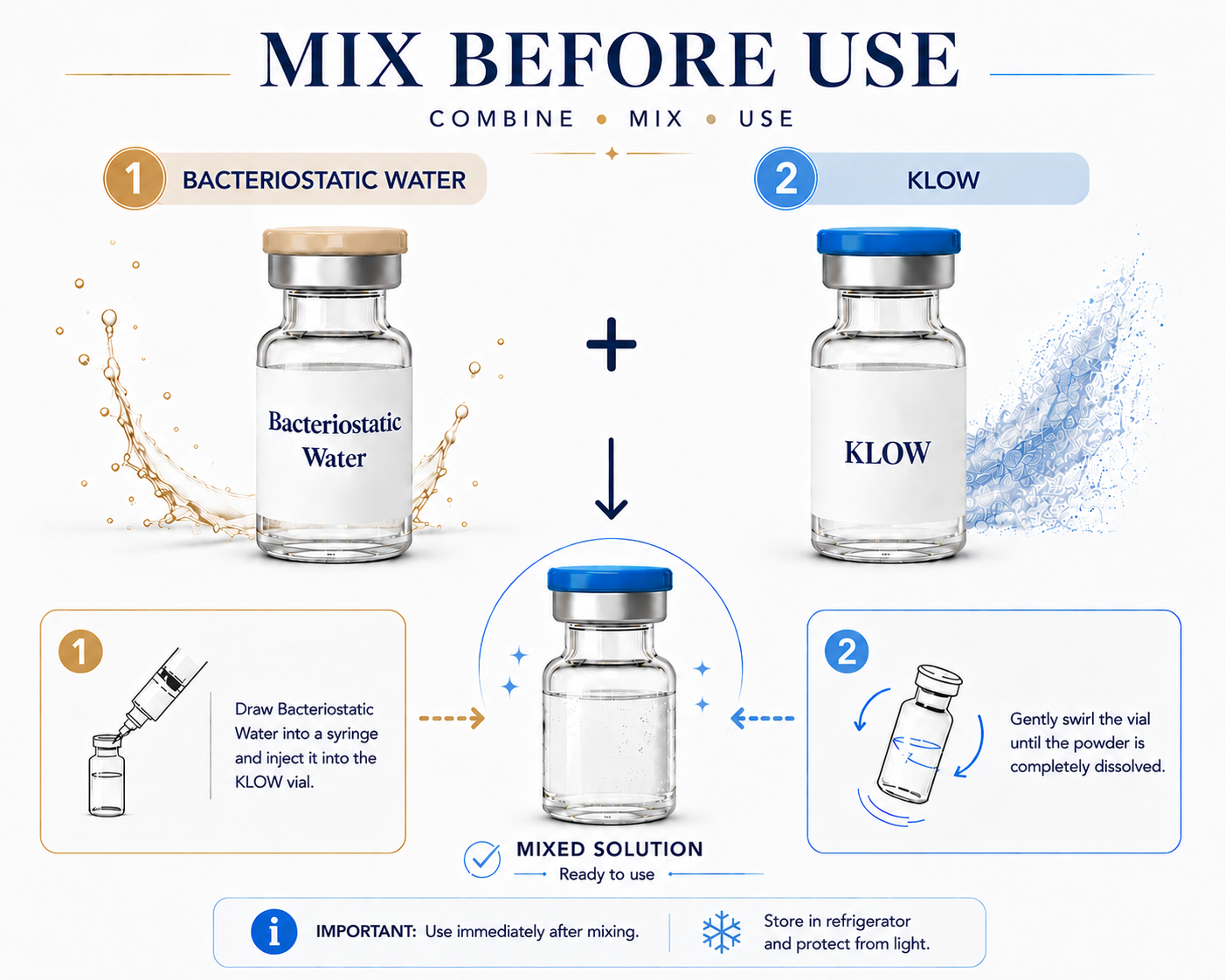
How To Mix Klow (Acetyl peptide blend)
1
CleanUse alcohol swabs to clean the tops of both vials.
2
Draw BAC WaterDraw the selected amount of bacteriostatic water.
3
Inject SlowlyAdd the liquid slowly down the side of the vial.
4
Swirl GentlyDo not shake. Swirl gently until dissolved.
5
Store ProperlyStore as directed and protect from heat and light.
Best Practices & Common Mistakes
Best Practices
- Use sterile technique.
- Protect from light and heat.
- Store refrigerated when appropriate.
- Use clean syringe-unit math before measuring.
Common Mistakes
- Confusing milligrams with milliliters.
- Choosing an option with awkward decimal units.
- Using too little liquid for very small measurements.
- Shaking the vial aggressively.
Klow (Acetyl peptide blend) Storage & Handling
Lyophilized Powder: −20°C (−4°F) for long-term storage (up to 24 months). Refrigeration 2–8°C (36–46°F) for short-term use (up to ~3 months). Original sealed vial in the freezer is safest.
Reconstituted Solution: 2–8°C (36–46°F), use within ~7–14 days. Keep sealed, avoid light, and do not repeat freeze-thaw cycles.
Reconstituted Solution: 2–8°C (36–46°F), use within ~7–14 days. Keep sealed, avoid light, and do not repeat freeze-thaw cycles.
Frequently Asked Questions
Your calculator is optimized for single peptides where you can use very small BAC volumes (1‑2mL) to get highly concentrated solutions. With the 80mg KLOW blend, most suppliers specifically instruct to add 3.0mL bacteriostatic water. This 3.0mL volume lowers the total concentration to ~26.7 mg/mL, which ensures that each individual component stays below its upper solubility limit in the solution. If you follow your calculator’s advice and use just 1mL, you might exceed GHK‑Cu’s solubility, causing cloudy solution and precipitation, which spoils the entire vial.
Your calculator is correct that 80mg total peptide ÷ 3mL BAC = 26.7 mg/mL total. But GHK‑Cu makes up the bulk of that: after 3mL reconstitution, the blend provides GHK‑Cu at ~16.7 mg/mL and TB‑500, BPC‑157, and KPV each at ~3.33 mg/mL. This means 1 unit (0.01mL) from a U‑100 syringe contains approximately 167 mcg of GHK‑Cu and only about 33 mcg of each of the other three peptides.
Klow uses a lyophilized powder that mixes GHK‑Cu with other peptides. The characteristic blue color comes from the copper ion in GHK‑Cu. If you add 3.0mL BAC water according to directions and the solution remains colorless or pale, it strongly suggests incomplete mixing or precipitation of GHK‑Cu rather than dissolution of the entire 80mg mass. Your calculator cannot detect this, but it will still return the calculated 26.7 mg/mL total. A clear blue solution is expected; anything else means you cannot trust the calculated values.
This is an inherent limitation of fixed‑ratio blends. If you increase your total injected volume to get more of one peptide, you automatically increase GHK‑Cu proportionally as well. The calculator doesn't know the ratio, so it treats the whole vial as an undifferentiated mass. To work around this, you must know the per‑unit value of each component (as in question 2) and calculate the specific dose of each that any total volume gives you. For true flexibility, you would need separate vials of each peptide.
An 80mg KLOW vial reconstituted with 3.0mL yields 26.7 mg total peptide per mL. If your protocol uses a typical 0.2mL (20‑unit) daily injection, each injection delivers about 5.34 mg total, and a single vial gives about 15 daily doses (80 ÷ 5.34 ≈ 15). For an 8‑16 week course, you will need multiple vials (e.g., ~4 vials for 8 weeks, ~8 vials for 16 weeks), not just one or two. Plan to reconstitute a fresh vial every 2 weeks and restock your supplies according to the weekly total volume requirement to avoid running out mid‑study.
Practical takeaway: If your real goal is weight or metabolic health, the most useful next step is discussing approved treatment options with a clinician rather than relying on an unapproved compound.
Important: This tool is for informational and research-reference purposes only. Not intended for human or veterinary use.