Klow8 Reconstitution Calculator
Enter the amount you want to measure. The vial buttons will highlight which vial strengths create cleaner syringe-unit measurements.
What amount do you need?
Type the target amount, then choose mg or mcg. Example: 2mg or 500mcg.
Syringe size:
Possible vial strengths:
Best Match
Good Match
Usable
Harder to Measure
Example Klow8 Titration Schedule
| Protocol Option | Total Daily Dose (Blend) | Volume @ 3.0 mL (≈26.7 mg/mL) | Volume @ 4.0 mL (20 mg/mL) |
|---|---|---|---|
| Conservative start | 200–250 mcg (0.20–0.25 mg) | ~0.0075–0.0094 mL (0.75–0.94U) | 0.010–0.0125 mL (1.0–1.25U) |
| Standard range | 2.5–4.0 mg | ~0.094–0.150 mL (9.4–15U) | 0.125–0.200 mL (12.5–20U) |
| Optional loading phase* | 8.0 mg daily | ~0.300 mL (30U) | 0.400 mL (40U) |
Possible vial strengths:
What Is It?
Klow8
Variant of klow cosmetic blend.
Bacteriostatic Water
Sterile water containing a bacteriostatic preservative, commonly used when preparing multi-use research vials.
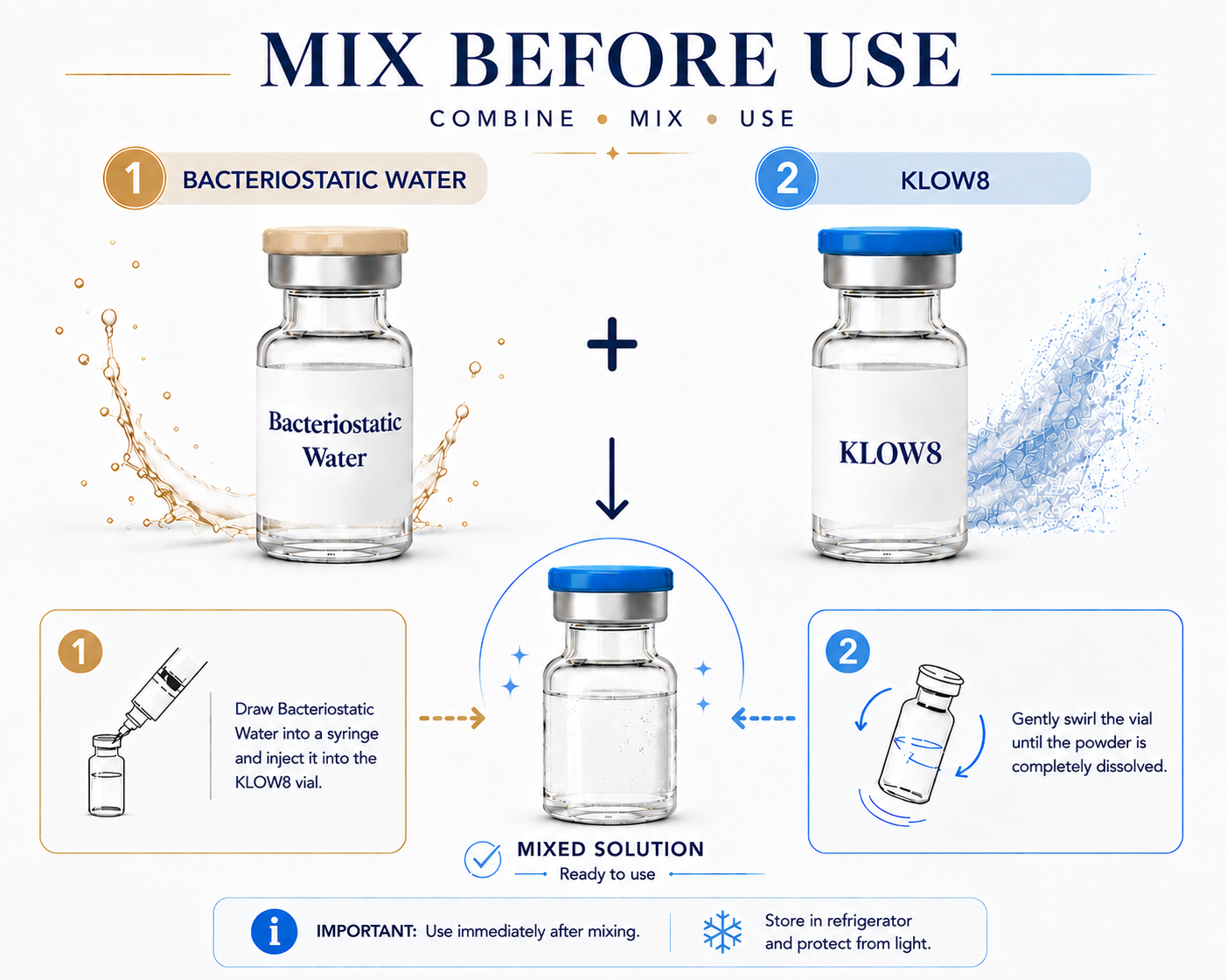
How To Mix Klow8
1
CleanUse alcohol swabs to clean the tops of both vials.
2
Draw BAC WaterDraw the selected amount of bacteriostatic water.
3
Inject SlowlyAdd the liquid slowly down the side of the vial.
4
Swirl GentlyDo not shake. Swirl gently until dissolved.
5
Store ProperlyStore as directed and protect from heat and light.
Best Practices & Common Mistakes
Best Practices
- Use sterile technique.
- Protect from light and heat.
- Store refrigerated when appropriate.
- Use clean syringe-unit math before measuring.
Common Mistakes
- Confusing milligrams with milliliters.
- Choosing an option with awkward decimal units.
- Using too little liquid for very small measurements.
- Shaking the vial aggressively.
Klow8 Storage & Handling
Lyophilized Powder: −20°C (−4°F) for long-term storage (up to 24 months). Refrigeration 2–8°C (36–46°F) for short-term use (up to ~3 months). Original sealed vial in the freezer is safest.
Reconstituted Solution: 2–8°C (36–46°F), use within ~7–14 days. Keep sealed, avoid light, and do not repeat freeze-thaw cycles.
Reconstituted Solution: 2–8°C (36–46°F), use within ~7–14 days. Keep sealed, avoid light, and do not repeat freeze-thaw cycles.
Frequently Asked Questions
The standard Klow8 ratio is 5 : 1 : 1 for GHK‑Cu, BPC‑157, and TB‑500, but some suppliers may replace the filler with more GHK‑Cu. Under the hood, your calculator treats the whole vial as one blob; it has no idea that tweaking one ingredient’s amount silently changes the others. If the blend shifts from 50/10/10 to 60/10/10, the same syringe volume will still accurately contain 60 mg of GHK‑Cu, but your records and assumptions about the intended ratio will be wrong. Always check the Certificate of Analysis (CoA) and adjust your calculator’s total peptide mass to match the real 60/10/10 composition.
KPV is known to cause severe turbidity during reconstitution when used alone. In the Klow8 blend, the combination of GHK‑Cu, BPC‑157, TB‑500, and KPV creates a synergistic solubility cascade. What usually requires 2–3 mL for a single peptide may dissolve instantly with 1.5–2 mL in the blend. Your calculator can’t predict this, nor will it warn you when less diluent is safe. The practical takeaway: you can often use a smaller BAC volume than expected, but you should still test clarity before injection.
The classic deep blue hue of GHK‑Cu is due to the copper ion coordinated by the peptide backbone. If your Klow8 solution is pale blue or colourless immediately after mixing, the pH of your BAC water may have drifted (sterile water for injection is more acidic than bacteriostatic water), the vial was stored above −20 °C for too long, or you used an older glass syringe that leached metal ions. Your calculator is completely blind to these visual clues; you must decide if the solution is usable based on colour and clarity.
The calculator gives you a best‑case total number of doses, assuming the peptide remains 100 % potent from day one to the last injection. In reality, Klow8 loses ~2–4 % potency per day at 4 °C, and more if the vial is repeatedly warmed to room temperature. You can create a log with daily entries: multiply the remaining volume by today’s degradation factor (e.g., 0.96) to estimate the remaining active mass. That gives you a true picture far more accurate than the calculator’s static count.
The original GLOW stack (GHK‑Cu + BPC‑157 + TB‑500) is known for moderate injection site burning. Adding KPV (as in KLOW) reduces pain slightly, but Klow8 removes KPV, bringing back the original GHK‑Cu sting. Since your calculator defaults to subcutaneous administration, you can reduce the concentration by adding 20–30 % more BAC water than the calculator suggests. For example, if the calculator says 2 mL, use 2.5 mL. The peptide content stays the same, but the larger volume makes the injection significantly less painful.
Practical takeaway: If your real goal is weight or metabolic health, the most useful next step is discussing approved treatment options with a clinician rather than relying on an unapproved compound.
Important: This tool is for informational and research-reference purposes only. Not intended for human or veterinary use.