SLU-PP-332 Reconstitution Calculator
Enter the amount you want to measure. The vial buttons will highlight which vial strengths create cleaner syringe-unit measurements.
What amount do you need?
Type the target amount, then choose mg or mcg. Example: 2mg or 500mcg.
Syringe size:
Possible vial strengths:
Best Match
Good Match
Usable
Harder to Measure
Example SLU-PP-332 Titration Schedule
📋 SLU-PP-332 Dosage & Usage Protocol Summary
Context / Use Case Typical Dosage Route / Form Frequency Duration / Notes
Preclinical (mice) – General study 50 mg/kg body weight Intraperitoneal (i.p.) injection Twice daily Acute to 28 days
Preclinical (mice) – Muscle‑specific gene study 25 mg/kg body weight Intraperitoneal (i.p.) injection Twice daily As per protocol
Human (informal / biohacking) – Starting dose 100 mcg Oral (capsule or solution) Twice daily (pre‑exercise & evening) Titrate based on tolerance
Human (informal) – Higher “therapeutic” dose 300 mcg Oral Three times daily Reportedly stronger effects
Human (informal) – Upper reported limit Up to 1,500 mcg (1.5 mg) per day Oral Divided doses, then reduce to maintenance Maintenance dose lower
Context / Use Case Typical Dosage Route / Form Frequency Duration / Notes
Preclinical (mice) – General study 50 mg/kg body weight Intraperitoneal (i.p.) injection Twice daily Acute to 28 days
Preclinical (mice) – Muscle‑specific gene study 25 mg/kg body weight Intraperitoneal (i.p.) injection Twice daily As per protocol
Human (informal / biohacking) – Starting dose 100 mcg Oral (capsule or solution) Twice daily (pre‑exercise & evening) Titrate based on tolerance
Human (informal) – Higher “therapeutic” dose 300 mcg Oral Three times daily Reportedly stronger effects
Human (informal) – Upper reported limit Up to 1,500 mcg (1.5 mg) per day Oral Divided doses, then reduce to maintenance Maintenance dose lower
Possible vial strengths:
250mcg, 500mcg
What Is It?
SLU-PP-332
ERR agonist research compound.
Bacteriostatic Water
Sterile water containing a bacteriostatic preservative, commonly used when preparing multi-use research vials.
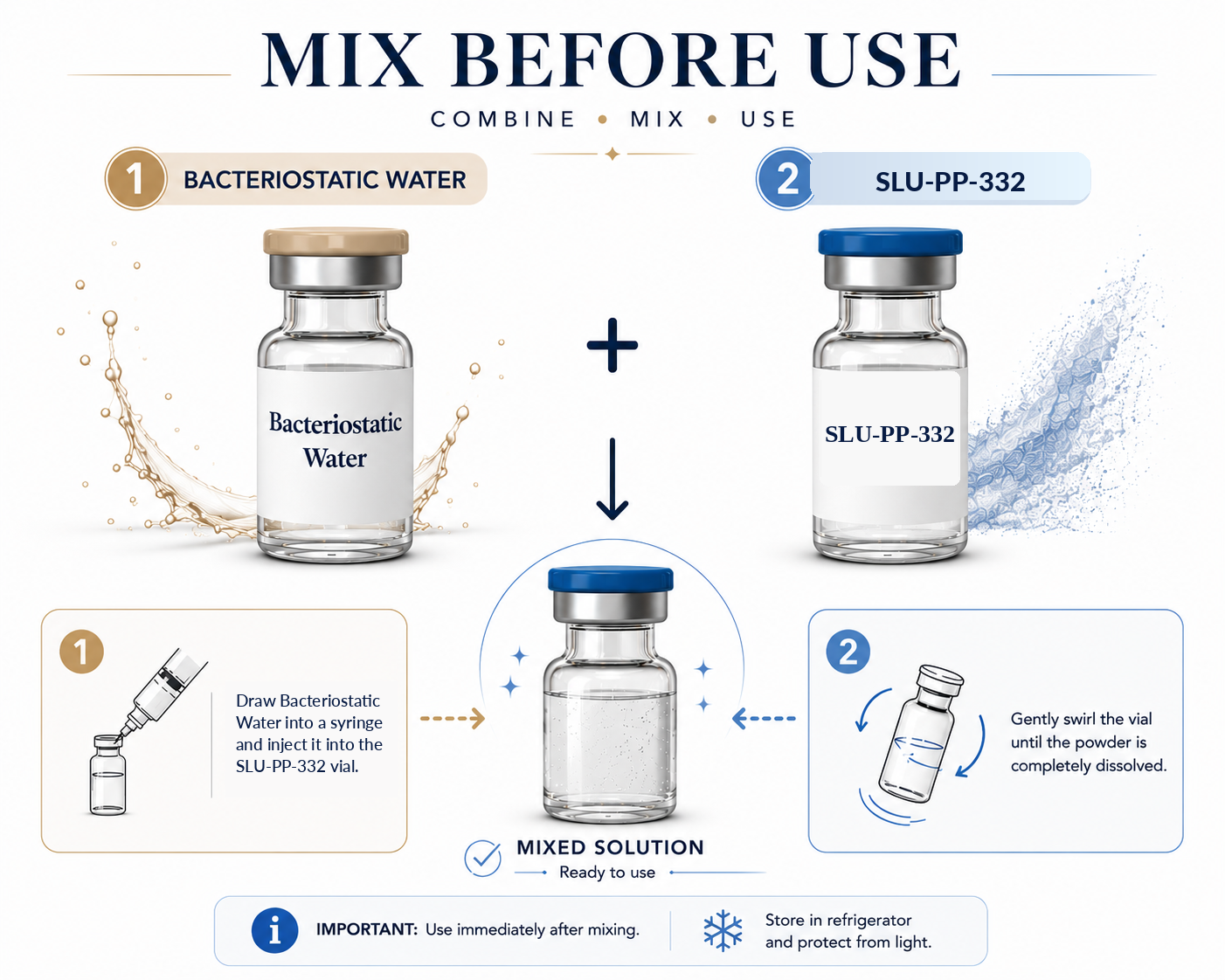
How To Mix SLU-PP-332
1
CleanUse alcohol swabs to clean the tops of both vials.
2
Draw BAC WaterDraw the selected amount of bacteriostatic water.
3
Inject SlowlyAdd the liquid slowly down the side of the vial.
4
Swirl GentlyDo not shake. Swirl gently until dissolved.
5
Store ProperlyStore as directed and protect from heat and light.
Best Practices & Common Mistakes
Best Practices
- Use sterile technique.
- Protect from light and heat.
- Store refrigerated when appropriate.
- Use clean syringe-unit math before measuring.
Common Mistakes
- Confusing milligrams with milliliters.
- Choosing an option with awkward decimal units.
- Using too little liquid for very small measurements.
- Shaking the vial aggressively.
SLU-PP-332 Storage & Handling
Lyophilized Powder: −20°C (−4°F) for long-term storage (up to 24 months). Refrigeration 2–8°C (36–46°F) for short-term use (up to ~3 months). Original sealed vial in the freezer is safest.
Reconstituted Solution: 2–8°C (36–46°F), use within ~7–14 days. Keep sealed, avoid light, and do not repeat freeze-thaw cycles.
Reconstituted Solution: 2–8°C (36–46°F), use within ~7–14 days. Keep sealed, avoid light, and do not repeat freeze-thaw cycles.
Frequently Asked Questions
Your calculator is designed for peptides, but SLU‑PP‑332 is a hydrophobic non-peptide small molecule. It is insoluble in water (aqueous) and will not dissolve properly in bacteriostatic water. For your research, you must first prepare a high-concentration stock solution in pure DMSO (e.g., 50–75 mg/mL), then carefully dilute this stock into an aqueous buffer or vehicle for in vivo administration. Never add water directly to the powder.
The calculator’s standard model is incorrect for this compound. SLU‑PP‑332 has a short elimination half‑life of approximately 4 hours. Preclinical studies show it is typically administered twice daily (b.i.d.), for example at 50 mg/kg intraperitoneally every 12 hours. To maintain effective exposure in your research, you must plan for multiple doses per day. The calculator’s single-dose assumption will lead to underdosing.
No, BAC water alone won't work. To prepare an injectable vehicle for in vivo research, suppliers recommend a multi-component mixture such as 5% DMSO, 40% PEG300, 5% Tween80, and 50% ddH₂O (water), which can keep the compound in solution at concentrations around 2.9 mg/mL. Your calculator has no interface for this formulation complexity. Use the proper vehicle to avoid unpredictable precipitation and inaccurate dosing.
No. Unlike typical peptides, the lyophilized powder of SLU‑PP‑332 should be stored at −20°C, kept desiccated. Once you dissolve it in an organic solvent (e.g., DMSO), the solution should be stored at −20°C and used within one month. Refrigeration alone (4°C) is not sufficient for long-term stability; your calculator cannot detect this.
Your calculator is set up for highly potent research peptides, but SLU‑PP‑332 was designed as a chemical tool and exhibits low potency in vivo relative to its mass. Published mouse studies use relatively high intraperitoneal doses, such as 50 mg/kg twice daily. In contrast, your calculator likely expects microgram-range doses. If you only enter a small number of milligrams, you will drastically underdose your animal model. Always base your entered mass on published in vivo protocols, not on typical peptide assumptions.
Practical takeaway: If your real goal is weight or metabolic health, the most useful next step is discussing approved treatment options with a clinician rather than relying on an unapproved compound.
Important: This tool is for informational and research-reference purposes only. Not intended for human or veterinary use.