MOTS-c Reconstitution Calculator
Enter the amount you want to measure. The vial buttons will highlight which vial strengths create cleaner syringe-unit measurements.
What amount do you need?
Type the target amount, then choose mg or mcg. Example: 2mg or 500mcg.
Syringe size:
Possible vial strengths:
Best Match
Good Match
Usable
Harder to Measure
Example MOTS-c Titration Schedule
| Protocol Item | Guidance |
|---|---|
| Dose | 500 mcg – 5 mg per dose |
| Frequency | 1–7× per week |
| Cycle Length | ~1 month (may be extended up to 3–4 months) |
| Minimum Break | 1 month minimum cycle break between cycles |
| Notes | Cycle length and intensity depend on response and goal. |
Possible vial strengths:
What Is It?
MOTS-c
Mitochondrial-derived peptide studied in metabolic research.
Bacteriostatic Water
Sterile water containing a bacteriostatic preservative, commonly used when preparing multi-use research vials.
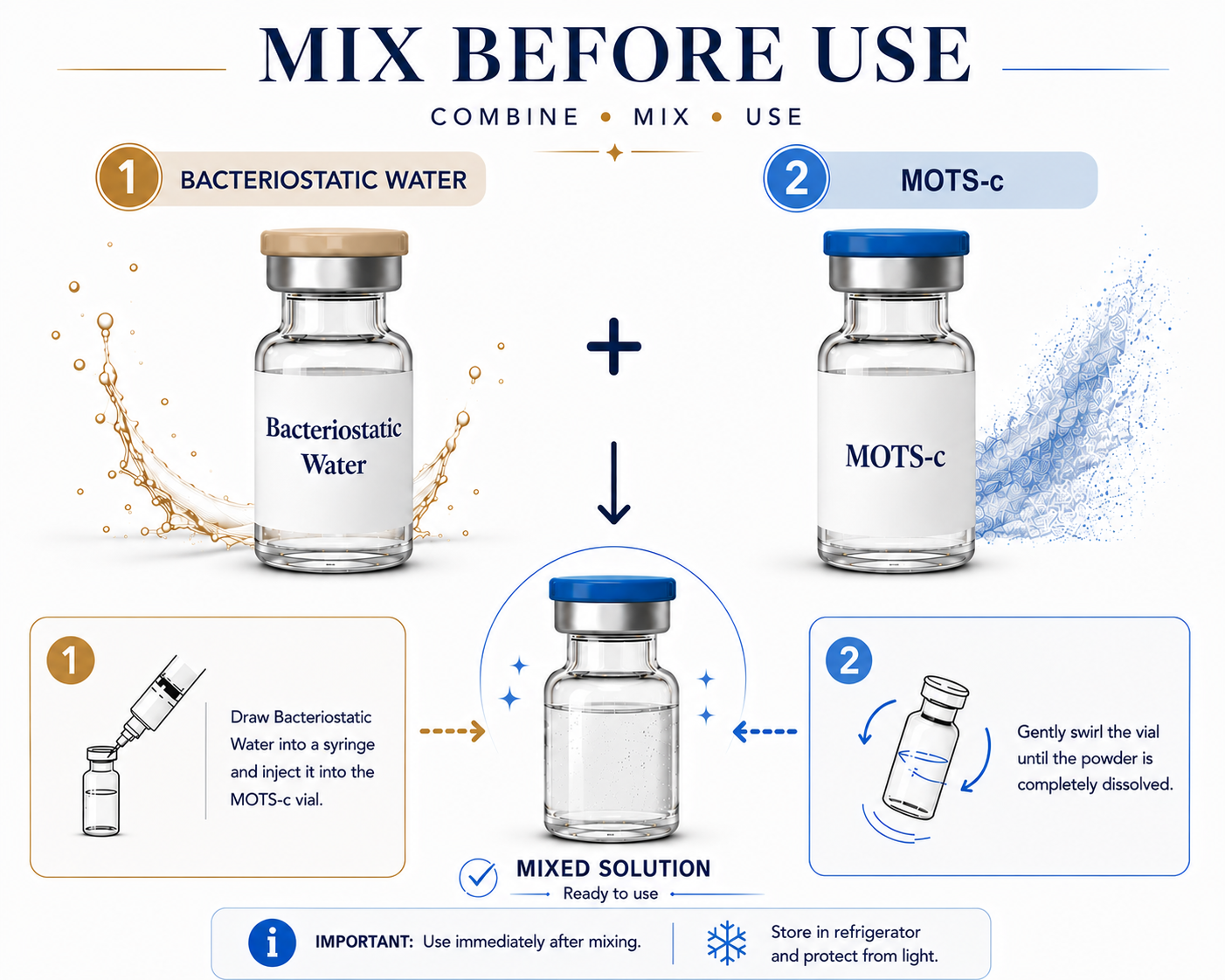
How To Mix MOTS-c
1
CleanUse alcohol swabs to clean the tops of both vials.
2
Draw BAC WaterDraw the selected amount of bacteriostatic water.
3
Inject SlowlyAdd the liquid slowly down the side of the vial.
4
Swirl GentlyDo not shake. Swirl gently until dissolved.
5
Store ProperlyStore as directed and protect from heat and light.
Best Practices & Common Mistakes
Best Practices
- Use sterile technique.
- Protect from light and heat.
- Store refrigerated when appropriate.
- Use clean syringe-unit math before measuring.
Common Mistakes
- Confusing milligrams with milliliters.
- Choosing an option with awkward decimal units.
- Using too little liquid for very small measurements.
- Shaking the vial aggressively.
MOTS-c Storage & Handling
Lyophilized Powder: −20°C (−4°F) for long-term storage (up to 24 months). Refrigeration 2–8°C (36–46°F) for short-term use (up to ~3 months). Original sealed vial in the freezer is safest.
Reconstituted Solution: 2–8°C (36–46°F), use within ~7–14 days. Keep sealed, avoid light, and do not repeat freeze-thaw cycles.
Reconstituted Solution: 2–8°C (36–46°F), use within ~7–14 days. Keep sealed, avoid light, and do not repeat freeze-thaw cycles.
Frequently Asked Questions
Your calculator is a dilution tool and does not distinguish between nuclear‑encoded and mitochondrial‑encoded peptides. MOTS‑c (mitochondrial open reading frame of the 12S rRNA type‑c) is one of the few known peptides directly encoded by mitochondrial DNA. When activated by stress or exercise, MOTS‑c is expressed and can translocate to the nucleus where it regulates genes containing antioxidant response elements (ARE). Its primary signaling mechanism is the Folate‑AICAR‑AMPK pathway, not a classical membrane receptor. This means that standard dose‑response assumptions (e.g., linear effect with increasing mass) do not necessarily apply. The calculator will output a mathematically correct volume for any entered mass, but the biological response will depend on the complex intracellular activation of this pathway, not simply the mass of peptide injected.
The minimum concentration guideline ensures complete dissolution and accurate dosing. If you reconstitute with too little water, the peptide may not fully go into solution, and your calculated dose will be incorrect. MOTS‑c has a net positive charge at neutral pH, making it a basic peptide. If solubility in water is limited (e.g., when preparing a highly concentrated stock), a small amount of a dilute acidic solution, such as 10‑25% acetic acid, can be used. For very hydrophobic preparations or if aggregation is observed, DMSO (which can dissolve MOTS‑c at up to 100 mg/mL) can be employed, followed by careful dilution in an aqueous buffer. Your calculator assumes standard BAC water and does not account for these solubility nuances; you must select the appropriate solvent for your specific concentration needs.
The short window is due to the peptide’s chemical structure. MOTS‑c contains methionine and tryptophan residues, which are highly susceptible to oxidation. Additionally, the peptide can aggregate in solution, especially if reconstituted at high concentrations. The manufacturer’s recommendation to add a carrier protein (0.1% HSA or BSA) for long‑term storage further underscores the stability issue. Therefore, the calculator’s “doses per vial” is a mathematical maximum, not a practical guide. For a study lasting more than a few days, you must aliquot the reconstituted solution immediately after mixing and freeze the aliquots at ‑20°C or below to avoid repeated freeze‑thaw cycles. Do not rely on the calculator’s count for extended protocols without this precaution.
The calculator will output a larger volume (and therefore a higher mass) for the 5 µM dose, but the biological data show that the lower dose was more effective. This inverted U‑shape dose response is common for peptides that act through complex intracellular pathways, such as the Folate‑AICAR‑AMPK cascade. If you use the calculator to simply increase the entered mass, you might miss the optimal therapeutic window and inadvertently reduce efficacy. You must determine the correct effective concentration from the literature, not from the calculator’s scaling, and then use the calculator to accurately prepare that dose.
The pain is related to the concentration of the peptide at the injection site, not the volume. Your calculator can help you reduce the concentration by choosing a larger BAC water volume, even if that larger volume is not marked as “Best”. For example, if you have a 10 mg vial and your protocol calls for a 1 mg dose, the calculator might show a “Best” match with 1 mL BAC water (giving 10 mg/mL, requiring 0.1 mL). However, you could instead reconstitute with 5 mL BAC water (2 mg/mL, requiring 0.5 mL). The larger volume (50 units vs. 10 units) will be less concentrated and may cause less pain, even though the calculator may label it as “Good” or “Usable” rather than “Best”. The calculator does not know about the “MOTS‑c sting”; you must prioritize comfort over mathematical roundness.
Practical takeaway: If your real goal is weight or metabolic health, the most useful next step is discussing approved treatment options with a clinician rather than relying on an unapproved compound.
Important: This tool is for informational and research-reference purposes only. Not intended for human or veterinary use.