Methylene Blue Reconstitution Calculator
Enter the amount you want to measure. The vial buttons will highlight which vial strengths create cleaner syringe-unit measurements.
What amount do you need?
Type the target amount, then choose mg or mcg. Example: 2mg or 500mcg.
Syringe size:
Possible vial strengths:
Best Match
Good Match
Usable
Harder to Measure
Example Methylene Blue Titration Schedule
FDA-Approved Medical Use & Official Dosage
Methylene blue is a prescription drug approved for acquired methemoglobinemia, a serious blood disorder where hemoglobin can't carry oxygen effectively.
Parameter Official Prescribing Information for Provayblue® Injection
Standard Dose 1 mg/kg via intravenous (IV) infusion over 5 to 30 minutes.
Repeat Dose If methemoglobin levels remain above 30% or symptoms persist, a second dose of 1 mg/kg may be given one hour after the first.
Renal Impairment In patients with moderate or severe kidney issues, a single dose of 1 mg/kg is recommended.
Pediatric Use The dosage is weight-based. For the 1% solution, it's 0.1 to 0.2 mL/kg; for the 0.5% solution, it's 1 mg/kg.
Route Intravenous (IV) only for the approved injection; oral use is off-label and not FDA-approved.
Onset of Action Symptomatic improvement typically begins within one hour after administration.
Methylene blue is a prescription drug approved for acquired methemoglobinemia, a serious blood disorder where hemoglobin can't carry oxygen effectively.
Parameter Official Prescribing Information for Provayblue® Injection
Standard Dose 1 mg/kg via intravenous (IV) infusion over 5 to 30 minutes.
Repeat Dose If methemoglobin levels remain above 30% or symptoms persist, a second dose of 1 mg/kg may be given one hour after the first.
Renal Impairment In patients with moderate or severe kidney issues, a single dose of 1 mg/kg is recommended.
Pediatric Use The dosage is weight-based. For the 1% solution, it's 0.1 to 0.2 mL/kg; for the 0.5% solution, it's 1 mg/kg.
Route Intravenous (IV) only for the approved injection; oral use is off-label and not FDA-approved.
Onset of Action Symptomatic improvement typically begins within one hour after administration.
Possible vial strengths:
What Is It?
Methylene Blue
Phenothiazine compound studied for mitochondrial function.
Bacteriostatic Water
Sterile water containing a bacteriostatic preservative, commonly used when preparing multi-use research vials.
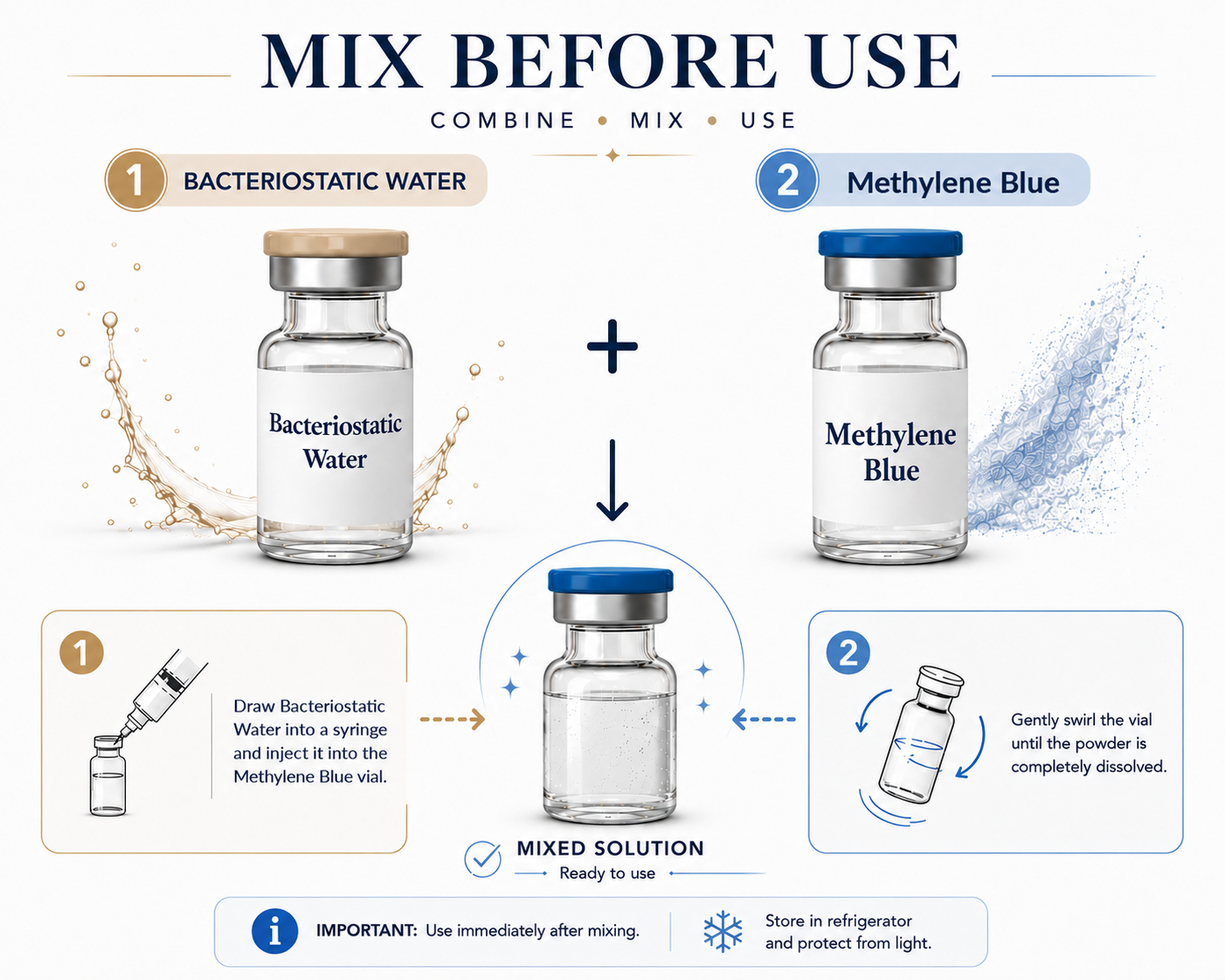
How To Mix Methylene Blue
1
CleanUse alcohol swabs to clean the tops of both vials.
2
Draw BAC WaterDraw the selected amount of bacteriostatic water.
3
Inject SlowlyAdd the liquid slowly down the side of the vial.
4
Swirl GentlyDo not shake. Swirl gently until dissolved.
5
Store ProperlyStore as directed and protect from heat and light.
Best Practices & Common Mistakes
Best Practices
- Use sterile technique.
- Protect from light and heat.
- Store refrigerated when appropriate.
- Use clean syringe-unit math before measuring.
Common Mistakes
- Confusing milligrams with milliliters.
- Choosing an option with awkward decimal units.
- Using too little liquid for very small measurements.
- Shaking the vial aggressively.
Methylene Blue Storage & Handling
Lyophilized Powder: −20°C (−4°F) for long-term storage (up to 24 months). Refrigeration 2–8°C (36–46°F) for short-term use (up to ~3 months). Original sealed vial in the freezer is safest.
Reconstituted Solution: 2–8°C (36–46°F), use within ~7–14 days. Keep sealed, avoid light, and do not repeat freeze-thaw cycles.
Reconstituted Solution: 2–8°C (36–46°F), use within ~7–14 days. Keep sealed, avoid light, and do not repeat freeze-thaw cycles.
Frequently Asked Questions
Unlike most peptides, methylene blue is a cationic dye that can recrystallize in solution. Standard BAC water may not be enough. To achieve a clear and stable stock solution, it's best to first dissolve the powder in pure DMSO at a high concentration (e.g., 50-100 mg/mL) to prevent it from crashing out, then dilute to the final concentration with an aqueous vehicle.
Cloudiness or a color change is a sign of precipitation or degradation. To get the powder back into solution, gently warm the vial to 37 °C and place it in an ultrasonic bath for a few minutes. This process typically resolves the issue by breaking up undissolved particles.
Your calculator treats all solvents the same, but the solubility of methylene blue varies significantly. In water at room temperature, the solubility is about 30 mg/mL. However, with mild heating, that limit increases to roughly 62 mg/mL. DMSO is also highly effective, showing similar solubility characteristics.
Yes, the dosing schedule is a critical variable. The compound has a complex pharmacokinetic profile: one study reported a terminal half-life of 5.25 hours in blood, while an FDA label lists a much longer half-life of approximately 24 hours in humans. Furthermore, oral bioavailability is notably low, with a systemic exposure (AUC) that can be drastically lower (around 9 nmol/min/ml) compared to intravenous administration (around 137 nmol/min/ml).
Yes, this is a well-documented and critical property for research. Methylene blue acts as an MAOI. Because of this, concomitant use with serotonergic drugs (like SSRIs, SNRIs, MAOIs, and some opioids) can lead to a serious or even fatal serotonergic syndrome. A washout period of at least 72 hours is advised after the last dose to avoid these dangerous interactions.
Practical takeaway: If your real goal is weight or metabolic health, the most useful next step is discussing approved treatment options with a clinician rather than relying on an unapproved compound.
Important: This tool is for informational and research-reference purposes only. Not intended for human or veterinary use.