NAD+ Reconstitution Calculator
Enter the amount you want to measure. The vial buttons will highlight which vial strengths create cleaner syringe-unit measurements.
What amount do you need?
Type the target amount, then choose mg or mcg. Example: 2mg or 500mcg.
Syringe size:
Possible vial strengths:
Best Match
Good Match
Usable
Harder to Measure
Example NAD+ Titration Schedule
| Protocol Item | Guidance |
|---|---|
| Typical Dose Range | 50–250 mg per dose |
| More Intensive Therapy | 500–1500 mg per day, often as part of a multi-day protocol |
| Cycling |
Possible vial strengths:
What Is It?
NAD+
Nicotinamide adenine dinucleotide research solution.
Bacteriostatic Water
Sterile water containing a bacteriostatic preservative, commonly used when preparing multi-use research vials.
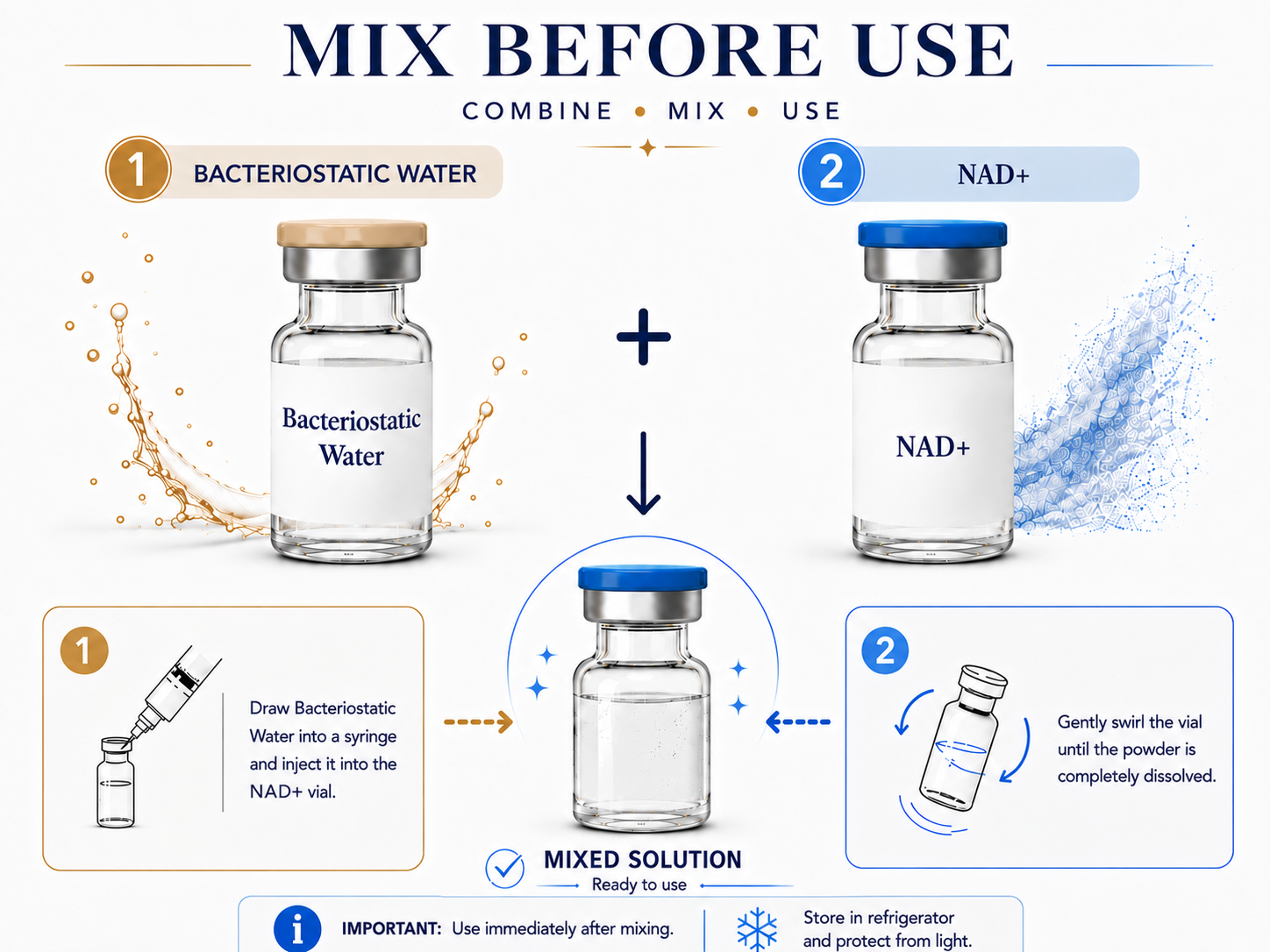
How To Mix NAD+
1
CleanUse alcohol swabs to clean the tops of both vials.
2
Draw BAC WaterDraw the selected amount of bacteriostatic water.
3
Inject SlowlyAdd the liquid slowly down the side of the vial.
4
Swirl GentlyDo not shake. Swirl gently until dissolved.
5
Store ProperlyStore as directed and protect from heat and light.
Best Practices & Common Mistakes
Best Practices
- Use sterile technique.
- Protect from light and heat.
- Store refrigerated when appropriate.
- Use clean syringe-unit math before measuring.
Common Mistakes
- Confusing milligrams with milliliters.
- Choosing an option with awkward decimal units.
- Using too little liquid for very small measurements.
- Shaking the vial aggressively.
NAD+ Storage & Handling
Lyophilized Powder: −20°C (−4°F) for long-term storage (up to 24 months). Refrigeration 2–8°C (36–46°F) for short-term use (up to ~3 months). Original sealed vial in the freezer is safest.
Reconstituted Solution: 2–8°C (36–46°F), use within ~7–14 days. Keep sealed, avoid light, and do not repeat freeze-thaw cycles.
Reconstituted Solution: 2–8°C (36–46°F), use within ~7–14 days. Keep sealed, avoid light, and do not repeat freeze-thaw cycles.
Frequently Asked Questions
The calculator treats all vials the same, but NAD+ has a distinct pH-dependent stability profile. Freshly prepared stock solutions of NAD+ in water at a pH of 2–7 can be stable for up to one month at 4°C; the product will decompose at an alkaline pH. This means that your standard BAC water (pH ~5.5) is within the stable range, but using an alkaline buffer or allowing the pH to drift above 7.0, as the calculator cannot warn you, will quickly degrade the molecule. Furthermore, data sheets note that a 1% aqueous NAD+ solution has a pH of 2–4, and such a solution should be aliquoted and stored at –20 °C for up to one week, not indefinitely. The calculator’s “Doses per vial” count is a mathematical maximum; for NAD+, you must rely on the chemistry.
For a typical injection of 50 mg of NAD+ at a concentration of 166.7 mg/mL, the required volume is 0.3 mL (30 units) on a 100-unit syringe. For 100 mg, the volume is 0.6 mL (60 units). Both volumes are easy to measure and within the calculator’s “Best” range for roundness. However, a 500 mg vial at 3 mL provides the ability to draw these volumes, but a single daily dose of 50–100 mg means a 500 mg vial contains only 5–10 daily doses. For an 8-week study, you would need multiple vials—around 11 vials—not just one or two. Your calculator’s vial strength presets (up to 60 mg) are much too small for this typical NAD+ protocol.
The calculator’s “Doses per vial” is a pure mathematical count based on mass, not a practical guide to the usable life of the solution. For NAD+, the usable window is fixed regardless of how many doses the vial can mathematically provide. If a 500 mg vial reconstituted to 166.7 mg/mL could mathematically supply 10 daily 50 mg doses, but the solution degrades after 14 days, you will still be forced to discard any remaining solution at that point, even if you have not used all 10 doses. Therefore, for NAD+, you should reconstitute only the amount of powder you will use within the 14-day window, or plan to freeze the reconstituted solution in single-use aliquots immediately after mixing.
The calculator treats all aqueous solvents as identical. For NAD+, this is incorrect. If you enter a 500 mg vial and the calculator suggests using 2.5 mL of water to achieve a concentration of 200 mg/mL for a cell culture experiment, that is feasible because NAD+ is soluble in pure water to that level. However, if the researcher uses the calculator’s “Desired dose” to prepare a stock solution in PBS (pH 7.2), the solubility drops to just 10 mg/mL. A 500 mg dose in PBS would require 50 mL of buffer, which is impossible in a 2 mL vial. The calculator cannot warn that the chosen diluent is incompatible, leading to a cloudy solution and inaccurate dosing. You must know the solubility of NAD+ in your specific experimental buffer.
The calculator only sees the mg number you type. The chemical formula C₂₁H₂₇N₇O₁₄P₂ (CAS 53‑84‑9) gives a molecular weight of 663.4 g/mol. But if the manufacturer sells the powder as a hydrate (e.g., NAD+ · xH₂O), the actual mass of the active NAD+ molecule in the vial will be lower than the total fill weight, because water molecules add to the total mass without contributing to the biological activity. A 100 mg vial of hydrated NAD+ might contain only 90 mg of active NAD+. If you use the calculator as is, you will unknowingly be drawing a dose that is systematically lower than the intended amount (by the percentage of water mass in the crystal). Your Certificate of Analysis must specify the active peptide content; you must then adjust the entered mass accordingly. The calculator cannot do this for you.
Practical takeaway: If your real goal is weight or metabolic health, the most useful next step is discussing approved treatment options with a clinician rather than relying on an unapproved compound.
Important: This tool is for informational and research-reference purposes only. Not intended for human or veterinary use.