Semax Reconstitution Calculator
Enter the amount you want to measure. The vial buttons will highlight which vial strengths create cleaner syringe-unit measurements.
What amount do you need?
Type the target amount, then choose mg or mcg. Example: 2mg or 500mcg.
Syringe size:
Possible vial strengths:
Best Match
Good Match
Usable
Harder to Measure
Example Semax Titration Schedule
| Protocol Item | Guidance |
|---|---|
| Standard Dose Range | 100–500 mcg per dose |
| Higher Range Noted | 500–1500 mcg per dose has been observed in research with positive results and is often seen in the bio-hacking community |
| Frequency | 1–7× per week |
| Cycle | 6 weeks on / 6 weeks off |
| Modification Notes | Limited research exists on dosing/cycling schemes for modified Semax versions (N-Acetyl and Amidate). Current dosing/cycling schemes are similar to the original compound. |
| Conservative Start | Often recommended to start with a more conservative dosing/cycling scheme when researching more potent compounds. |
Possible vial strengths:
What Is It?
Semax
ACTH-derived peptide studied in cognition research.
Bacteriostatic Water
Sterile water containing a bacteriostatic preservative, commonly used when preparing multi-use research vials.
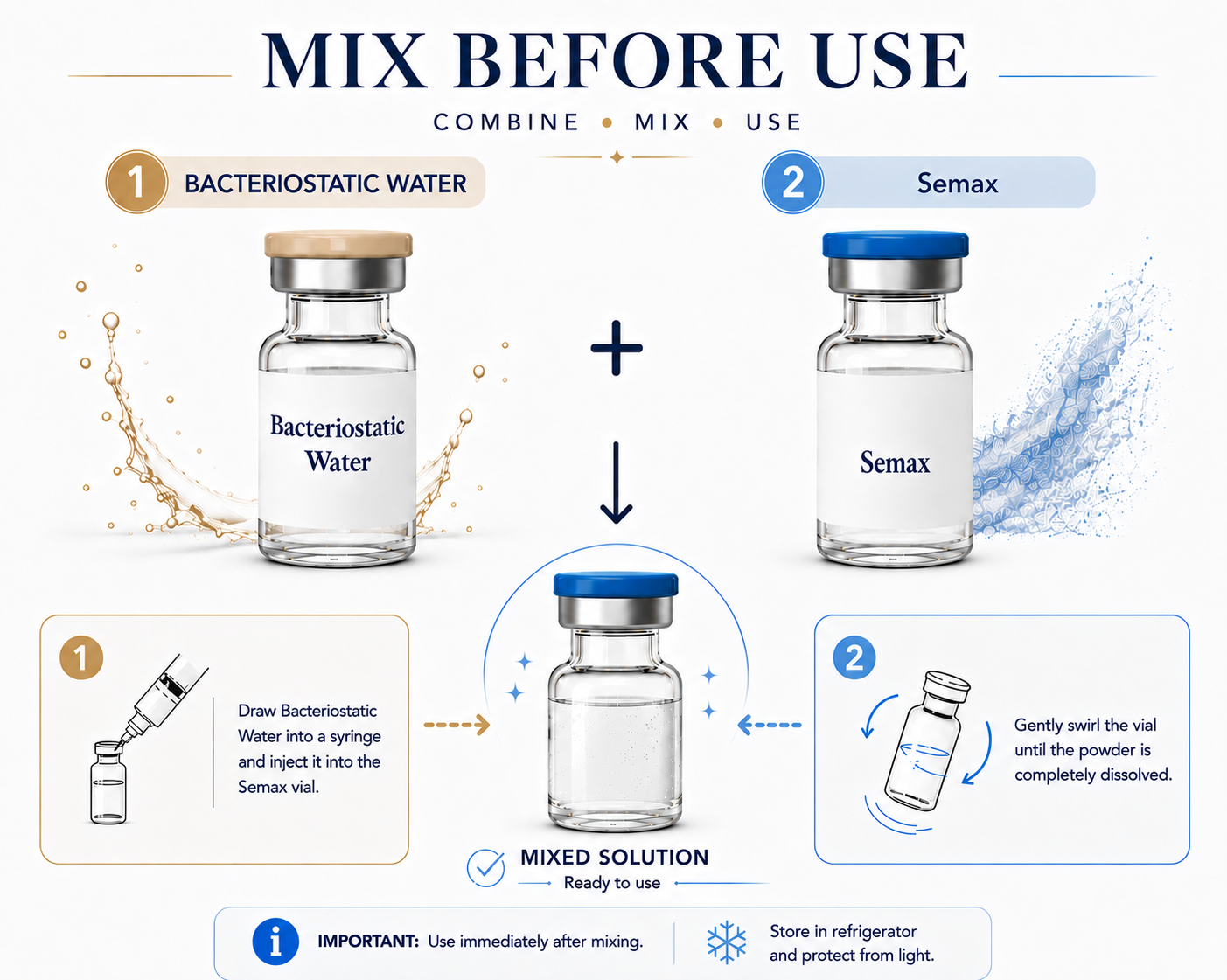
How To Mix Semax
1
CleanUse alcohol swabs to clean the tops of both vials.
2
Draw BAC WaterDraw the selected amount of bacteriostatic water.
3
Inject SlowlyAdd the liquid slowly down the side of the vial.
4
Swirl GentlyDo not shake. Swirl gently until dissolved.
5
Store ProperlyStore as directed and protect from heat and light.
Best Practices & Common Mistakes
Best Practices
- Use sterile technique.
- Protect from light and heat.
- Store refrigerated when appropriate.
- Use clean syringe-unit math before measuring.
Common Mistakes
- Confusing milligrams with milliliters.
- Choosing an option with awkward decimal units.
- Using too little liquid for very small measurements.
- Shaking the vial aggressively.
Semax Storage & Handling
Lyophilized Powder: −20°C (−4°F) for long-term storage (up to 24 months). Refrigeration 2–8°C (36–46°F) for short-term use (up to ~3 months). Original sealed vial in the freezer is safest.
Reconstituted Solution: 2–8°C (36–46°F), use within ~7–14 days. Keep sealed, avoid light, and do not repeat freeze-thaw cycles.
Reconstituted Solution: 2–8°C (36–46°F), use within ~7–14 days. Keep sealed, avoid light, and do not repeat freeze-thaw cycles.
Frequently Asked Questions
Your calculator’s pharmacokinetic model is based on a standard linear timeline. However, a rat brain study found that the half-life of Semax in the presence of plasma membranes is just longer than one hour at 37 °C. But the therapeutic effect of a single dose lasts 20 to 24 hours. This apparent discrepancy occurs because Semax initiates a cascade that triggers transcription factors. A single dose has been found to increase BDNF protein levels 1.4‑fold and trkB mRNA (BDNF's receptor) 2‑fold in the hippocampus. The peptide itself is quickly broken down (primarily by dipeptidylaminopeptidases), but the expression changes it induces have a much longer effect. Your calculator cannot model this gene‑based effect and may underestimate the biological duration of a single dose.
The calculator assumes all peptides behave the same in solution. However, the manufacturer's data sheet specifies that upon reconstitution, Semax should be stored at 4 °C for only 2‑7 days and, for long‑term storage, it should be stored below –18 °C or, preferably, with a carrier protein like 0.1% HSA or BSA to maintain stability. The benzyl alcohol preservative in your calculator’s BAC water does not prevent chemical degradation of the peptide itself. If you follow the calculator’s plan to use a reconstituted vial for 28 days, you risk injecting degraded material and getting inaccurate results. For the multi‑week protocols that Semax is used for (e.g., 8‑week cycles), you should either add a carrier protein or split the solution into single‑use aliquots before freezing to avoid multiple freeze‑thaw cycles.
The calculator prioritizes mathematical aesthetics; Semax research prioritizes practical microgram dosing. Standard research protocols add 3.0 mL of bacteriostatic water to a 10 mg vial, resulting in a concentration of about 3.33 mg/mL. On a U‑100 insulin syringe, 1 unit (0.01 mL) equals approximately 33.3 mcg of Semax. A common starting dose of 300 mcg equals 9 units, which is easy to measure. If you used the calculator’s "Best" match of 1 mL (10 mg/mL), a 300 mcg dose would be only 3 units. This very small volume significantly increases the risk of measurement error. You must override the calculator when the mathematically neat option produces a clinically impractical injection volume.
Your calculator’s field expects a single mass input, but there are at least three distinct research forms of this peptide. The standard form has a free N‑terminus. N‑Acetyl Semax is modified to be more resistant to enzymatic degradation and to better cross biological barriers. Semax Amidate has a C‑terminal amidate group that extends its half‑life from about 45 minutes to 2.5–3.5 hours and enhances its ability to upregulate BDNF for a sustained period. If you enter the mass of a standard form into your calculator but use the amidate variant, your bioactivity results will not be comparable to published studies. The calculator cannot warn you about these critical structural differences.
Your calculator assumes 100 % systemic bioavailability for a subcutaneous injection. For Semax, the route is critical. It was designed for intranasal delivery and has been shown to bypass hepatic first‑pass metabolism, achieving CNS bioavailability 15–20 times higher than intravenous administration of equivalent doses. A dose of 200 mcg/kg intranasally may saturate brain receptors, while the same 200 mcg/kg given subcutaneously may produce minimal CNS effects because most of the peptide is distributed systemically and degraded. The calculator will output the same volume for the entered mass regardless of route. For accurate CNS research, you cannot rely on the calculator’s mass‑based output. You must interpret the dose based on the specific bioavailability of your chosen route (intranasal vs. subcutaneous).
Practical takeaway: If your real goal is weight or metabolic health, the most useful next step is discussing approved treatment options with a clinician rather than relying on an unapproved compound.
Important: This tool is for informational and research-reference purposes only. Not intended for human or veterinary use.