N-Acetyl Epithalon Amidate Reconstitution Calculator
Enter the amount you want to measure. The vial buttons will highlight which vial strengths create cleaner syringe-unit measurements.
What amount do you need?
Type the target amount, then choose mg or mcg. Example: 2mg or 500mcg.
Syringe size:
Possible vial strengths:
Best Match
Good Match
Usable
Harder to Measure
Example N-Acetyl Epithalon Amidate Titration Schedule
| Week | Daily Dose (mcg) | Injection Volume (mL / Units) |
|---|---|---|
| Weeks 1–2 | 200 mcg (0.200 mg) | 0.06 mL (6 units) |
| Weeks 3–4 | 300 mcg (0.300 mg) | 0.09 mL (9 units) |
| Weeks 5–6 | 400 mcg (0.400 mg) | 0.12 mL (12 units) |
| Weeks 7–12 | 500 mcg (0.500 mg) | 0.15 mL (15 units) |
Possible vial strengths:
What Is It?
N-Acetyl Epithalon Amidate
Stabilised epithalon variant.
Bacteriostatic Water
Sterile water containing a bacteriostatic preservative, commonly used when preparing multi-use research vials.
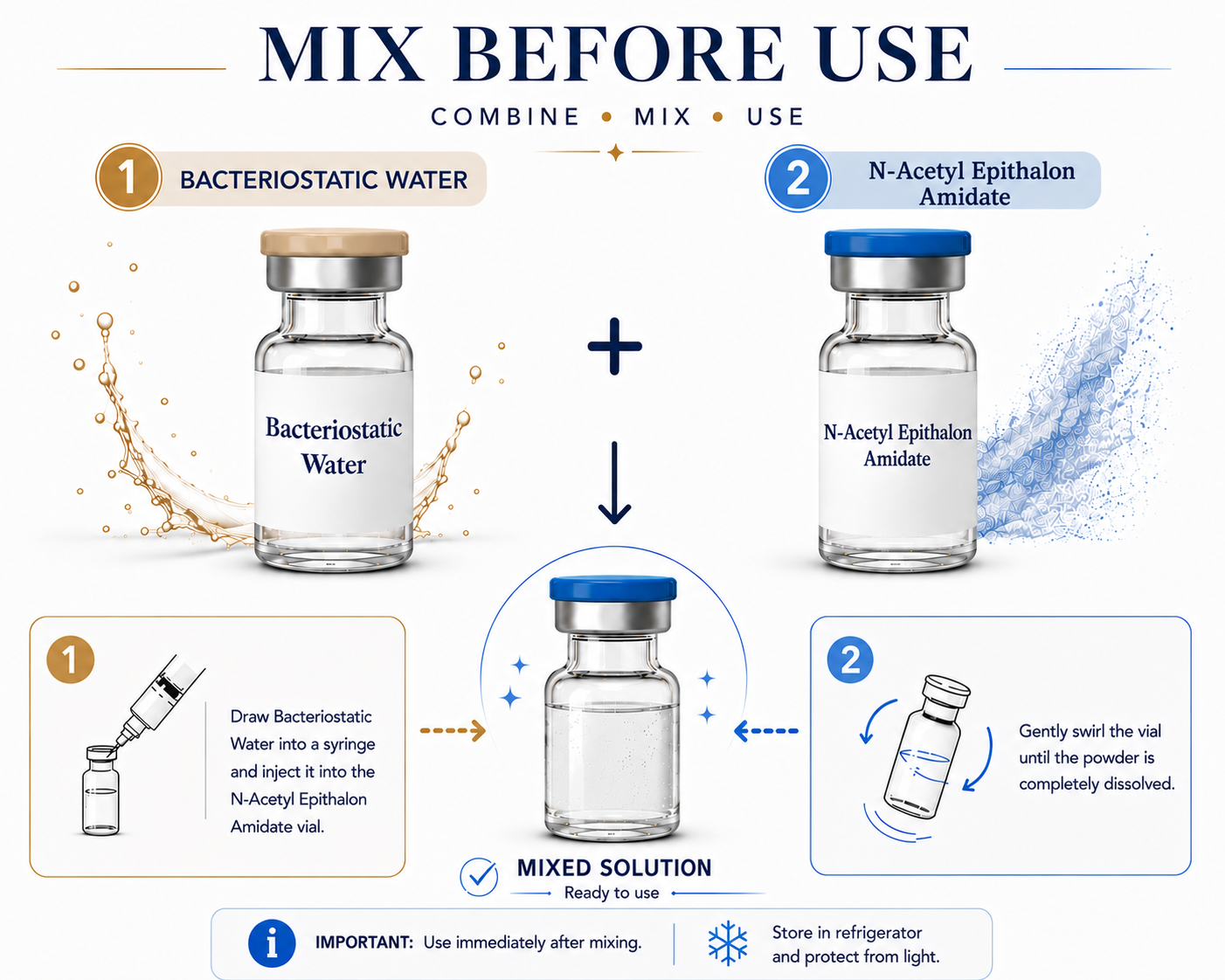
How To Mix N-Acetyl Epithalon Amidate
1
CleanUse alcohol swabs to clean the tops of both vials.
2
Draw BAC WaterDraw the selected amount of bacteriostatic water.
3
Inject SlowlyAdd the liquid slowly down the side of the vial.
4
Swirl GentlyDo not shake. Swirl gently until dissolved.
5
Store ProperlyStore as directed and protect from heat and light.
Best Practices & Common Mistakes
Best Practices
- Use sterile technique.
- Protect from light and heat.
- Store refrigerated when appropriate.
- Use clean syringe-unit math before measuring.
Common Mistakes
- Confusing milligrams with milliliters.
- Choosing an option with awkward decimal units.
- Using too little liquid for very small measurements.
- Shaking the vial aggressively.
N-Acetyl Epithalon Amidate Storage & Handling
Lyophilized Powder: −20°C (−4°F) for long-term storage (up to 24 months). Refrigeration 2–8°C (36–46°F) for short-term use (up to ~3 months). Original sealed vial in the freezer is safest.
Reconstituted Solution: 2–8°C (36–46°F), use within ~7–14 days. Keep sealed, avoid light, and do not repeat freeze-thaw cycles.
Reconstituted Solution: 2–8°C (36–46°F), use within ~7–14 days. Keep sealed, avoid light, and do not repeat freeze-thaw cycles.
Frequently Asked Questions
The base molecular weight of the unmodified Epithalon tetrapeptide is approximately 404.4 g/mol. N‑terminal acetylation (adding an acetyl group, C₂H₃O) and C‑terminal amidation (‑CONH₂ instead of ‑COOH) increase the total weight by roughly 42 g/mol, bringing the modified peptide to about 446.4 g/mol. Your calculator assumes the mass you enter corresponds to the unmodified peptide. If you have a vial labelled “5 mg of N‑Acetyl Epithalon Amidate”, entering 5 mg into the calculator would overestimate the number of active molecules by about 10 % compared to standard Epithalon. Always use the peptide content as stated on the Certificate of Analysis (CoA) for that specific batch.
The peptide works by binding to the G‑rich 3’‑overhang of telomeric DNA and forming a stable G‑quadruplex that blocks telomerase access to the chromosome end. Because a single peptide molecule can induce a conformational change in a large DNA structure, the biological effect saturates at a relatively low concentration, well below the level required to directly inhibit telomerase one‑to‑one. Your calculator will linearly increase the output mass if you double the entered dose, but the G‑quadruplex stabilisation will not double. For DNA‑targeting peptides like this one, the effective concentration may be determined by the stoichiometry of the DNA target, not by free peptide in solution.
The product page for a 10 mg lyophilised N‑Acetyl Epithalon Amidate lists “mannitol” as an excipient, and the Certificate of Analysis shows a purity of over 96 % HPLC. The total mass in the vial is the sum of the active peptide plus the mannitol. The calculator requires you to enter only the active peptide content (e.g., 10 mg, not 10 mg + mannitol). If you mistakenly enter the total fill weight, the calculated concentration will be inflated, and the syringe draw will contain far less active compound than intended. Always check the CoA for the exact active peptide mass and use that value, ignoring the excipient.
The N‑acetyl and C‑terminal amide modifications reduce terminal flexibility and protect both ends of the peptide from enzymatic degradation, resulting in “highly stabilised” behaviour in solution. Standard Epithalon is often reconstituted in separate vials for each 5‑day block to avoid loss of activity. For the modified version, a single vial reconstituted with bacteriostatic water can likely be stored at 4 °C and used for up to 30 days with minimal degradation. Therefore, for a 10‑day cycle, you could reconstitute one vial and use it for the entire study, despite the calculator’s “Doses per vial” number being a pure mathematical count. However, the calculator cannot tell you which storage window applies; you must rely on the chemical stability conferred by the dual modifications.
The calculator assumes a bioavailability of 100 % for subcutaneous injection, which is appropriate for the standard reconstitution method. However, the primary purpose of the N‑acetyl and C‑terminal amide modifications is to improve metabolic stability and absorption, making the peptide more viable for oral delivery. Some suppliers explicitly state that traditional Epithalon is “unstable” when taken orally because it degrades in the stomach, whereas the acetylated/amidated version is engineered for superior bioavailability. If your research protocol administers the peptide orally, you cannot use the calculator’s injection‑derived values without adjusting for the significantly lower bioavailability (even with the modifications). The calculator is a dilution tool for injectable preparations; it does not, and cannot, adjust for route‑specific absorption losses.
Practical takeaway: If your real goal is weight or metabolic health, the most useful next step is discussing approved treatment options with a clinician rather than relying on an unapproved compound.
Important: This tool is for informational and research-reference purposes only. Not intended for human or veterinary use.