Cerebrolysin Reconstitution Calculator
Enter the amount you want to measure. The vial buttons will highlight which vial strengths create cleaner syringe-unit measurements.
What amount do you need?
Type the target amount, then choose mg or mcg. Example: 2mg or 500mcg.
Syringe size:
Possible vial strengths:
Best Match
Good Match
Usable
Harder to Measure
Example Cerebrolysin Titration Schedule
| Use Case / Condition | Dose (mL) | Frequency | Duration / Cycling Notes |
|---|---|---|---|
| Stroke (Acute Phase) | 20–50 mL | Daily | 21 days; described as higher-dose early rehab support |
| Vascular Dementia | 10–30 mL | 5×/week | 4 weeks; repeat 2–4 cycles/year |
| Alzheimer’s Disease | 10–30 mL | 5×/week | 4 weeks; repeat 2–4 cycles/year |
| Traumatic Brain Injury (TBI) | 20–50 mL | Daily | 7–30 days; varies by severity; start early post-injury if possible |
| Nootropic / Off-label Cognitive Use | 1–5 mL | 5×/week | 4 weeks; described as lower-dose cognitive / mood / neuroprotection cycle |
| “Standard Cognitive Support” (general) | 5 mL | Daily (IM) | Often described as a ~4-week cycle unless otherwise directed |
Possible vial strengths:
What Is It?
Cerebrolysin
Porcine brain peptide preparation, 215 mg/mL solution.
Bacteriostatic Water
Sterile water containing a bacteriostatic preservative, commonly used when preparing multi-use research vials.
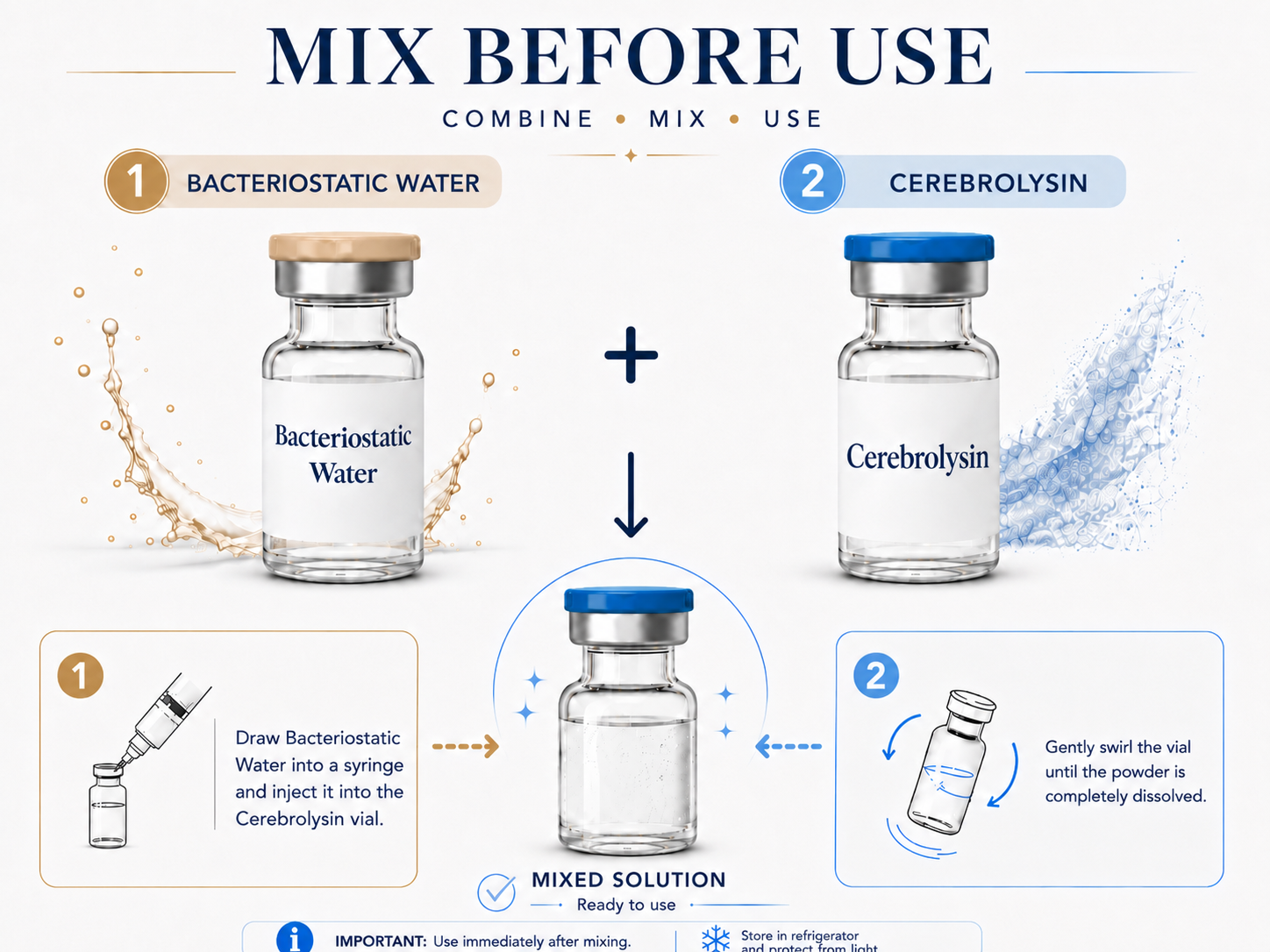
How To Mix Cerebrolysin
1
CleanUse alcohol swabs to clean the tops of both vials.
2
Draw BAC WaterDraw the selected amount of bacteriostatic water.
3
Inject SlowlyAdd the liquid slowly down the side of the vial.
4
Swirl GentlyDo not shake. Swirl gently until dissolved.
5
Store ProperlyStore as directed and protect from heat and light.
Best Practices & Common Mistakes
Best Practices
- Use sterile technique.
- Protect from light and heat.
- Store refrigerated when appropriate.
- Use clean syringe-unit math before measuring.
Common Mistakes
- Confusing milligrams with milliliters.
- Choosing an option with awkward decimal units.
- Using too little liquid for very small measurements.
- Shaking the vial aggressively.
Cerebrolysin Storage & Handling
Lyophilized Powder: −20°C (−4°F) for long-term storage (up to 24 months). Refrigeration 2–8°C (36–46°F) for short-term use (up to ~3 months). Original sealed vial in the freezer is safest.
Reconstituted Solution: 2–8°C (36–46°F), use within ~7–14 days. Keep sealed, avoid light, and do not repeat freeze-thaw cycles.
Reconstituted Solution: 2–8°C (36–46°F), use within ~7–14 days. Keep sealed, avoid light, and do not repeat freeze-thaw cycles.
Frequently Asked Questions
Your calculator would not be applicable to Cerebrolysin as it is normally supplied. It’s designed for reconstituting peptide powders by adding a specific volume of bacteriostatic water. Cerebrolysin is a pre-mixed, sterile, aqueous solution that is injected directly; it contains 215.2 mg of peptide concentrate per 1 mL and requires no dilution or reconstitution. If you try to force‑fit a standard 10‑mL ampoule into your calculator, you will get nonsensical results because the ampoule is not a vacuum‑sealed vial containing powder—it is a liquid. For Cerebrolysin, you should completely ignore the calculator and instead rely on the official dosage guidelines described in the following questions.
Ampoules are single‑use containers; once opened, their contents are no longer sterile and should ideally be administered immediately. However, in practice, some research settings use an opened ampoule over up to 2 days, but this is not recommended. If you must save part of an ampoule, the safest method is to pre‑fill sterile syringes with individual doses (e.g., draw four separate 5‑mL doses), cap each syringe, and store them between 10–25 °C (room temperature) in a clean, dark place. For extra safety, replace the needle with a new one before each injection. Do not attempt to transfer the liquid back into a vial or store it in the opened ampoule—that invites contamination and peptide degradation.
The official description states that Cerebrolysin is a clear solution with no visible particles. Particles can appear due to glass fragmentation from the ampoule’s neck during opening. If you see any particles, do not inject the solution. You may attempt to filter it using a 5‑micron filter needle (the smallest pore size generally available and effective for peptide solutions) to remove glass and other particulates. However, if the solution is cloudy, discoloured, or contains clumps, it may have degraded and should be discarded. Your calculator does not, and cannot, warn you about particulate contamination—this is a physical inspection that only you can perform.
This is a major mismatch with your calculator’s underlying assumption (subcutaneous administration). The typical daily dose of Cerebrolysin in research is 10 to 50 mL (approx. 2,152 mg to 10,760 mg of peptide concentrate per day). Doses up to 5 mL may be injected intramuscularly; doses up to 10 mL may be given as a direct IV injection over about 3 minutes; doses of 10–50 mL must be diluted in 50–100 mL of saline or 5% glucose and infused intravenously over 15–60 minutes. Your calculator cannot accommodate these large volumes or the need for intravenous infusion. If you were to misinterpret the calculator’s output and inject, say, 50 units (0.5 mL) subcutaneously, you would be delivering only a tiny fraction of the therapeutic dose. Do not use your calculator for Cerebrolysin; instead, follow the established routes and volumes from the product information.
Your calculator’s “doses per vial” display assumes that the peptide has a short half‑life and that each dose is independent. For Cerebrolysin, however, the neurotrophic activity can be detected in blood plasma for up to 24 hours after a single administration, and its therapeutic benefits (e.g., in Alzheimer’s disease) are often detectable even 6 months after stopping treatment. This means that the dose‑spacing is not a simple function of the vial’s contents. A typical protocol involves daily administrations for 10 to 20 days, but the “doses per vial” count from a standard peptide calculator would be meaningless because it doesn’t account for the drug’s long‑lasting effects. The optimal dose schedule for your application must be derived from clinical literature, not from a generic dilution calculator.
Practical takeaway: If your real goal is weight or metabolic health, the most useful next step is discussing approved treatment options with a clinician rather than relying on an unapproved compound.
Important: This tool is for informational and research-reference purposes only. Not intended for human or veterinary use.