Selank Reconstitution Calculator
Enter the amount you want to measure. The vial buttons will highlight which vial strengths create cleaner syringe-unit measurements.
What amount do you need?
Type the target amount, then choose mg or mcg. Example: 2mg or 500mcg.
Syringe size:
Possible vial strengths:
Best Match
Good Match
Usable
Harder to Measure
Example Selank Titration Schedule
| Protocol Item | Guidance |
|---|---|
| Dose | 100–500 mcg per dose |
| Frequency | 1–7× per week |
| Cycle | 6 weeks on, 6 weeks off |
Possible vial strengths:
What Is It?
Selank
Tuftsin analogue studied for anxiolytic models.
Bacteriostatic Water
Sterile water containing a bacteriostatic preservative, commonly used when preparing multi-use research vials.
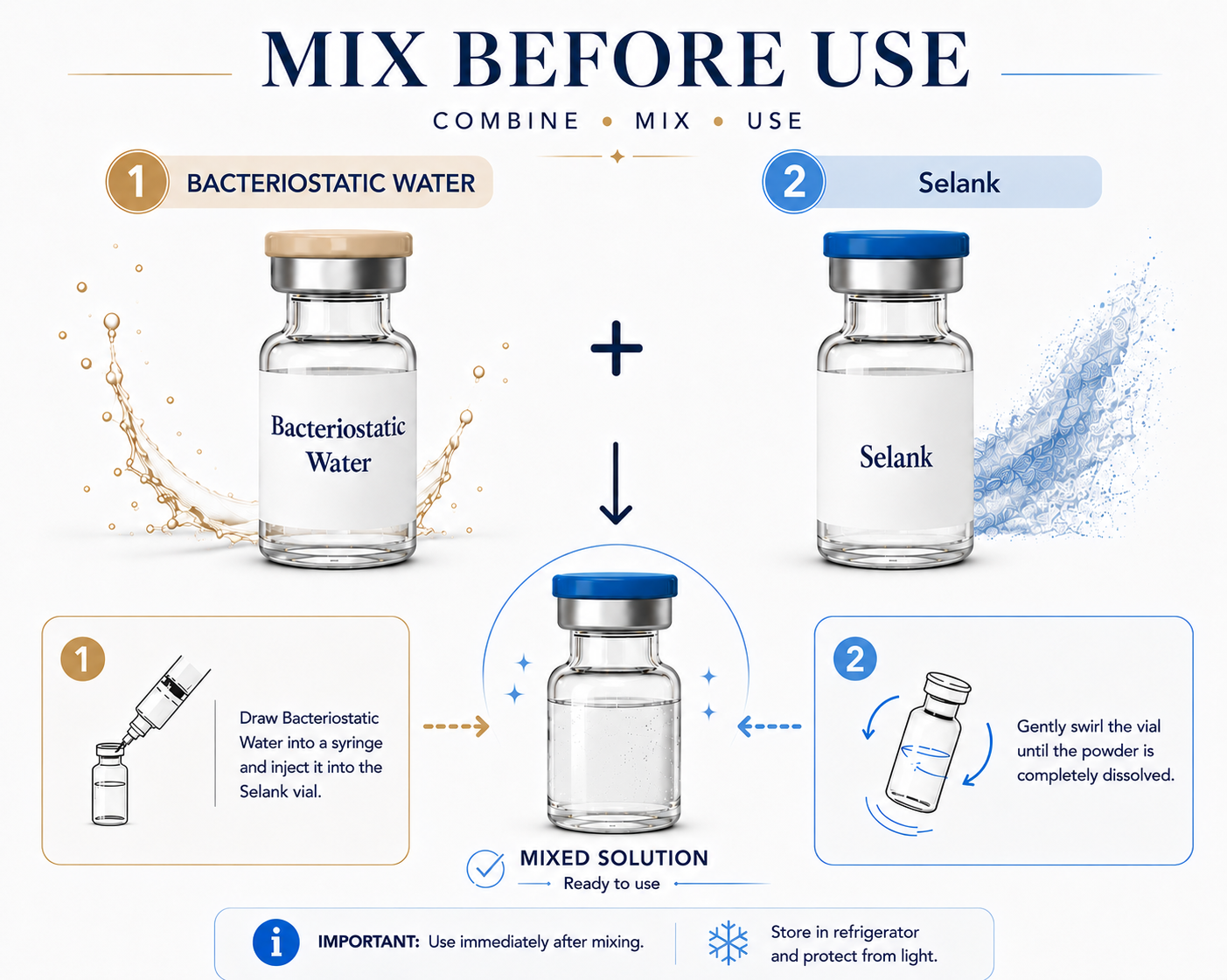
How To Mix Selank
1
CleanUse alcohol swabs to clean the tops of both vials.
2
Draw BAC WaterDraw the selected amount of bacteriostatic water.
3
Inject SlowlyAdd the liquid slowly down the side of the vial.
4
Swirl GentlyDo not shake. Swirl gently until dissolved.
5
Store ProperlyStore as directed and protect from heat and light.
Best Practices & Common Mistakes
Best Practices
- Use sterile technique.
- Protect from light and heat.
- Store refrigerated when appropriate.
- Use clean syringe-unit math before measuring.
Common Mistakes
- Confusing milligrams with milliliters.
- Choosing an option with awkward decimal units.
- Using too little liquid for very small measurements.
- Shaking the vial aggressively.
Selank Storage & Handling
Lyophilized Powder: −20°C (−4°F) for long-term storage (up to 24 months). Refrigeration 2–8°C (36–46°F) for short-term use (up to ~3 months). Original sealed vial in the freezer is safest.
Reconstituted Solution: 2–8°C (36–46°F), use within ~7–14 days. Keep sealed, avoid light, and do not repeat freeze-thaw cycles.
Reconstituted Solution: 2–8°C (36–46°F), use within ~7–14 days. Keep sealed, avoid light, and do not repeat freeze-thaw cycles.
Frequently Asked Questions
Selank acts by modifying gene expression. Research has identified that it specifically alters the expression of four key genes: Drd1a, Drd2, Slc6a13, and Ptgs2, which are involved in dopamine signaling and GABA transport. Because some of its downstream effects rely on protein transcription and translation, the biological response to a given mg dose is not linear in time. A single subcutaneous injection may produce a rapid, short-term anxiolytic effect while simultaneously initiating a slower, longer-lasting genetic reprogramming. Your calculator will output a volume based purely on mass, but an effective research protocol must consider that the same dose will produce two different effect curves: an immediate, receptor-mediated component and a delayed, gene-expression component.
The calculator’s number is a mathematical maximum that does not reflect reality. The specific stability guidance for Selank states: after reconstitution, the peptide should be stored at 4 °C for only 2–7 days, and for long-term storage, it is recommended to add a carrier protein like 0.1% HSA or BSA. Furthermore, aqueous solutions of Selank should not be stored for more than one day at room temperature; for longer storage, stock solutions must be kept at -20°C (for one month) or -80°C (for up to six months). If your protocol calls for daily injections over a three-week period, the calculator’s suggested dose count might be 21, but you will never be able to use the 21st dose from a single vial without significant degradation. You must plan to prepare fresh, small batches or freeze aliquots for long-term use.
The calculator cannot know that Selank is reported to have no sedative, cognitive-impairing, or addictive properties. A comparative safety analysis shows that, unlike benzodiazepines, Selank is not associated with drowsiness, cognitive impairment (amnesia/confusion), dependence, or withdrawal. The most commonly reported side effect is mild nasal irritation when administered intranasally. This means that even a high mg dose calculated by your tool might not impair motor function or cause tolerance, a major difference from traditional drugs. Your calculator treats mass as the only variable, but for Selank, the risk of side effects does not scale with dose in the same way as for other molecules.
The calculator will produce a pure mass output, but the route of administration fundamentally changes the dosage. The official product is dosed by drops: 2–3 drops (approximately 400–600 mg) in each nostril, 2–3 times a day. One vial lasts for about 5–14 days. In contrast, subcutaneous injection delivers the peptide systemically and is often reported to require a lower absolute mass than intranasal administration to achieve a similar effect, because intranasal delivery must cross the olfactory epithelium. The peptide’s ability to pass the blood-brain barrier (BBB) is crucial here; Selank itself has varying reported ability to cross the BBB, but the amidated version is designed to be better. If you use the calculator’s subcutaneous-derived dose but switch to an intranasal route, you will likely under-dose the research subject.
The calculator only sees the mg number you type. If you have a 5 mg vial of Selank (diacetate) and you enter “5” into the calculator, the tool assumes you are delivering 5 mg of the active peptide. However, because the salt form includes two acetate ions, the actual active peptide content is only about 86 % of the total mass (751.87 ÷ 872.0). If your protocol requires a specific molar concentration based on the free base, you will be systematically under-dosing by about 14 %. For most experiments, this error might be acceptable, but for precise receptor binding or dose-escalation studies, it is significant. Your Certificate of Analysis will specify whether the purity is given for the salt or the active core; you must manually adjust the entered mg value, as the calculator cannot.
Practical takeaway: If your real goal is weight or metabolic health, the most useful next step is discussing approved treatment options with a clinician rather than relying on an unapproved compound.
Important: This tool is for informational and research-reference purposes only. Not intended for human or veterinary use.