N-Acetyl Semax Amidate Reconstitution Calculator
Enter the amount you want to measure. The vial buttons will highlight which vial strengths create cleaner syringe-unit measurements.
What amount do you need?
Type the target amount, then choose mg or mcg. Example: 2mg or 500mcg.
Syringe size:
Possible vial strengths:
Best Match
Good Match
Usable
Harder to Measure
Example N-Acetyl Semax Amidate Titration Schedule
| Week | Daily Dose (mcg) | Injection Volume (mL / Units) |
|---|---|---|
| Weeks 1–2 | 200 mcg (0.200 mg) | 0.06 mL (6 units) |
| Weeks 3–4 | 300 mcg (0.300 mg) | 0.09 mL (9 units) |
| Weeks 5–6 | 400 mcg (0.400 mg) | 0.12 mL (12 units) |
| Weeks 7–12 | 500 mcg (0.500 mg) | 0.15 mL (15 units) |
Possible vial strengths:
What Is It?
N-Acetyl Semax Amidate
Stabilised semax variant.
Bacteriostatic Water
Sterile water containing a bacteriostatic preservative, commonly used when preparing multi-use research vials.
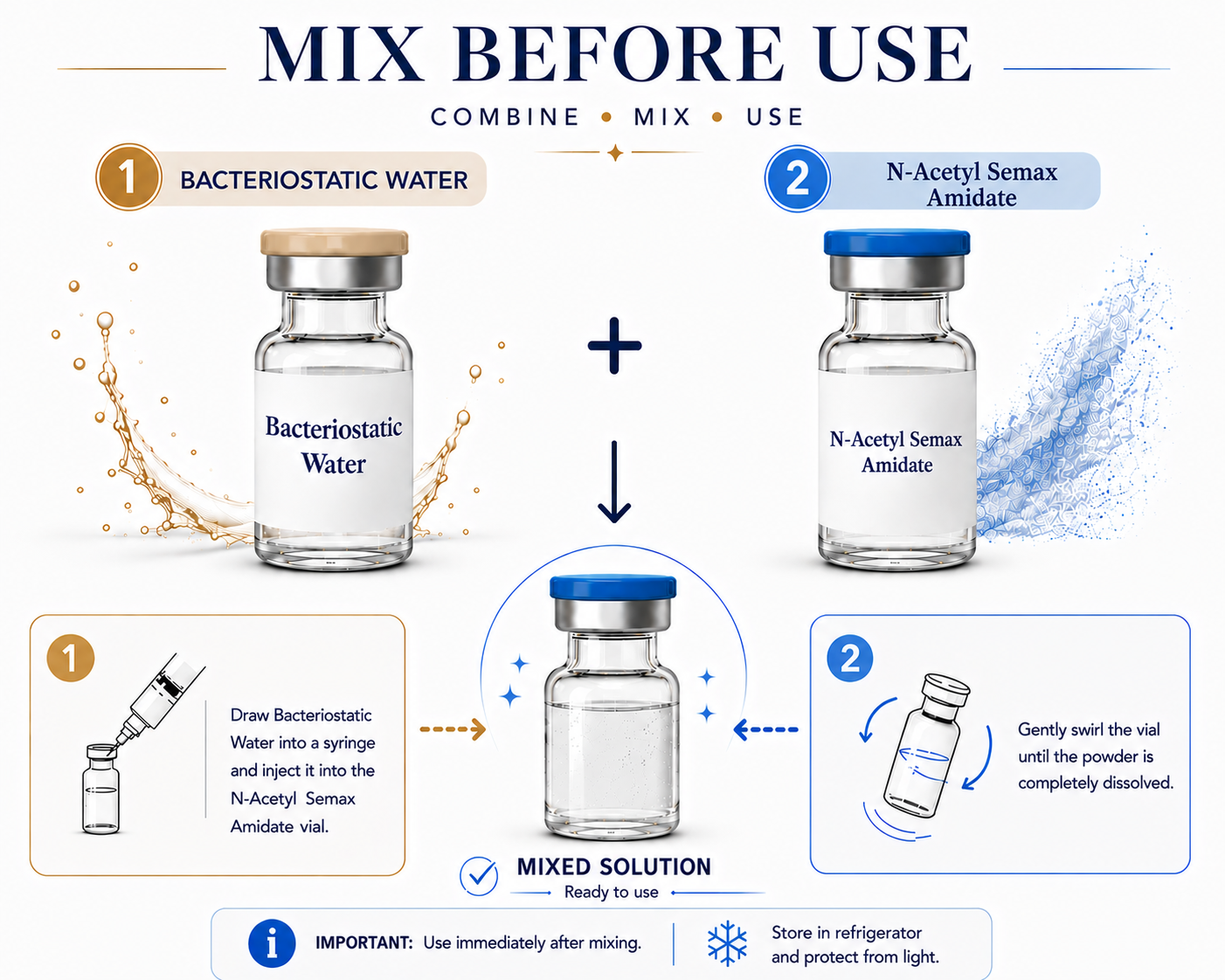
How To Mix N-Acetyl Semax Amidate
1
CleanUse alcohol swabs to clean the tops of both vials.
2
Draw BAC WaterDraw the selected amount of bacteriostatic water.
3
Inject SlowlyAdd the liquid slowly down the side of the vial.
4
Swirl GentlyDo not shake. Swirl gently until dissolved.
5
Store ProperlyStore as directed and protect from heat and light.
Best Practices & Common Mistakes
Best Practices
- Use sterile technique.
- Protect from light and heat.
- Store refrigerated when appropriate.
- Use clean syringe-unit math before measuring.
Common Mistakes
- Confusing milligrams with milliliters.
- Choosing an option with awkward decimal units.
- Using too little liquid for very small measurements.
- Shaking the vial aggressively.
N-Acetyl Semax Amidate Storage & Handling
Lyophilized Powder: −20°C (−4°F) for long-term storage (up to 24 months). Refrigeration 2–8°C (36–46°F) for short-term use (up to ~3 months). Original sealed vial in the freezer is safest.
Reconstituted Solution: 2–8°C (36–46°F), use within ~7–14 days. Keep sealed, avoid light, and do not repeat freeze-thaw cycles.
Reconstituted Solution: 2–8°C (36–46°F), use within ~7–14 days. Keep sealed, avoid light, and do not repeat freeze-thaw cycles.
Frequently Asked Questions
The calculator's Doses per vial count is a static number based on mass, but for standard Semax, the practical limit for using a single reconstituted vial is only 2‑7 days at 4°C. The dual modifications significantly alter this timeline: researchers report that N‑Acetyl Semax Amidate resists degradation 30 minutes longer in blood plasma than unmodified Semax and also exhibits heightened stability in brain tissue. Consequently, the reconstituted solution can be reliably stored for up to one month at 2‑8°C. Therefore, the calculator’s displayed number of doses is a realistic guide for multi‑week protocols, provided the solution is kept refrigerated, whereas standard Semax would likely have degraded beyond use within a week.
The solubility ceiling is a critical constraint that your calculator does not flag. It will mechanically calculate concentrations at any volume, but if the calculator suggests a combination that pushes the concentration above 5 mg/mL (e.g., 10 mg in 2 mL = 5 mg/mL, but 20 mg in 2 mL = 10 mg/mL), the peptide may not fully dissolve. The official technical data specifies that the peptide is Soluble in sterile or bacteriostatic water, and for optimal results, the formulation should be prepared at 1‑5 mg/mL. If you attempt to use a smaller BAC volume, the powder may remain cloudy or form particles, leading to inaccurate dosing even though the calculator's output appears mathematically correct.
The calculator’s "Best" match prioritises mathematical neatness, but the research dose range tells a different story. For the N‑Acetyl Amidate version, common doses vary by route: intranasal 200‑400 mcg, subcutaneous 400‑800 mcg. For a subcutaneous dose of 0.6 mg, a 5 mg/mL concentration (1 mL BAC) would require a draw of 0.12 mL (12 units). While this is a small volume, it is not problematic. The issue arises if a researcher uses the calculator to reconstitute a 10 mg vial with 1 mL BAC (10 mg/mL) and then draws a 0.6 mg dose, which would be 0.06 mL (6 units). This very small volume significantly increases the risk of measurement error. The calculator cannot weigh this practical clinical risk; you must choose your BAC volume to ensure your target dose results in a comfortable, measurable draw volume.
This is a case where you override the calculator's Best/Good/Usable rating. You want a final concentration of 2 mg/mL. To achieve this, you add 5 mL of BAC water to a 10 mg vial (10 mg / 5 mL = 2 mg/mL). The calculator will allow you to select "5 mL" as the BAC volume. However, this 5 mL volume might be rated as "Good" or "Usable" because the unit math for your specific desired dose may not be perfectly round. Nevertheless, this concentration is scientifically optimal for peptide stability. You should ignore the calculator's colour‑coding and trust the empirically validated concentration that ensures complete dissolution and solution stability for the entire study duration.
The calculator assumes the peptide stays chemically intact. However, the methionine residue (Met) in the Ac‑Met‑Glu‑His‑Phe‑Pro‑Gly‑Pro‑NH₂ sequence is prone to oxidation when in solution, potentially forming a sulfoxide and reducing potency. The free thiol group adds to the risk of oxidative degradation, especially if the solution is exposed to repeated air exchanges (common when a vial is punctured many times). To preserve potency for the full number of doses calculated, you must take active measures: after reconstitution, use sterile technique, aliquot the solution into smaller single‑use vials to minimise repeated air exposure, and store at 2‑8°C. If you simply keep a single vial and draw from it daily for 30 days, the later doses may have degraded, rendering the calculator's dose count inaccurate.
Practical takeaway: If your real goal is weight or metabolic health, the most useful next step is discussing approved treatment options with a clinician rather than relying on an unapproved compound.
Important: This tool is for informational and research-reference purposes only. Not intended for human or veterinary use.