Pinealon Reconstitution Calculator
Enter the amount you want to measure. The vial buttons will highlight which vial strengths create cleaner syringe-unit measurements.
What amount do you need?
Type the target amount, then choose mg or mcg. Example: 2mg or 500mcg.
Syringe size:
Possible vial strengths:
Best Match
Good Match
Usable
Harder to Measure
Example Pinealon Titration Schedule
| Protocol Item | Guidance |
|---|---|
| Dose | 1–5 mg per dose |
| Loading Phase (Year 1) | Month 1: Daily |
| Maintenance (Year 2+) | 10–20 day cycles, about 3× per year, spaced evenly |
Possible vial strengths:
What Is It?
Pinealon
Pineal peptide bioregulator.
Bacteriostatic Water
Sterile water containing a bacteriostatic preservative, commonly used when preparing multi-use research vials.
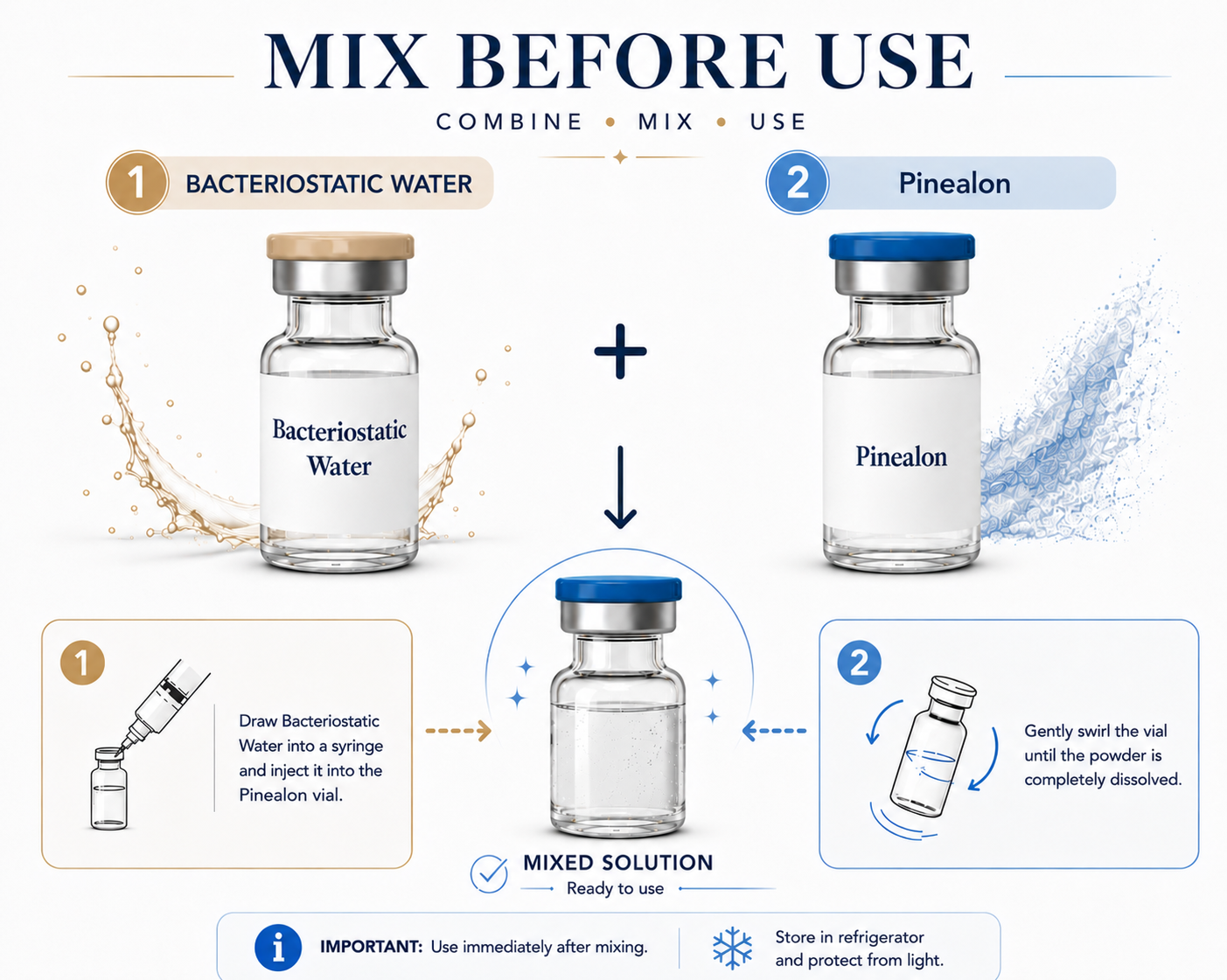
How To Mix Pinealon
1
CleanUse alcohol swabs to clean the tops of both vials.
2
Draw BAC WaterDraw the selected amount of bacteriostatic water.
3
Inject SlowlyAdd the liquid slowly down the side of the vial.
4
Swirl GentlyDo not shake. Swirl gently until dissolved.
5
Store ProperlyStore as directed and protect from heat and light.
Best Practices & Common Mistakes
Best Practices
- Use sterile technique.
- Protect from light and heat.
- Store refrigerated when appropriate.
- Use clean syringe-unit math before measuring.
Common Mistakes
- Confusing milligrams with milliliters.
- Choosing an option with awkward decimal units.
- Using too little liquid for very small measurements.
- Shaking the vial aggressively.
Pinealon Storage & Handling
Lyophilized Powder: −20°C (−4°F) for long-term storage (up to 24 months). Refrigeration 2–8°C (36–46°F) for short-term use (up to ~3 months). Original sealed vial in the freezer is safest.
Reconstituted Solution: 2–8°C (36–46°F), use within ~7–14 days. Keep sealed, avoid light, and do not repeat freeze-thaw cycles.
Reconstituted Solution: 2–8°C (36–46°F), use within ~7–14 days. Keep sealed, avoid light, and do not repeat freeze-thaw cycles.
Frequently Asked Questions
Your calculator is a dilution tool that assumes that if you double the entered mass, the biological effect will roughly double. However, Pinealon’s mechanism of action is fundamentally different. It is a synthetic tripeptide (Glu‑Asp‑Arg) that functions as a cytogen – it penetrates the cell nucleus, binds directly to specific DNA sequences (showing a preference for CAG‑containing sequences), and modulates gene expression in a sequence‑specific manner. Because its primary effect is epigenetic (turning genes on or off), the dose‑response curve is not simple. Research has shown that in neuronal cells, the restriction of ROS accumulation saturates at lower concentrations, while cell cycle modulation continues at higher concentrations. Therefore, the same mg mass calculated by your tool could produce a very different biological outcome depending on whether you are targeting the antioxidant or gene‑expression pathway.
The calculator assumes that all peptides have similar solubility characteristics. In reality, due to the presence of charged residues like glutamic acid and arginine, the solubility of Pinealon is generally excellent, and it is described as “aqueous soluble”. For a 10 mg or 20 mg vial, using the calculator’s recommended volume of 1‑3 mL of BAC water should easily create a clear, stable solution. The risk here is not that it won’t dissolve – it’s that a researcher might use an excessive amount of BAC water (e.g., 5 mL for a 10 mg vial), producing a large weekly injection volume that is unnecessarily painful, just because the calculator marked it as “Best”. The small size and high polarity mean you can confidently use 1‑2 mL of BAC water to achieve a highly concentrated solution, as long as the units remain accurately measurable.
The generic calculator protocol assumes you can add cold BAC water directly from the refrigerator to a cold vial, and the powder will dissolve. For Pinealon, however, the recommended handling is to allow both the peptide and the chosen solvent to reach ambient laboratory temperature before reconstitution to help maintain structural integrity during dissolution. A sudden temperature shock (placing cold liquid on a cold powder) can cause aggregation or a temporary pH shift that hinders complete dissolution. If a researcher follows the calculator’s generic advice and uses refrigerated BAC water directly, the powder may not fully dissolve, and the syringe draw will contain an unpredictable amount of peptide. The calculator does not, and cannot, include this preparation step in its instruction set.
The calculator’s “Doses per vial” is a pure mathematical count. For Pinealon, the manufacturer‑specified storage guidelines state that the lyophilised powder should be stored desiccated below –18 °C for long‑term stability, but upon reconstitution, the peptide should be stored at 4 °C between 2‑21 days. If the calculator shows 50 “doses per vial” for a very low-dose protocol, but the solution will be chemically degraded after 21 days, you will never be able to use all 50 doses from a single vial. The 21‑day stability window is a hard chemical limit that the calculator cannot communicate. Therefore, you should align your protocol design so that the total volume you reconstitute is completely used within 21 days, regardless of what the theoretical “doses per vial” number suggests.
The calculator cannot warn you about extremely low unit volumes. Research protocols have used doses as low as 50‑200 ng/kg in rats to achieve cognitive effects. For a 70 kg human equivalent, this would be about 3.5‑14 µg (0.0035‑0.014 mg) per dose. The calculator would typically output an immeasurably small syringe volume for these low doses. Instead of using the calculator for the final injection volume, use it to create a highly concentrated stock solution by dissolving, for example, a 20 mg vial in 2 mL of BAC water (10 mg/mL). Then, take 0.1 mL of that stock solution and further dilute it with 9.9 mL of sterile water in a sterile vial to create a 0.1 mg/mL working solution. The calculator can help you with the initial reconcentration, but you must perform the secondary dilution manually, as the calculator is not designed for serial dilutions. This two‑step process allows you to draw a comfortable, measurable volume (e.g., 10‑20 units) that contains only a few micrograms of Pinealon, a task the calculator alone cannot directly accomplish.
Practical takeaway: If your real goal is weight or metabolic health, the most useful next step is discussing approved treatment options with a clinician rather than relying on an unapproved compound.
Important: This tool is for informational and research-reference purposes only. Not intended for human or veterinary use.