PRL-8-53 Reconstitution Calculator
Enter the amount you want to measure. The vial buttons will highlight which vial strengths create cleaner syringe-unit measurements.
What amount do you need?
Type the target amount, then choose mg or mcg. Example: 2mg or 500mcg.
Syringe size:
Possible vial strengths:
Best Match
Good Match
Usable
Harder to Measure
Example PRL-8-53 Titration Schedule
| Parameter | Details |
|---|---|
| Typical Dosage | 5–20 mg/day (common baseline). 5 mg starting dose recommended |
| Route | Oral |
| Frequency | As needed; some cycle 5 days on / 2 days off |
| Cycle Length | Variable (no established cycle) |
| Onset of Action | 2–2.5 hours (1978 human study timing) |
| Half‑life | Not established |
| Important Notes | Research chemical; exact mechanism unknown; may act as a dopamine agonist |
Possible vial strengths:
What Is It?
PRL-8-53
Memory-research benzyl amine compound.
Bacteriostatic Water
Sterile water containing a bacteriostatic preservative, commonly used when preparing multi-use research vials.
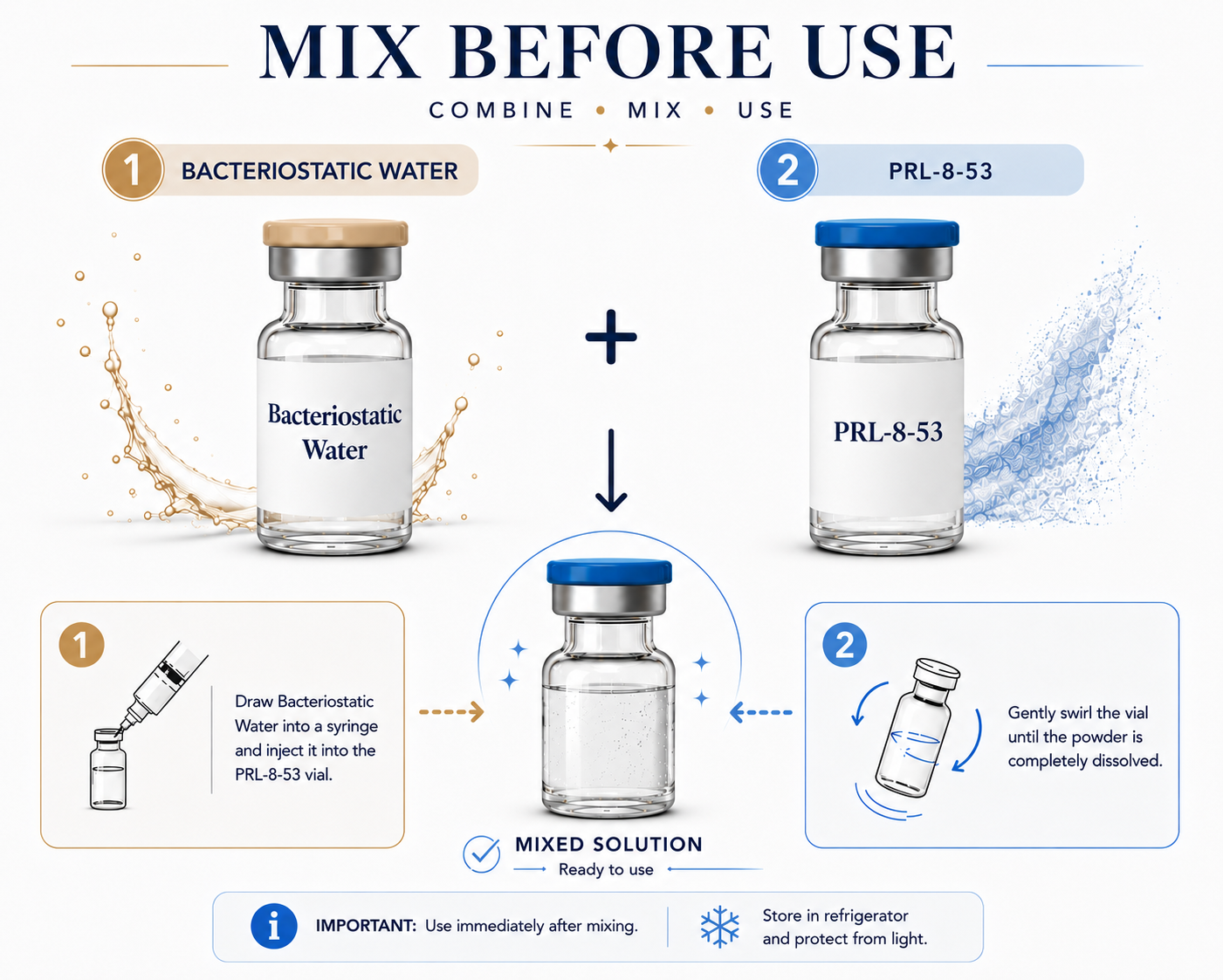
How To Mix PRL-8-53
1
CleanUse alcohol swabs to clean the tops of both vials.
2
Draw BAC WaterDraw the selected amount of bacteriostatic water.
3
Inject SlowlyAdd the liquid slowly down the side of the vial.
4
Swirl GentlyDo not shake. Swirl gently until dissolved.
5
Store ProperlyStore as directed and protect from heat and light.
Best Practices & Common Mistakes
Best Practices
- Use sterile technique.
- Protect from light and heat.
- Store refrigerated when appropriate.
- Use clean syringe-unit math before measuring.
Common Mistakes
- Confusing milligrams with milliliters.
- Choosing an option with awkward decimal units.
- Using too little liquid for very small measurements.
- Shaking the vial aggressively.
PRL-8-53 Storage & Handling
Lyophilized Powder: −20°C (−4°F) for long-term storage (up to 24 months). Refrigeration 2–8°C (36–46°F) for short-term use (up to ~3 months). Original sealed vial in the freezer is safest.
Reconstituted Solution: 2–8°C (36–46°F), use within ~7–14 days. Keep sealed, avoid light, and do not repeat freeze-thaw cycles.
Reconstituted Solution: 2–8°C (36–46°F), use within ~7–14 days. Keep sealed, avoid light, and do not repeat freeze-thaw cycles.
Frequently Asked Questions
The published human data used a single 5 mg oral dose, not an injection. The cognitive tests were performed 120–150 minutes (2–2.5 hours) after ingestion, indicating this is the approximate time to reach peak blood levels. Your calculator assumes immediate action after injection, which is not accurate for PRL‑8‑53.
The only human trial used a fixed 5 mg dose (~0.07 mg/kg for a 70 kg subject). However, the patent describes a much broader effective range of 0.01–4 mg/kg, with an “ideal” range of 0.05–1.2 mg/kg. The calculator cannot know the context for the dose‑response, and has no built‑in logic for the “linear scaling” of such a wide, untested range.
PRL‑8‑53 (hydrochloride) has a solubility of only 10 mg/mL in PBS (pH 7.2). To achieve full dissolution for a stock solution, you should use DMSO, DMF, or ethanol (30 mg/mL each) as the primary solvent, and then dilute that stock into the final vehicle. BAC water alone may not achieve the desired concentration without sonication.
The dry powder remains stable for up to 3 years at ‑20 °C. For the in‑solution stock (in DMSO), store aliquots at ‑80 °C for ≤6 months, or ‑20 °C for ≤1 month. Refrigeration at 4 °C in solution is not recommended for long‑term storage of PRL‑8‑53. Your calculator’s “28‑day refrigerator” assumption would lead to significant degradation.
The exact mechanism is unknown, but rodent studies show it is a dopamine agonist. In the conditioned avoidance learning model, PRL‑8‑53 exhibited a dose‑dependent effect in the 5‑20 mg/kg oral range. The calculator assumes a perfectly linear dose‑response, but the dopamine agonist effect may saturate at higher doses, producing a ceiling effect that the tool’s outputs cannot predict.
Practical takeaway: If your real goal is weight or metabolic health, the most useful next step is discussing approved treatment options with a clinician rather than relying on an unapproved compound.
Important: This tool is for informational and research-reference purposes only. Not intended for human or veterinary use.