PE-22-28 Reconstitution Calculator
Enter the amount you want to measure. The vial buttons will highlight which vial strengths create cleaner syringe-unit measurements.
What amount do you need?
Type the target amount, then choose mg or mcg. Example: 2mg or 500mcg.
Syringe size:
Possible vial strengths:
Best Match
Good Match
Usable
Harder to Measure
Example PE-22-28 Titration Schedule
| Protocol Item | Guidance |
|---|---|
| Dosing | 200–600 mcg daily |
| Cycling | Daily for 30-day cycles (or shorter), with a 30-day minimum cycle break between |
| Daily Dose | Volume @ 4 mg/mL (8 mg / 2.0 mL) |
| 200 mcg (0.2 mg) | 0.05 mL (5 units) |
| 400 mcg (0.4 mg) | 0.10 mL (10 units) |
| 600 mcg (0.6 mg) | 0.15 mL (15 units) |
Possible vial strengths:
What Is It?
PE-22-28
Spadin analogue studied for mood models.
Bacteriostatic Water
Sterile water containing a bacteriostatic preservative, commonly used when preparing multi-use research vials.
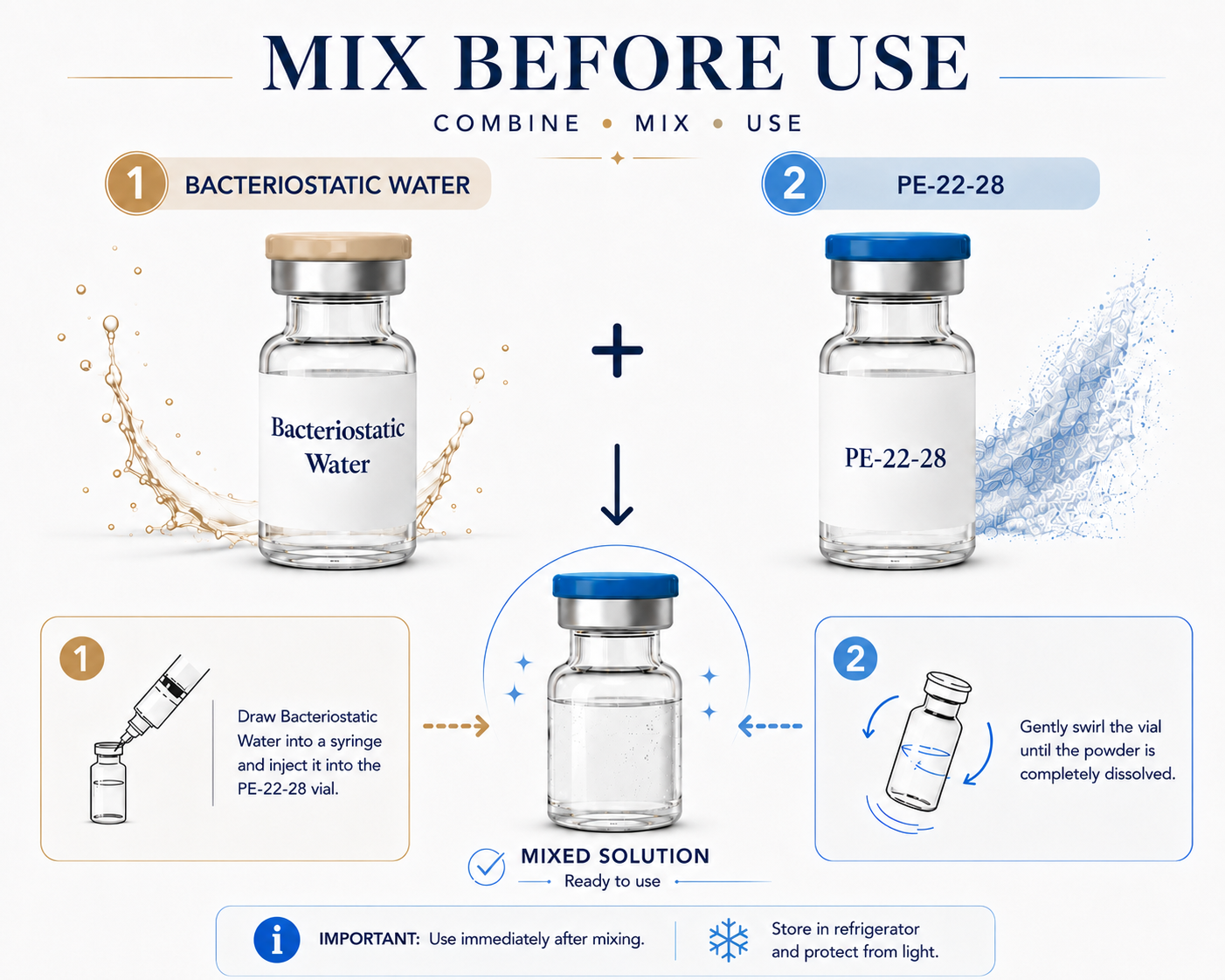
How To Mix PE-22-28
1
CleanUse alcohol swabs to clean the tops of both vials.
2
Draw BAC WaterDraw the selected amount of bacteriostatic water.
3
Inject SlowlyAdd the liquid slowly down the side of the vial.
4
Swirl GentlyDo not shake. Swirl gently until dissolved.
5
Store ProperlyStore as directed and protect from heat and light.
Best Practices & Common Mistakes
Best Practices
- Use sterile technique.
- Protect from light and heat.
- Store refrigerated when appropriate.
- Use clean syringe-unit math before measuring.
Common Mistakes
- Confusing milligrams with milliliters.
- Choosing an option with awkward decimal units.
- Using too little liquid for very small measurements.
- Shaking the vial aggressively.
PE-22-28 Storage & Handling
Lyophilized Powder: −20°C (−4°F) for long-term storage (up to 24 months). Refrigeration 2–8°C (36–46°F) for short-term use (up to ~3 months). Original sealed vial in the freezer is safest.
Reconstituted Solution: 2–8°C (36–46°F), use within ~7–14 days. Keep sealed, avoid light, and do not repeat freeze-thaw cycles.
Reconstituted Solution: 2–8°C (36–46°F), use within ~7–14 days. Keep sealed, avoid light, and do not repeat freeze-thaw cycles.
Frequently Asked Questions
PE-22-28 is a highly amphipathic peptide containing a hydrophobic tryptophan residue and a strongly basic C-terminal arginine, which limits its water solubility. When reconstituting a 10 mg vial, a solubility ceiling of 2 mg/mL means you must use at least 5 mL of BAC water (10 mg / 2 mg/mL). Using the calculator’s default small BAC volumes (e.g., 1 mL) would attempt to create a 10 mg/mL solution, exceeding the peptide’s solubility limit by a factor of five. The result will be a cloudy, partially dissolved solution that leads to unpredictable dosing. Always ensure the final concentration does not exceed 2 mg/mL, even if the calculator marks a smaller volume as “Best” for unit roundness.
No, and this may be misleading. PE-22-28 was developed from spadin degradation products and blocks the TREK‑1 potassium channel with an IC₅₀ of just 0.12 nM, making it several hundred times more potent than its parent molecule spadin. In living animal studies, the duration of action of PE‑22‑28 is about 23 hours, compared to only 7 hours for spadin. A single daily dose of as little as 3 μg/kg (intraperitoneal) is already sufficient to induce antidepressant‑like effects in mice. If you simply enter a higher mg value into the calculator expecting a proportionally stronger effect, you may surpass the optimal therapeutic window and produce no additional benefit—or even a reduced effect—due to the unusually high potency and prolonged duration of this peptide.
The peptide is most commonly supplied as a trifluoroacetate (TFA) or acetate salt. For a typical acetate salt formulation, the peptide may dissolve more readily in acidic conditions. If you simply add BAC water and the solution remains cloudy (exceeding the 2 mg/mL limit), you can warm the tube to 37 °C and shake it in an ultrasonic bath to improve dissolution without compromising the integrity of the lyophilised material. Your calculator cannot warn you about this need for additional physical agitation, which is specific to acetate formulations of this heptapeptide.
The specialised handling note for PE‑22‑28 instructs researchers to allow both the peptide and chosen solvent to reach ambient laboratory temperature before reconstitution to help maintain structural integrity during dissolution. If you follow the calculator’s generic protocol and immediately add cold BAC water directly from the refrigerator, the sudden temperature shock can cause aggregation of the peptide, leading to an incompletely dissolved solution and inaccurate syringe draws, even if the final concentration is mathematically correct. The peptide’s sequence contains a tryptophan residue that is particularly sensitive to aggregation when combined with a hydrophobic core region, making this pre‑warming step essential.
The peptide’s design ensures enhanced stability in biological fluids, but after reconstitution in BAC water, the solution can be stored at 2‑8 °C for up to 28 days under sterile conditions before significant degradation begins, as per the manufacturer’s data sheet for this peptide. The calculator’s mathematical “Doses per vial” number is a maximum theoretical count based purely on mass. If you have a 10 mg vial and plan to use it for more than 4 weeks (e.g., 30 daily doses), the later injections may contain degraded material. The 28‑day stability window is a real chemical constraint that the calculator does not display. Always align your usage plan with the 28‑day shelf life to ensure consistent potency for the entire study duration.
Practical takeaway: If your real goal is weight or metabolic health, the most useful next step is discussing approved treatment options with a clinician rather than relying on an unapproved compound.
Important: This tool is for informational and research-reference purposes only. Not intended for human or veterinary use.