P21 (P021) Reconstitution Calculator
Enter the amount you want to measure. The vial buttons will highlight which vial strengths create cleaner syringe-unit measurements.
What amount do you need?
Type the target amount, then choose mg or mcg. Example: 2mg or 500mcg.
Syringe size:
Possible vial strengths:
Best Match
Good Match
Usable
Harder to Measure
Example P21 (P021) Titration Schedule
| Protocol Item | Guidance |
|---|---|
| Dose | 100–500 mcg per dose |
| Cycling | Daily, for 30-day cycles (or shorter), with a 30-day minimum cycle break between |
Possible vial strengths:
What Is It?
P21 (P021)
CNTF-derived peptide in neurogenesis research.
Bacteriostatic Water
Sterile water containing a bacteriostatic preservative, commonly used when preparing multi-use research vials.
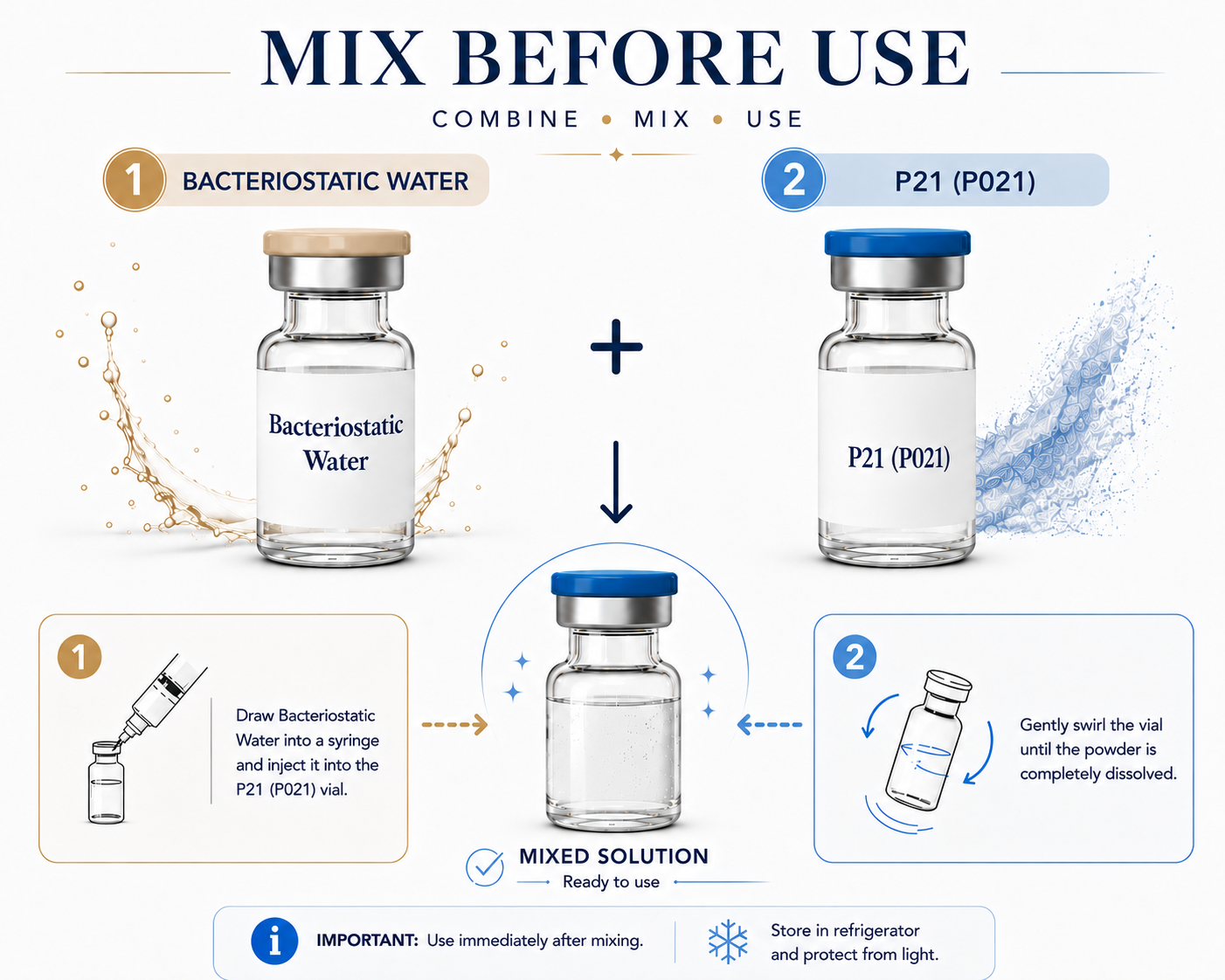
How To Mix P21 (P021)
1
CleanUse alcohol swabs to clean the tops of both vials.
2
Draw BAC WaterDraw the selected amount of bacteriostatic water.
3
Inject SlowlyAdd the liquid slowly down the side of the vial.
4
Swirl GentlyDo not shake. Swirl gently until dissolved.
5
Store ProperlyStore as directed and protect from heat and light.
Best Practices & Common Mistakes
Best Practices
- Use sterile technique.
- Protect from light and heat.
- Store refrigerated when appropriate.
- Use clean syringe-unit math before measuring.
Common Mistakes
- Confusing milligrams with milliliters.
- Choosing an option with awkward decimal units.
- Using too little liquid for very small measurements.
- Shaking the vial aggressively.
P21 (P021) Storage & Handling
Lyophilized Powder: −20°C (−4°F) for long-term storage (up to 24 months). Refrigeration 2–8°C (36–46°F) for short-term use (up to ~3 months). Original sealed vial in the freezer is safest.
Reconstituted Solution: 2–8°C (36–46°F), use within ~7–14 days. Keep sealed, avoid light, and do not repeat freeze-thaw cycles.
Reconstituted Solution: 2–8°C (36–46°F), use within ~7–14 days. Keep sealed, avoid light, and do not repeat freeze-thaw cycles.
Frequently Asked Questions
The confusion is real and dangerous for a peptide calculator. The name “P21” can refer to either the peptide of interest (P021, the CNTF mimetic) or p21ᴺ⁰ᵀᴵ⁼⁼ᶠ, a cyclin‑dependent kinase inhibitor (CDKI) that plays a central role in cell‑cycle arrest and tumour suppression. P021 was rationally designed from the active region of CNTF, while p21ᴺ⁰ᵀᴵ⁼⁼ᶠ is an intracellular protein that works by blocking CDK‑cyclin complexes. Research products with the wrong labelling could contain a completely different molecule. Before using any calculator, a researcher must verify the peptide sequence (P021 has the unique sequence Ac‑DGGLAG‑NH₂, molecular weight 578.3 g/mol) and confirm with the Certificate of Analysis that it is the CNTF mimetic, not the CDKI, to avoid substituting one research pathway for another.
Your calculator’s concentration maths remains valid for oral preparation, but its syringe‑unit output is irrelevant. P021 has demonstrated greater than 95% stability in artificial gastric juice for over 30 minutes and approximately 100% stability in intestinal fluid for over 2 hours, which allowed researchers to add it directly to the diet at a dose of 60 nM per gram of feed in a 3 × Tg‑AD mouse model, starting as early as 3 months of age and continuing until 21 months. To adapt the calculator, enter your target oral dose in mg (e.g., the total daily mass needed) and your desired final volume of diet solution or drinking water. The calculator will show the correct concentration, but you can completely ignore the “units” display, as the prepared stock will not be injected.
The adamantylated glycine is a bulky, lipophilic group attached to the C‑terminus that acts as a cap, stabilising the active core (the CNTF‑mimetic tetrapeptide) by blocking cleavage by exopeptidases. As a result, the peptide maintains a plasma half‑life of over 3 hours in mice, which is unusually long for a small peptidergic compound. However, this chemical stability in the body does not mean the reconstituted solution is immune to degradation on the bench. P021’s sequence contains residues susceptible to oxidation and aggregation if improperly handled. The lyophilised powder is stable for long periods at –20 °C, but once reconstituted, it should be stored at 4 °C and used within a few weeks. The calculator’s “Doses per vial” count is a mathematical maximum and should be reduced if your protocol extends beyond about 3‑4 weeks of daily draws. For proper long‑term storage after reconstitution, the solution should be aliquoted and frozen at –20 °C, then thawed only once for use.
The calculator will faithfully show a larger volume (or a more concentrated reconstitution) for intranasal doses. However, the reason for the higher intranasal dose is pharmacokinetic, not chemical. Intranasal delivery bypasses the blood‑brain barrier through direct olfactory and trigeminal nerve pathways, but the fraction of the dose that reaches the central nervous system is much lower than that of a subcutaneous injection. For a subcutaneous dose of 500 mcg, the same volume of an intranasal preparation would deliver less active peptide to the target brain regions. Therefore, a researcher cannot simply use the subcutaneous dose in an intranasal setting. The calculator cannot warn about this route‑specific absorption; you must know that for intranasal research, the entered mg dose should be scaled up according to published protocols.
The calculator’s “Doses per vial” is based on the mass you enter and the volume you reconstitute. For a long‑term survival study lasting 18 months, a single vial may not provide all the doses. Moreover, mice that survive longer will continue to consume the peptide, so the total number of vials required will be higher than the theoretical minimum. The calculator cannot predict survival dynamics or the fact that the treatment itself may keep animals alive longer, thereby increasing the total peptide needed. For such studies, always design a safety margin into your vial‑ordering calculations, regardless of what the static “doses per vial” number suggests.
Practical takeaway: If your real goal is weight or metabolic health, the most useful next step is discussing approved treatment options with a clinician rather than relying on an unapproved compound.
Important: This tool is for informational and research-reference purposes only. Not intended for human or veterinary use.