Humanin Reconstitution Calculator
Enter the amount you want to measure. The vial buttons will highlight which vial strengths create cleaner syringe-unit measurements.
What amount do you need?
Type the target amount, then choose mg or mcg. Example: 2mg or 500mcg.
Syringe size:
Possible vial strengths:
Best Match
Good Match
Usable
Harder to Measure
Example Humanin Titration Schedule
| Protocol Item | Guidance |
|---|---|
| Dose | 500 mcg – 5 mg per dose |
| Frequency | Varies from every day to once per week |
| Cycle Length | 30-day cycles (can extend longer depending on goal/response) |
| Minimum Cycle Break | 30-day minimum break between cycles |
| Practical Note | Typically, smaller doses are used for more frequent dosing, with larger doses used for less frequent dosing. |
Possible vial strengths:
What Is It?
Humanin
Mitochondrial-derived peptide.
Bacteriostatic Water
Sterile water containing a bacteriostatic preservative, commonly used when preparing multi-use research vials.
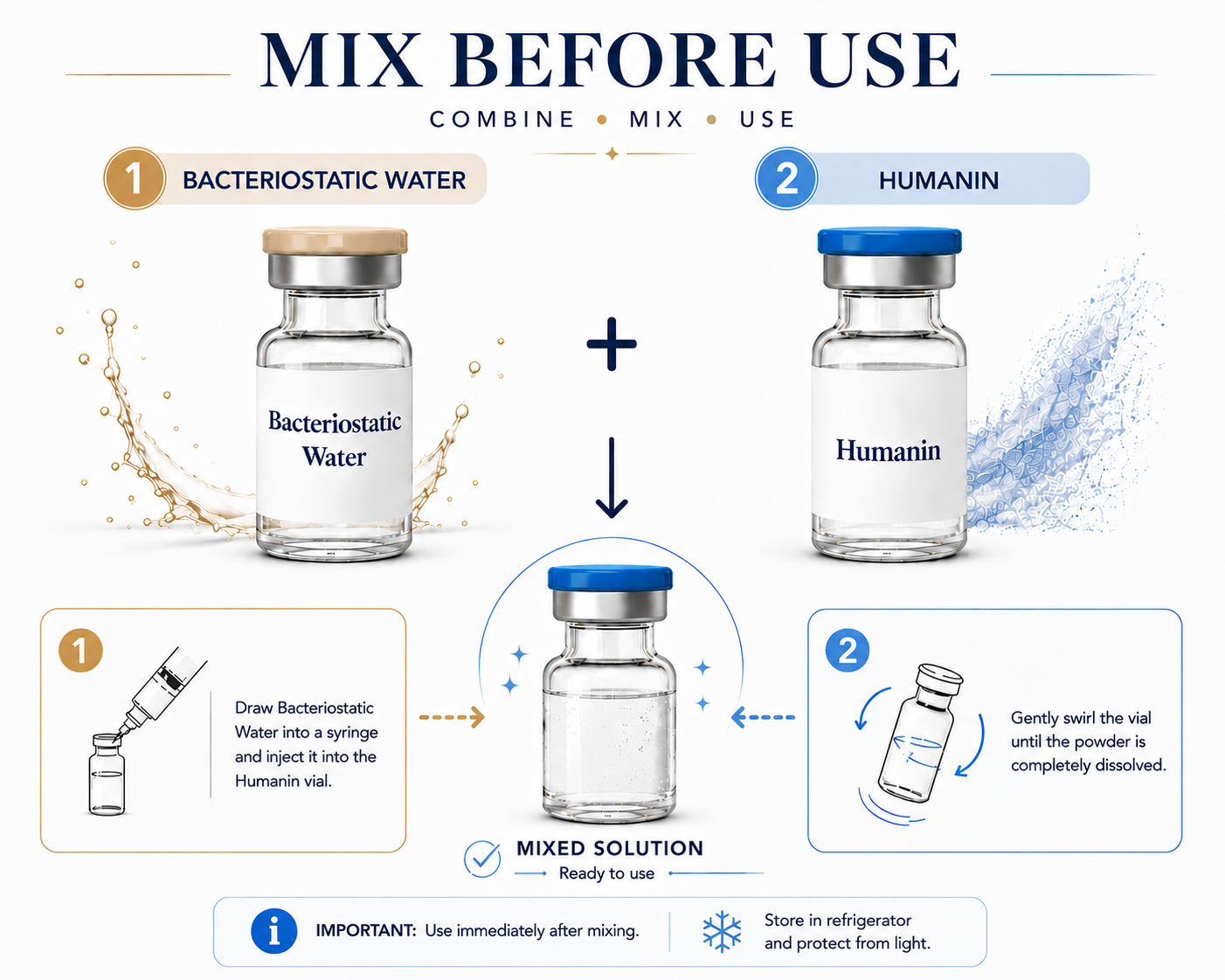
How To Mix Humanin
1
CleanUse alcohol swabs to clean the tops of both vials.
2
Draw BAC WaterDraw the selected amount of bacteriostatic water.
3
Inject SlowlyAdd the liquid slowly down the side of the vial.
4
Swirl GentlyDo not shake. Swirl gently until dissolved.
5
Store ProperlyStore as directed and protect from heat and light.
Best Practices & Common Mistakes
Best Practices
- Use sterile technique.
- Protect from light and heat.
- Store refrigerated when appropriate.
- Use clean syringe-unit math before measuring.
Common Mistakes
- Confusing milligrams with milliliters.
- Choosing an option with awkward decimal units.
- Using too little liquid for very small measurements.
- Shaking the vial aggressively.
Humanin Storage & Handling
Lyophilized Powder: −20°C (−4°F) for long-term storage (up to 24 months). Refrigeration 2–8°C (36–46°F) for short-term use (up to ~3 months). Original sealed vial in the freezer is safest.
Reconstituted Solution: 2–8°C (36–46°F), use within ~7–14 days. Keep sealed, avoid light, and do not repeat freeze-thaw cycles.
Reconstituted Solution: 2–8°C (36–46°F), use within ~7–14 days. Keep sealed, avoid light, and do not repeat freeze-thaw cycles.
Frequently Asked Questions
Your calculator assumes that all peptides are the same and will dissolve as expected. However, Humanin is a small mitochondrial‑derived peptide (MDP) that is not merely a linear polypeptide but is part of a class that includes MOTS‑c and SHLPs. Its secondary structure in water is unique and not fully understood—some analogues exhibit extensive β‑sheet formation. If you reconstitute with bacteriostatic water (pH ~5.5), the peptide may adopt a specific conformation that is different from what is seen in other aqueous buffers. For consistent long‑term stability, some protocols recommend using sterile water and storing at −20 °C. If you use the calculator to create a large‑volume stock solution, you may need to test the solubility in your chosen solvent, as not all water‑based diluents will maintain the same three‑dimensional structure.
Your calculator will not perform the kg‑to‑mg conversion for you. You must manually compute the total mg by multiplying your body weight (in kg) by the desired dose (in μg/kg), then dividing by 1000 to obtain mg. For example, in the study of Humanin’s effect on myocardial infarction, rats received 252 μg/kg intraperitoneally. For a 70 kg subject, that would be 70 × 252 = 17,640 μg, or 17.6 mg. This is far larger than the calculator’s typical vial strengths (5–60 mg) and may require multiple vials or a single very large vial. Your calculator will accurately show the required volume for any mg dose you enter, but you must first calculate the correct mg from the literature.
Your calculator is a dilution tool that works the same for any peptide mass, but it cannot select the optimal analogue for you. In rodent studies, the half‑life of Humanin analogues varies: HNGF6A and HNG in IGFBP‑3‑knockout mice have a longer half‑life than wild‑type HNG. Meanwhile, the half‑life of Humanin itself is longer in rats than in mice. If you are using an analogue such as HNG or HNGF6A, your calculator will accurately reconstitute them to any concentration. However, the number of “doses per vial” calculated assumes a single injection. If your analogue has a prolonged circulation time, you may need fewer doses per week, potentially changing your usage schedule. Conversely, if the standard Humanin has a very short half‑life in your model, you might require more frequent injections, which would reduce the practical number of doses per vial.
Your calculator assumes subcutaneous injection and 100 % bioavailability, but Humanin has been studied by various routes. For example, Humanin‑G (100 μg/kg) has been administered intra‑arterially during resuscitation, and intraperitoneal injections (3 mg/kg) are commonly used in metabolic research. Intratesticular (IT) injections have also been used for reproductive studies. The bioavailability of Humanin from different routes is not well established; an intra‑arterial dose will reach the target organ differently from a subcutaneous injection. Your calculator cannot adjust for these differences. If your research protocol uses a non‑subcutaneous route, you may need to adjust the entered mg dose to account for the expected lower or higher systemic exposure. For this reason, the same mg dose may produce different effects depending on the chosen route.
The calculator’s “doses per vial” count is purely mathematical, but Humanin’s interaction with IGFBP‑3 means that its effects are not strictly dose‑dependent in a linear fashion. In rodents, following HNG injection, both IGF‑1 and IGFBP‑3 levels decrease over time as the peptide binds to its partner. This creates a dynamic equilibrium where the effective dose may be blunted after multiple injections, possibly requiring dose escalation to maintain the same biological effect. The calculator will tell you how many times you can draw a given mg amount from a vial, but it will not warn you that the biological activity may change over time due to receptor or binding protein saturation. For extended studies, you may need to re‑evaluate your dose schedule based on longitudinal measurements of IGF‑1 or IGFBP‑3, rather than just following the calculator’s vial‑usage count.
Practical takeaway: If your real goal is weight or metabolic health, the most useful next step is discussing approved treatment options with a clinician rather than relying on an unapproved compound.
Important: This tool is for informational and research-reference purposes only. Not intended for human or veterinary use.