Argireline Reconstitution Calculator
Enter the amount you want to measure. The vial buttons will highlight which vial strengths create cleaner syringe-unit measurements.
What amount do you need?
Type the target amount, then choose mg or mcg. Example: 2mg or 500mcg.
Syringe size:
Possible vial strengths:
Best Match
Good Match
Usable
Harder to Measure
Example Argireline Titration Schedule
| Parameter | Details |
|---|---|
| Typical Concentration | 5% – 10% in serums or creams (clinical standard: 10%) |
| Frequency | Twice daily (morning and evening) |
| Cycle Length | 4 weeks for initial results; ≥30 days – 3 months for optimal effects |
| Route | Topical (serum, cream, or gel) applied to clean, dry skin on forehead, periorbital area, and face |
| Stability (Lyophilized) | Store at -20°C, stable for 36 months |
| Stability (In Solution) | Store at -20°C, use within 1 month; aliquot to avoid freeze/thaw cycles |
| Mechanism | Mimics SNAP-25 protein; inhibits acetylcholine release at neuromuscular junction, reducing muscle contractions and expression lines |
Possible vial strengths:
What Is It?
Argireline
Acetyl hexapeptide-3 for cosmetic muscle signaling.
Bacteriostatic Water
Sterile water containing a bacteriostatic preservative, commonly used when preparing multi-use research vials.
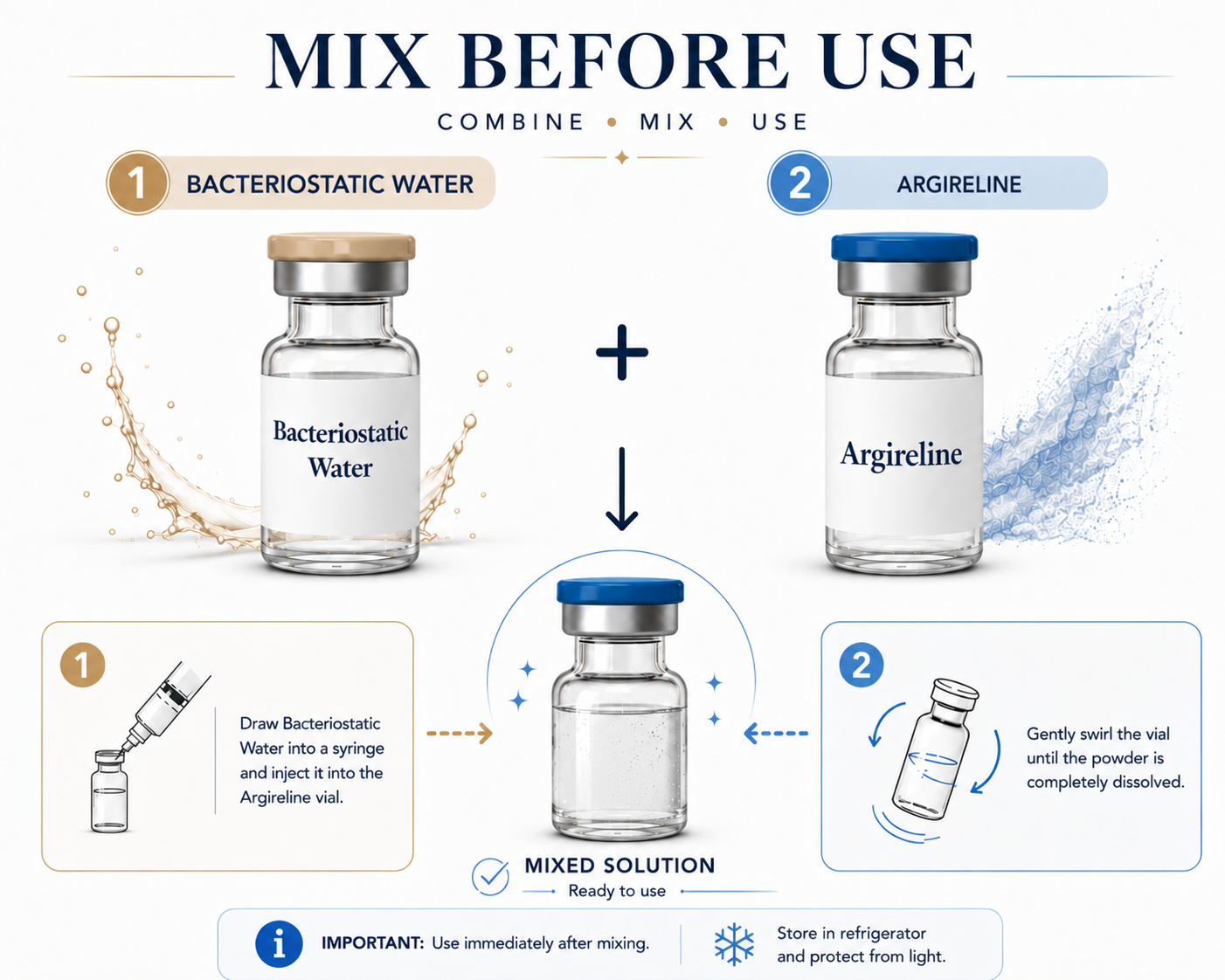
How To Mix Argireline
1
CleanUse alcohol swabs to clean the tops of both vials.
2
Draw BAC WaterDraw the selected amount of bacteriostatic water.
3
Inject SlowlyAdd the liquid slowly down the side of the vial.
4
Swirl GentlyDo not shake. Swirl gently until dissolved.
5
Store ProperlyStore as directed and protect from heat and light.
Best Practices & Common Mistakes
Best Practices
- Use sterile technique.
- Protect from light and heat.
- Store refrigerated when appropriate.
- Use clean syringe-unit math before measuring.
Common Mistakes
- Confusing milligrams with milliliters.
- Choosing an option with awkward decimal units.
- Using too little liquid for very small measurements.
- Shaking the vial aggressively.
Argireline Storage & Handling
Lyophilized Powder: −20°C (−4°F) for long-term storage (up to 24 months). Refrigeration 2–8°C (36–46°F) for short-term use (up to ~3 months). Original sealed vial in the freezer is safest.
Reconstituted Solution: 2–8°C (36–46°F), use within ~7–14 days. Keep sealed, avoid light, and do not repeat freeze-thaw cycles.
Reconstituted Solution: 2–8°C (36–46°F), use within ~7–14 days. Keep sealed, avoid light, and do not repeat freeze-thaw cycles.
Frequently Asked Questions
Probably not. Argireline's 20+ years of research are based on topical application, not subcutaneous injection. It's a charged, hydrophilic, 889‑Dalton peptide – properties that severely impair its penetration through the skin barrier. The calculator assumes 100% bioavailability, whereas a penetration study found over 99% of applied Argireline fails to reach the dermis. Calculator outputs are meaningless for topical use.
It's water‑soluble in vitro (≥100 mg/mL with ultrasonication). However, standard in vivo formulations for injection use a two‑step process: first dissolve in DMSO (53 mg/mL) or ethanol, then dilute into a vehicle like CMC‑Na (≥5 mg/mL as a homogeneous suspension). BAC water alone may not produce a clear injectable solution.
The powder is stable for 36 months at –20°C when lyophilised. Once dissolved, the solution should be stored at –20°C and used within 1 month to avoid loss of potency, and must be aliquoted to prevent multiple freeze‑thaw cycles. The calculator's generic 28‑day fridge assumption is not safe – it needs freezing.
For a standard 10% emulsion, the typical topical dose is about 2mg of peptide per cm². However, there is no established injectable dose. The peptide is not intended for systemic administration – its entire clinical database is topical. Any calculator output for injection is purely speculative.
Both are SNARE‑complex inhibitors. Argireline (Ac‑EEMQRR‑NH₂) mimics the N‑terminal fragment of SNAP‑25. SNAP‑8 (Ac‑EEMQRRAD‑NH₂) includes two additional C‑terminal residues (Ala‑Asp) and is marketed as a longer, more potent alternative. The calculator treats them as identical, but SNAP‑8's different solubility and aggregation profile may require different reconstitution handling.
Practical takeaway: If your real goal is weight or metabolic health, the most useful next step is discussing approved treatment options with a clinician rather than relying on an unapproved compound.
Important: This tool is for informational and research-reference purposes only. Not intended for human or veterinary use.