9-Me-BC Reconstitution Calculator
Enter the amount you want to measure. The vial buttons will highlight which vial strengths create cleaner syringe-unit measurements.
What amount do you need?
Type the target amount, then choose mg or mcg. Example: 2mg or 500mcg.
Syringe size:
Possible vial strengths:
Best Match
Good Match
Usable
Harder to Measure
Example 9-Me-BC Titration Schedule
.
Usage Protocols (Based on Preclinical & Anecdotal Data)
Parameter Details
Standard Clinical Dose (Preclinical Studies) In rodent studies, doses range from 10 mg to 50 mg per day. One 2010 study used 2 μmol/100 g of body weight over 10 days.
User-Reported Nootropic Dosage The most common dosage reported is 15-30 mg per day. Due to its potency, some users advise starting as low as 2 mg/day.
Onset of Effects Not immediate. The neuroregenerative benefits of 9-Me-BC are believed to build up over time. Many users take it for a period (e.g., a month) and then cycle off.
Administration Routes Anecdotal reports mention sublingual administration (holding liquid under the tongue) for 10-20 minutes to increase bioavailability, but it is often described as having a strong, metallic taste. Some anecdotal reports also mention intranasal and oral use.
Usage Protocols (Based on Preclinical & Anecdotal Data)
Parameter Details
Standard Clinical Dose (Preclinical Studies) In rodent studies, doses range from 10 mg to 50 mg per day. One 2010 study used 2 μmol/100 g of body weight over 10 days.
User-Reported Nootropic Dosage The most common dosage reported is 15-30 mg per day. Due to its potency, some users advise starting as low as 2 mg/day.
Onset of Effects Not immediate. The neuroregenerative benefits of 9-Me-BC are believed to build up over time. Many users take it for a period (e.g., a month) and then cycle off.
Administration Routes Anecdotal reports mention sublingual administration (holding liquid under the tongue) for 10-20 minutes to increase bioavailability, but it is often described as having a strong, metallic taste. Some anecdotal reports also mention intranasal and oral use.
Possible vial strengths:
What Is It?
9-Me-BC
9-Methyl-beta-carboline research compound.
Bacteriostatic Water
Sterile water containing a bacteriostatic preservative, commonly used when preparing multi-use research vials.
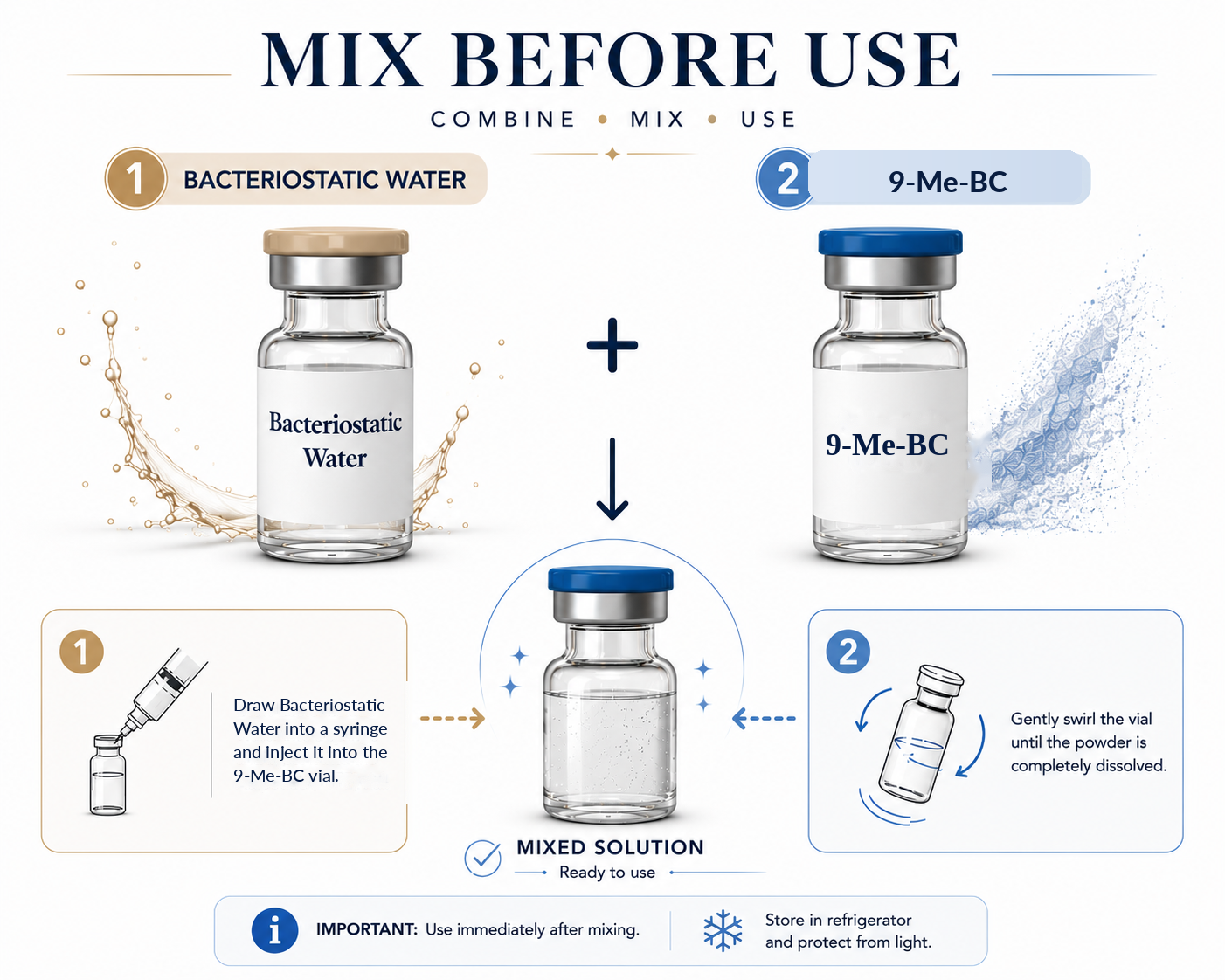
How To Mix 9-Me-BC
1
CleanUse alcohol swabs to clean the tops of both vials.
2
Draw BAC WaterDraw the selected amount of bacteriostatic water.
3
Inject SlowlyAdd the liquid slowly down the side of the vial.
4
Swirl GentlyDo not shake. Swirl gently until dissolved.
5
Store ProperlyStore as directed and protect from heat and light.
Best Practices & Common Mistakes
Best Practices
- Use sterile technique.
- Protect from light and heat.
- Store refrigerated when appropriate.
- Use clean syringe-unit math before measuring.
Common Mistakes
- Confusing milligrams with milliliters.
- Choosing an option with awkward decimal units.
- Using too little liquid for very small measurements.
- Shaking the vial aggressively.
9-Me-BC Storage & Handling
Lyophilized Powder: −20°C (−4°F) for long-term storage (up to 24 months). Refrigeration 2–8°C (36–46°F) for short-term use (up to ~3 months). Original sealed vial in the freezer is safest.
Reconstituted Solution: 2–8°C (36–46°F), use within ~7–14 days. Keep sealed, avoid light, and do not repeat freeze-thaw cycles.
Reconstituted Solution: 2–8°C (36–46°F), use within ~7–14 days. Keep sealed, avoid light, and do not repeat freeze-thaw cycles.
Frequently Asked Questions
9-Me-BC is a β-carboline alkaloid, not a peptide. It has a much lower molecular weight (~182 g/mol vs. ~1000+ g/mol for peptides), which has major implications for your dosing regimen. Unlike peptide GLP-1 agonists, this small molecule is highly orally bioavailable, meaning its administration doesn't typically require reconstitution and injection.
BAC water alone will fail. 9-Me-BC is poorly soluble in water but readily soluble in DMSO (up to 100 mg/mL) and DMF (up to 20 mg/mL). To prepare an injectable formulation, a common strategy is to first create a high-concentration stock in DMSO, then dilute it into PEG300/Tween‑80/saline vehicle (not standard BAC water).
9-Me-BC is photosensitive. The packaging is intended to be stored "dry, dark". Ambient laboratory light during reconstitution or prolonged exposure on the benchtop can degrade the compound. Your calculator assumes light-stable, which is not true for this chemical.
Yes. A published study shows that 10 days of treatment with 9-Me-BC improves spatial learning and elevates hippocampal dopamine levels in the radial maze, while 5 days of treatment does not. The calculator cannot capture this non-linear, multi-day threshold effect.
This reported effect likely stems from its mechanism as a MAO-A/B inhibitor. The calculator models a single compound, not the complex synergy between 9-Me-BC and a second compound. Using the calculator's output for 9-Me-BC alone will not predict its impact on co-administered compounds. You must adjust the dose of the second compound independently.
Practical takeaway: If your real goal is weight or metabolic health, the most useful next step is discussing approved treatment options with a clinician rather than relying on an unapproved compound.
Important: This tool is for informational and research-reference purposes only. Not intended for human or veterinary use.