Tesofensine Reconstitution Calculator
Enter the amount you want to measure. The vial buttons will highlight which vial strengths create cleaner syringe-unit measurements.
What amount do you need?
Type the target amount, then choose mg or mcg. Example: 2mg or 500mcg.
Syringe size:
Possible vial strengths:
Best Match
Good Match
Usable
Harder to Measure
Example Tesofensine Titration Schedule
| Parameter | Details |
|---|---|
| Dosage | 0.125–1.0 mg/day (common: 0.25–0.5 mg/day). Titration: 0.125/0.25 mg → up to 1 mg max |
| Route | Oral (capsule) |
| Frequency | Once daily |
| Cycle Length | 14–48 weeks (clinical trials) |
| Half‑life | ~9 days (~220 h) |
| Reconstitution | Not applicable (oral) |
Possible vial strengths:
500mcg
What Is It?
Tesofensine
Monoamine reuptake inhibitor studied for weight research.
Bacteriostatic Water
Sterile water containing a bacteriostatic preservative, commonly used when preparing multi-use research vials.
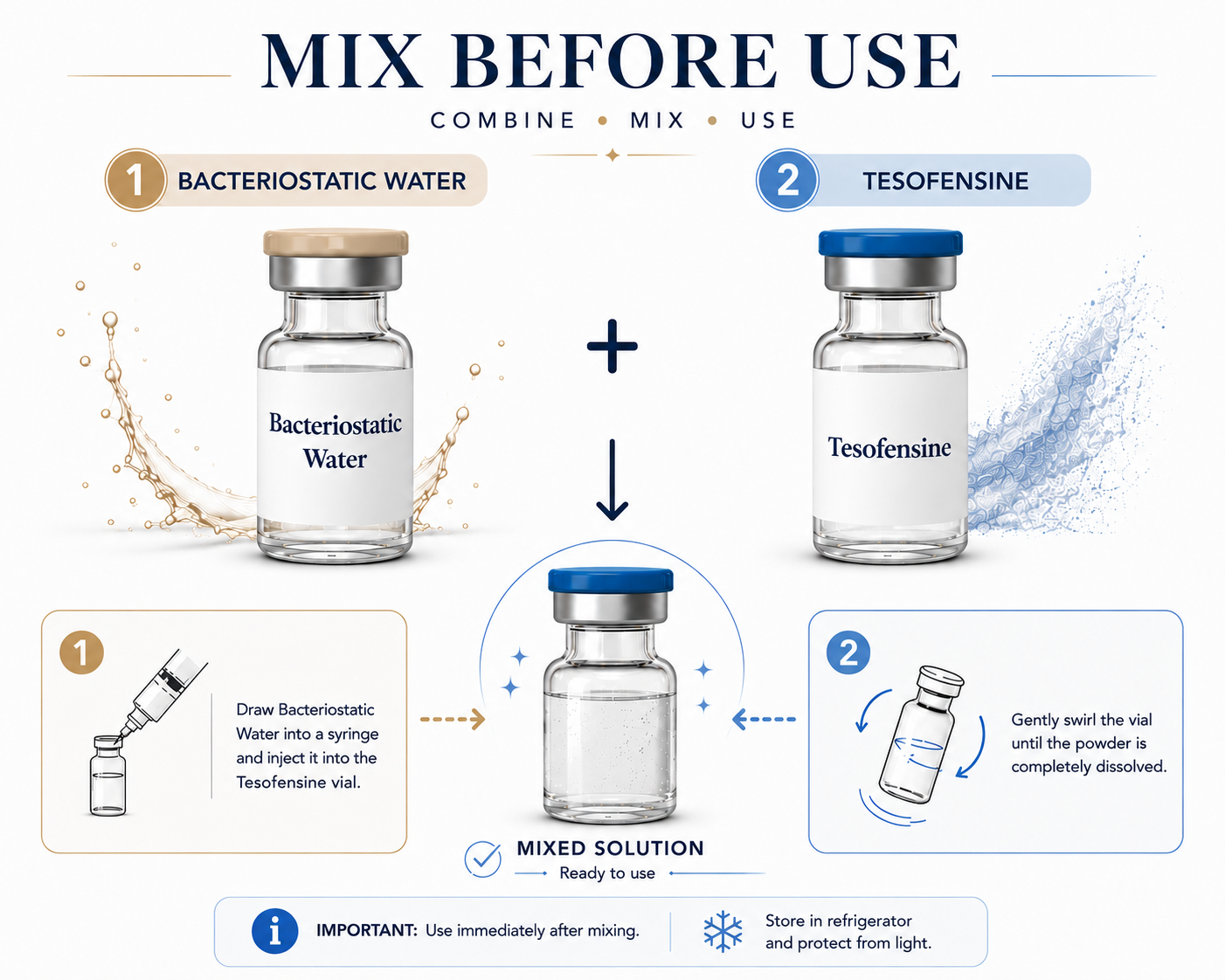
How To Mix Tesofensine
1
CleanUse alcohol swabs to clean the tops of both vials.
2
Draw BAC WaterDraw the selected amount of bacteriostatic water.
3
Inject SlowlyAdd the liquid slowly down the side of the vial.
4
Swirl GentlyDo not shake. Swirl gently until dissolved.
5
Store ProperlyStore as directed and protect from heat and light.
Best Practices & Common Mistakes
Best Practices
- Use sterile technique.
- Protect from light and heat.
- Store refrigerated when appropriate.
- Use clean syringe-unit math before measuring.
Common Mistakes
- Confusing milligrams with milliliters.
- Choosing an option with awkward decimal units.
- Using too little liquid for very small measurements.
- Shaking the vial aggressively.
Tesofensine Storage & Handling
Lyophilized Powder: −20°C (−4°F) for long-term storage (up to 24 months). Refrigeration 2–8°C (36–46°F) for short-term use (up to ~3 months). Original sealed vial in the freezer is safest.
Reconstituted Solution: 2–8°C (36–46°F), use within ~7–14 days. Keep sealed, avoid light, and do not repeat freeze-thaw cycles.
Reconstituted Solution: 2–8°C (36–46°F), use within ~7–14 days. Keep sealed, avoid light, and do not repeat freeze-thaw cycles.
Frequently Asked Questions
Because it’s not a peptide. The free base is sparingly soluble in water (0.2 mg/mL) and only slightly soluble in PBS. Standard BAC water or saline will yield a cloudy suspension. To make an injectable formulation, first prepare a stock in DMSO at ≥2 mg/mL (warming and ultrasound may be needed), then dilute into a multi‑component vehicle (e.g., DMSO : PEG300 : Tween‑80 : saline). Do not add BAC water directly to the powder.
Your peptide calculator is built for short‑lived molecules, but the half‑life of the drug is about 234 hours (~9‑10 days). This extremely long elimination time is the reason human research uses once‑daily oral dosing, and it allows plasma levels to be maintained with a single daily dose. Accumulation will occur over the first few weeks – do not increase the dose based on your calculator’s short‑lived default model.
The entire clinical database for the drug is oral administration – it is an oral small molecule. Human Phase 1‑2 studies used 0.125 mg to 2.0 mg once daily. The highest tested weight‑loss dose was 1.0 mg per day. There is no validated injectable protocol – using the product subcutaneously is experimental.
It is a CNS‑active drug. Approved small‑molecule monoamine reuptake inhibitors carry risks of elevated heart rate, blood pressure, insomnia, headache, dry mouth, and exacerbation of anxiety. These are dose‑dependent and the product was not approved for obesity due to cardiovascular risk. Your calculator cannot predict these effects based on mass alone.
The unopened powder is stable for 2‑3 years when stored at –20 °C in an inert atmosphere. Once the substance is dissolved in DMSO, the solution must be aliquoted and frozen: –80 °C for up to 6 months, –20 °C for only 1 month. It should not be stored as a refrigerated (4 °C) liquid for more than a few days – the generic peptide‑calculator “28‑day fridge” rule will cause degradation
Practical takeaway: If your real goal is weight or metabolic health, the most useful next step is discussing approved treatment options with a clinician rather than relying on an unapproved compound.
Important: This tool is for informational and research-reference purposes only. Not intended for human or veterinary use.