Liraglutide Reconstitution Calculator
Enter the amount you want to measure. The vial buttons will highlight which vial strengths create cleaner syringe-unit measurements.
What amount do you need?
Type the target amount, then choose mg or mcg. Example: 2mg or 500mcg.
Syringe size:
Possible vial strengths:
Best Match
Good Match
Usable
Harder to Measure
Example Liraglutide Titration Schedule
| Phase | Timeline | Daily Dose | Frequency / Route |
|---|---|---|---|
| Initiation | Week 1 | 0.6 mg | 1× daily (SC) |
| Maintenance | After Week 1 | 1.2 mg | 1× daily (SC) |
| Maximum (for this indication) | As needed | 1.8 mg | 1× daily (SC) |
Possible vial strengths:
What Is It?
Liraglutide
Daily GLP-1 analogue, predecessor to semaglutide.
Bacteriostatic Water
Sterile water containing a bacteriostatic preservative, commonly used when preparing multi-use research vials.
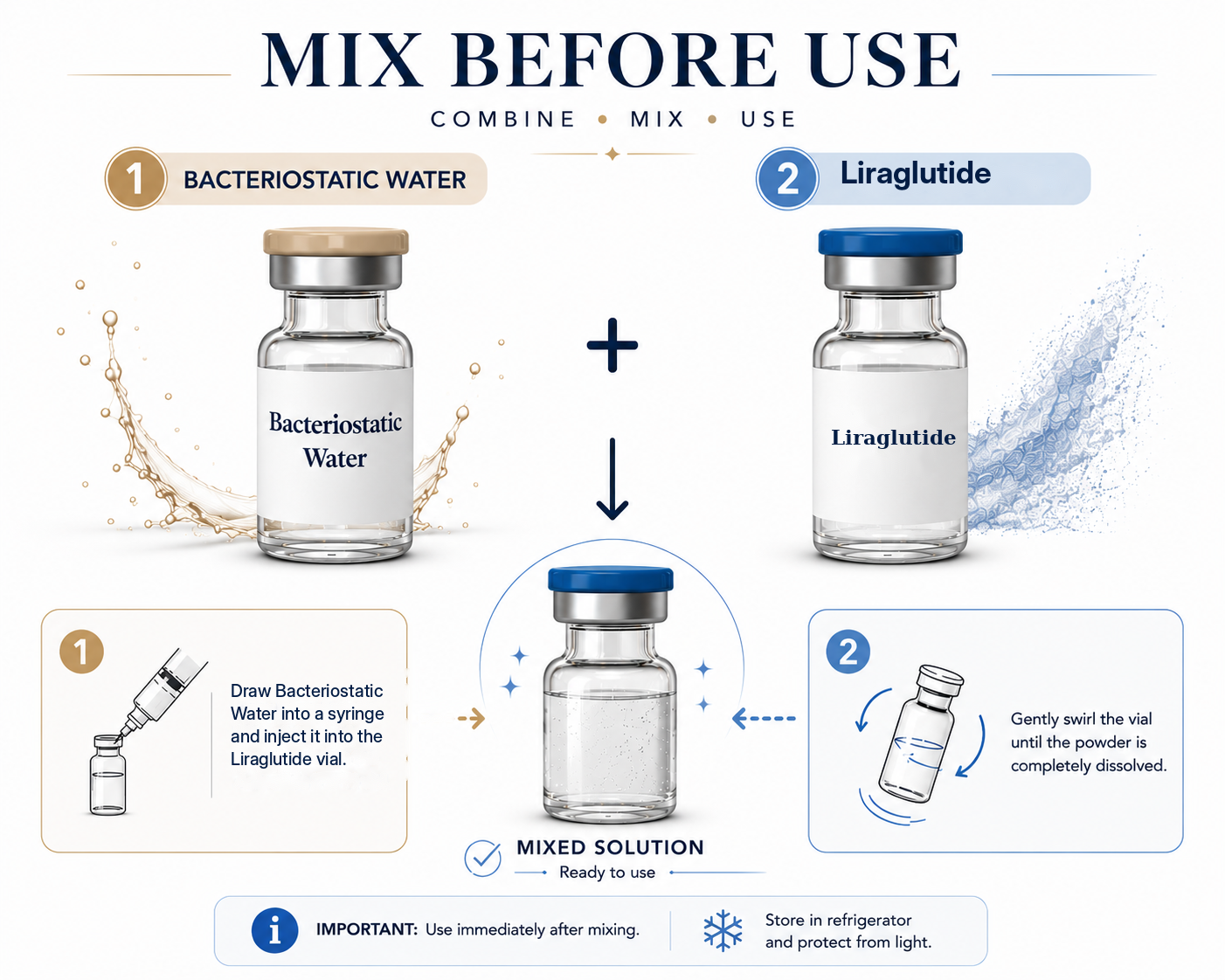
How To Mix Liraglutide
1
CleanUse alcohol swabs to clean the tops of both vials.
2
Draw BAC WaterDraw the selected amount of bacteriostatic water.
3
Inject SlowlyAdd the liquid slowly down the side of the vial.
4
Swirl GentlyDo not shake. Swirl gently until dissolved.
5
Store ProperlyStore as directed and protect from heat and light.
Best Practices & Common Mistakes
Best Practices
- Use sterile technique.
- Protect from light and heat.
- Store refrigerated when appropriate.
- Use clean syringe-unit math before measuring.
Common Mistakes
- Confusing milligrams with milliliters.
- Choosing an option with awkward decimal units.
- Using too little liquid for very small measurements.
- Shaking the vial aggressively.
Liraglutide Storage & Handling
Lyophilized Powder: −20°C (−4°F) for long-term storage (up to 24 months). Refrigeration 2–8°C (36–46°F) for short-term use (up to ~3 months). Original sealed vial in the freezer is safest.
Reconstituted Solution: 2–8°C (36–46°F), use within ~7–14 days. Keep sealed, avoid light, and do not repeat freeze-thaw cycles.
Reconstituted Solution: 2–8°C (36–46°F), use within ~7–14 days. Keep sealed, avoid light, and do not repeat freeze-thaw cycles.
Frequently Asked Questions
Liraglutide has a high propensity to form amyloid‑like fibrils, a specific type of aggregation where the molecule’s higher‑order structure is perturbed, characterised by a β‑sheet enrichment. In the FDA‑approved 6 mg/mL liquid formulation, this risk is minimised through precise pH control and the presence of proprietary stabilisers. Your calculator will faithfully compute concentrations from lyophilised powder, but if you reconstitute to a concentration above ~2 mg/mL without these stabilisers, you risk the peptide precipitating into visible fibrils. This is a real example: a 6 mg/mL test solution of liraglutide was specifically used in an assay to prepare fibrils for research. Always reconstitute research‑grade liraglutide powder to a final concentration ≤2 mg/mL to avoid fibrillation; the calculator cannot warn you about this.
Your calculator treats all peptides as linear, water‑soluble molecules. However, liraglutide is a synthetic acylated analogue in which a C‑16 fatty acid chain (palmitic acid) is attached to lysine at position 26 via a glutamic acid spacer, and lysine at position 34 is substituted with arginine. This fatty acid side chain dramatically reduces water solubility at low pH (≤ 0.8 mg/mL at pH 2.5) and makes the peptide behave like a self‑assembling molecule that forms heptamers in solution. If your calculator suggests a BAC volume that would give a concentration above 5 mg/mL for a small vial, the fatty acid may not fully dissolve in pure water, leading to a cloudy solution. The calculator is blind to this chemistry.
The calculator’s “Doses per vial” is a pure mathematical count based on the entered mg dose. For liraglutide, the once‑daily regimen is a core pharmacological property. In clinical use, the starting dose is 0.6 mg once daily for one week, typically increased in 0.6 mg increments to a target of 1.2‑1.8 mg per day for diabetes (Victoza) or up to 3.0 mg per day for obesity (Saxenda). If a researcher, accustomed to once‑weekly peptides, sees “7 doses per vial” in the calculator, they might assume the vial will last 7 weeks. In reality, with daily injections, it lasts only 7 days. The calculator cannot know which dosing schedule applies; you must manually adjust your expectations based on liraglutide’s distinct once‑daily pharmacology.
The commercial formulation of liraglutide (Victoza, Saxenda) is a ready‑to‑use, clear, colourless 3 mL pre‑filled pen containing 18 mg of liraglutide at a concentration of 6 mg/mL. At this concentration, 0.6 mg = 0.1 mL = 10 units on a U‑100 syringe, and 1.2 mg = 20 units, etc. Your calculator is designed for lyophilised powder, not pre‑mixed liquid pens. If a researcher obtains bulk lyophilised liraglutide powder and lets the calculator recommend a “Best” match that uses, for example, 1 mL of BAC water for a 6 mg vial (giving 6 mg/mL), they will exactly match the approved 6 mg/mL concentration. However, the calculator’s quality ranking (Best/Good/Usable) cannot account for the fact that this specific concentration was scientifically validated to balance efficacy, stability, and injection volume. Your calculator treats 6 mg/mL as just another concentration; it does not know that 6 mg/mL is the clinically established standard.
Most peptides your calculator handles are used in 0.1‑1 mg daily doses. Liraglutide’s obesity dose of 3 mg per day is 10‑30 times higher. For a 60 mg vial, 3 mg per day yields only 20 “Doses per vial”. This means a single vial lasts less than three weeks at the maximum dose. Furthermore, at 6 mg/mL, a 3 mg dose requires drawing 0.5 mL (50 units) of solution on a U‑100 syringe. This is a relatively large volume for a subcutaneous injection and is near the upper limit of what a 1 mL syringe can comfortably hold. Your calculator will correctly display this volume, but it cannot warn you that repeated 0.5 mL injections may cause more injection‑site discomfort and require rotation among multiple sites (thigh, abdomen, upper arm) more frequently than with smaller‑volume peptides. The high mass dose is a fundamental property of liraglutide that your calculator’s interface was not originally designed to emphasise.
Practical takeaway: If your real goal is weight or metabolic health, the most useful next step is discussing approved treatment options with a clinician rather than relying on an unapproved compound.
Important: This tool is for informational and research-reference purposes only. Not intended for human or veterinary use.