Semaglutide Reconstitution Calculator
Enter the amount you want to measure. The vial buttons will highlight which vial strengths create cleaner syringe-unit measurements.
What amount do you need?
Type the target amount, then choose mg or mcg. Example: 2mg or 500mcg.
Syringe size:
Possible vial strengths:
Best Match
Good Match
Usable
Harder to Measure
Example Semaglutide Titration Schedule
| Phase (Example) | Dose (mcg per dose) | Frequency | Titration Note |
|---|---|---|---|
| Weeks 1–4 | 250 mcg | 1× weekly | Starting dose |
| Weeks 5–8 | 500 mcg | 1× weekly | +250 mcg after 4 weeks |
| Weeks 9–12 | 750 mcg | 1× weekly | Continue titration if needed |
| Weeks 13–16 | 1000 mcg | 1× weekly | Continue titration if needed |
| Ongoing | Up to 2400 mcg | 1× weekly | Increase by +250 mcg every 4 weeks until goal response |
Possible vial strengths:
What Is It?
Semaglutide
GLP-1 analogue widely studied for weight and glycemic research.
Bacteriostatic Water
Sterile water containing a bacteriostatic preservative, commonly used when preparing multi-use research vials.
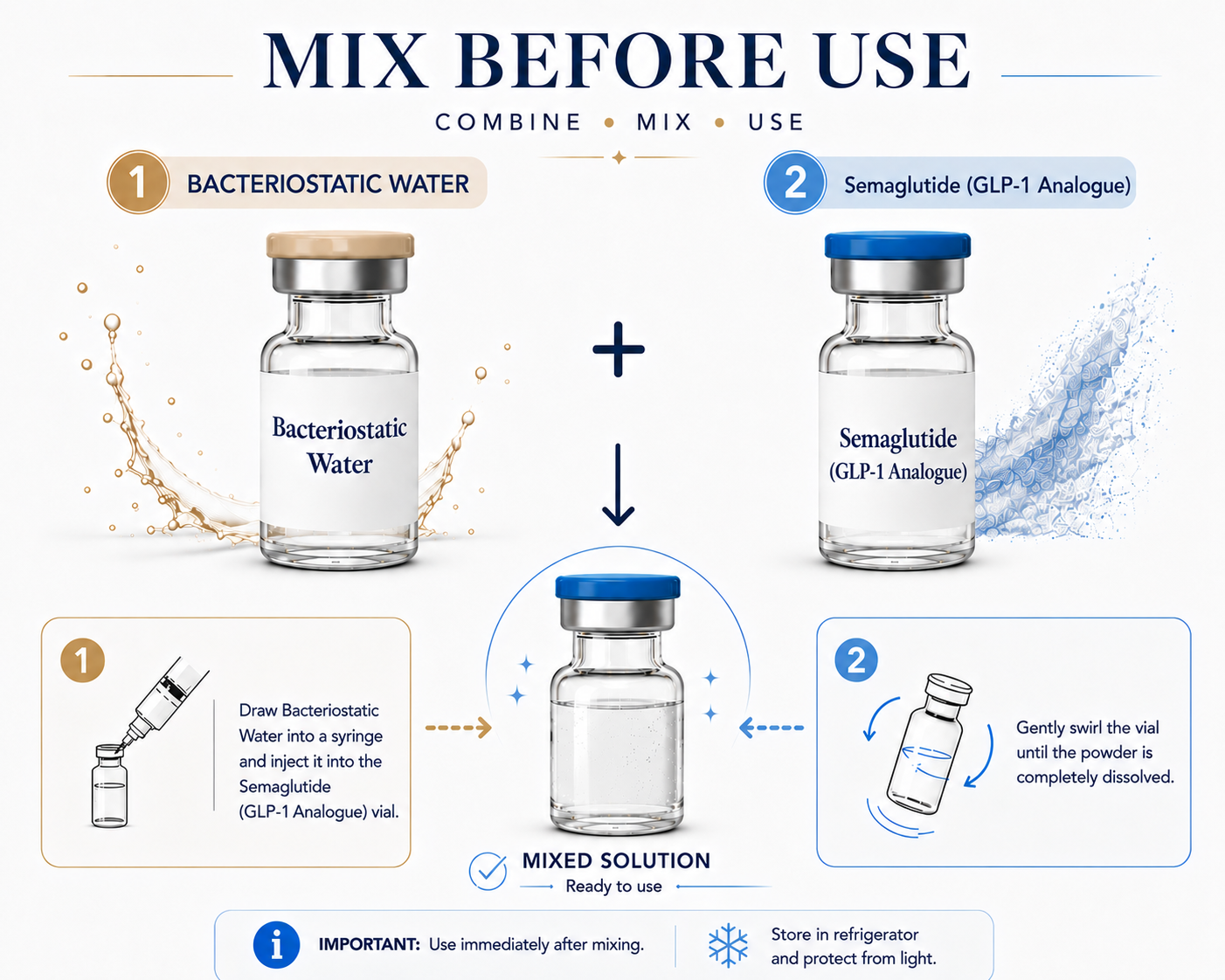
How To Mix Semaglutide
1
CleanUse alcohol swabs to clean the tops of both vials.
2
Draw BAC WaterDraw the selected amount of bacteriostatic water.
3
Inject SlowlyAdd the liquid slowly down the side of the vial.
4
Swirl GentlyDo not shake. Swirl gently until dissolved.
5
Store ProperlyStore as directed and protect from heat and light.
Best Practices & Common Mistakes
Best Practices
- Use sterile technique.
- Protect from light and heat.
- Store refrigerated when appropriate.
- Use clean syringe-unit math before measuring.
Common Mistakes
- Confusing milligrams with milliliters.
- Choosing an option with awkward decimal units.
- Using too little liquid for very small measurements.
- Shaking the vial aggressively.
Semaglutide Storage & Handling
Lyophilized Powder: −20°C (−4°F) for long-term storage (up to 24 months). Refrigeration 2–8°C (36–46°F) for short-term use (up to ~3 months). Original sealed vial in the freezer is safest.
Reconstituted Solution: 2–8°C (36–46°F), use within ~7–14 days. Keep sealed, avoid light, and do not repeat freeze-thaw cycles.
Reconstituted Solution: 2–8°C (36–46°F), use within ~7–14 days. Keep sealed, avoid light, and do not repeat freeze-thaw cycles.
Frequently Asked Questions
The calculator's "Doses per vial" assumes a set duration of activity, but Semaglutide is designed for sustained action. Natural human GLP-1 is degraded in minutes, yet Semaglutide incorporates two key modifications: an α-aminoisobutyric acid (Aib) at position 8 that prevents DPP‑4 degradation, and a C18 fatty-diacid side chain linked to Lys26 that promotes reversible albumin binding, resulting in a plasma half‑life of approximately 160 hours (6–7 days). This extended half-life is crucial because it allows once-weekly subcutaneous injections. If a researcher uses the calculator to prepare a daily dosing schedule, they would be administering far more total peptide than necessary. The calculator's "Doses per vial" count is a static number; for Semaglutide, you must manually account for the once-weekly frequency.
The calculator's default assumption of solubility can be problematic. Scientific solubility data indicates that semaglutide is insoluble in water at neutral pH (less than 0.1 mg/mL), with complete dissolution often requiring an acidic environment (for example, at pH 1.0, solubility can be 1.25 mg/mL after adjusting with HCl). Because commercial pharmaceutical formulations contain proprietary stabilisers, there is no universal rule, but researchers have reported that commercial 1 mg and 2 mg vials reconstitute clearly with 2 mL of BAC water. If you encounter a clumpy powder that does not fully dissolve, it is a physical indicator that the calculated concentration is impossible to achieve in water alone. The safest approach is to follow the exact diluent volume recommended by your supplier, even if the calculator marks a smaller volume as "Best," as using insufficient water could compromise the solubility and stability of the entire vial.
The calculator's "Doses per vial" count is a pure mathematical maximum, but the physics of the peptide's stability is different. Once reconstituted, semaglutide solution should be stored at 2‑8 °C (refrigerator temperature) and is typically stable for approximately 28 days under proper refrigeration. For the branded injectable pen, which does not require reconstitution, the solution is stable at room temperature for 28 days once opened. For a researcher who reconstitutes a 5 mg vial and uses a once‑weekly dose of 0.5 mg, the "Doses per vial" would be about 10 weeks' worth, but the 28‑day window would expire long before the vial is empty. Therefore, a single vial cannot be used for more than 4 weeks, regardless of how much peptide remains, unless you aliquot and freeze the solution immediately after mixing.
The calculator will show one number for a given dose, but for Semaglutide, the dose is not static. The FDA‑approved titration protocol for subcutaneous semaglutide begins with 0.25 mg once weekly for four weeks, followed by stepwise increases at four‑week intervals to 0.5 mg, 1.0 mg, 1.7 mg, and finally 2.4 mg. If you reconstitute a 5 mg vial, the calculator can help at each step, but the "Doses per vial" count will shrink as the dose increases. A single 5 mg vial reconstituted with a fixed volume of BAC water could provide the first few weeks of the titration, but you will need to plan to reconstitute additional vials for the higher‑dose weeks. The calculator does not automatically account for this dynamic schedule; you must manually recalculate at each dose step.
The calculator's output is purely a matter of mass and volume. However, clinical trial data report nausea in up to 44% of participants and vomiting in 24%, which are more frequent during the first 4‑5 weeks after starting treatment and after each dose increase. To reduce side effects, the standard approach is to follow the slow titration schedule (0.25 mg → 0.5 mg → 1.0 mg → 1.7 mg → 2.4 mg, each for 4 weeks). The calculator does not include this clinical protocol. If you attempt to bypass the initial low doses, the nausea and vomiting can be severe enough to force discontinuation of the research. The volume drawn by the calculator is not a tool to manage side effects; the side effects depend on the total mass and the body's adaptation to the GLP‑1 mechanism, not the injection volume.
Practical takeaway: If your real goal is weight or metabolic health, the most useful next step is discussing approved treatment options with a clinician rather than relying on an unapproved compound.
Important: This tool is for informational and research-reference purposes only. Not intended for human or veterinary use.