Cagrilintide Reconstitution Calculator
Enter the amount you want to measure. The vial buttons will highlight which vial strengths create cleaner syringe-unit measurements.
What amount do you need?
Type the target amount, then choose mg or mcg. Example: 2mg or 500mcg.
Syringe size:
Possible vial strengths:
Best Match
Good Match
Usable
Harder to Measure
Example Cagrilintide Titration Schedule
| Weeks | Weekly Dose | Notes |
|---|---|---|
| Weeks 1–4 | 0.6 mg | Starting dose |
| Weeks 5–8 | 1.2 mg | +0.6 mg after 4 weeks |
| Weeks 9–12 | 1.8 mg | +0.6 mg after another 4 weeks |
| Extended use (optional) | Continue +0.6 mg every 4 weeks | Do not exceed 4.5 mg per dose |
Possible vial strengths:
What Is It?
Cagrilintide
Long-acting amylin analogue paired with GLP-1 agents.
Bacteriostatic Water
Sterile water containing a bacteriostatic preservative, commonly used when preparing multi-use research vials.
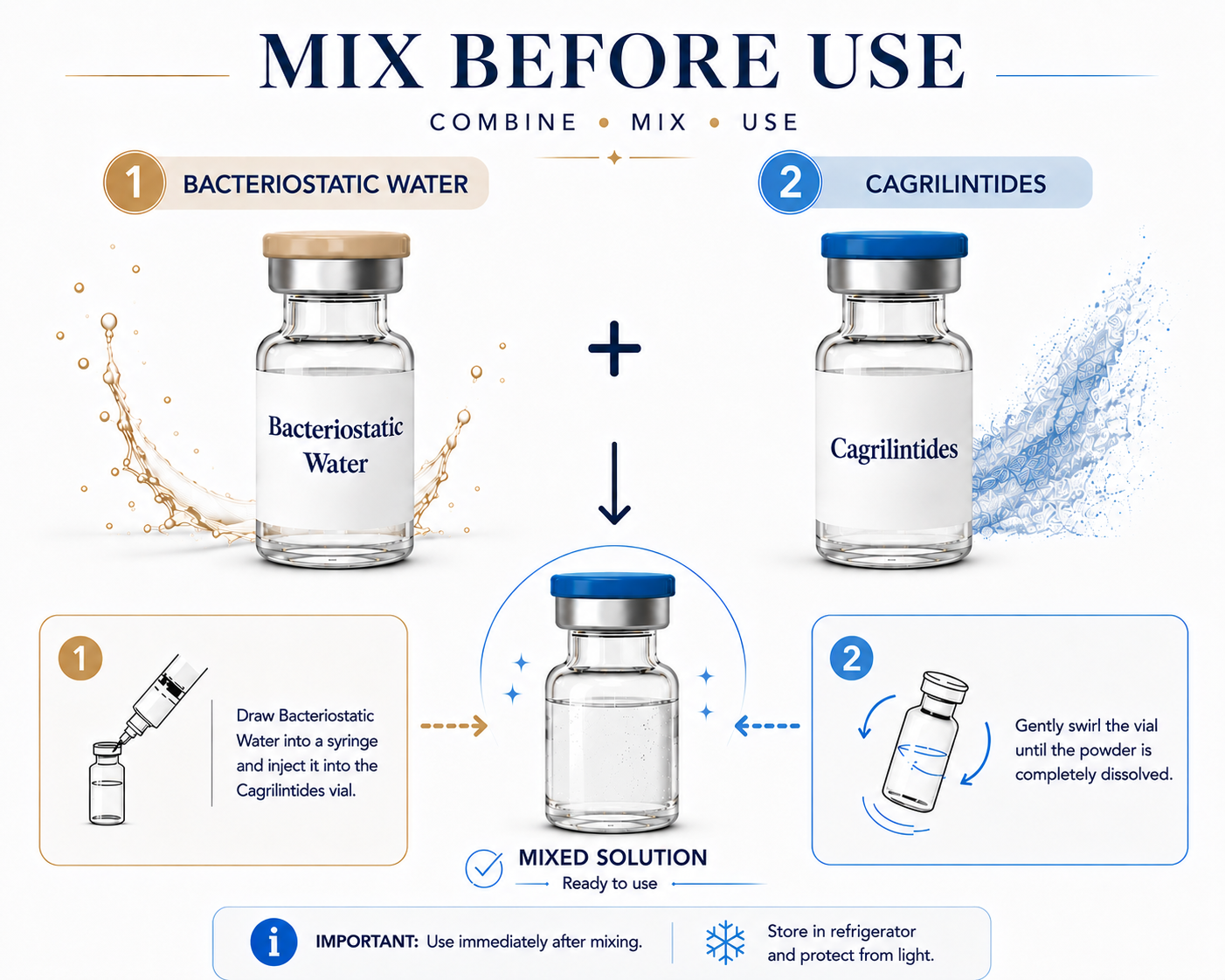
How To Mix Cagrilintide
1
CleanUse alcohol swabs to clean the tops of both vials.
2
Draw BAC WaterDraw the selected amount of bacteriostatic water.
3
Inject SlowlyAdd the liquid slowly down the side of the vial.
4
Swirl GentlyDo not shake. Swirl gently until dissolved.
5
Store ProperlyStore as directed and protect from heat and light.
Best Practices & Common Mistakes
Best Practices
- Use sterile technique.
- Protect from light and heat.
- Store refrigerated when appropriate.
- Use clean syringe-unit math before measuring.
Common Mistakes
- Confusing milligrams with milliliters.
- Choosing an option with awkward decimal units.
- Using too little liquid for very small measurements.
- Shaking the vial aggressively.
Cagrilintide Storage & Handling
Lyophilized Powder: −20°C (−4°F) for long-term storage (up to 24 months). Refrigeration 2–8°C (36–46°F) for short-term use (up to ~3 months). Original sealed vial in the freezer is safest.
Reconstituted Solution: 2–8°C (36–46°F), use within ~7–14 days. Keep sealed, avoid light, and do not repeat freeze-thaw cycles.
Reconstituted Solution: 2–8°C (36–46°F), use within ~7–14 days. Keep sealed, avoid light, and do not repeat freeze-thaw cycles.
Frequently Asked Questions
Potentially, yes. Your calculator is likely designed for peptides cleared within a day. Cagrilintide's half‑life is approximately 160 hours. This extremely long half‑life is the reason it is administered once weekly, not daily, in clinical research. If you simply follow a standard daily protocol that the calculator might suggest, you will be dosing the peptide approximately seven times more often than intended, leading to a rapid and potentially dangerous accumulation of the compound.
Yes. While one source notes Cagrilintide is soluble in water up to 50 mg/mL, other research suggests that obtaining a higher solubility (e.g., >10 mg/mL) may require warming the vial to 37°C and using ultrasonication. In clinical research, a common dose is 2.4 mg, which is often derived from a 5 mg vial reconstituted with 2 mL (giving 2.5 mg/mL), or from a 10 mg vial reconstituted with 3 mL (giving ~3.33 mg/mL). More concentrated solutions can be used for very high weekly doses (e.g., 4.5 mg), but for standard protocols, the moderate concentration is preferred to ensure it dissolves completely and to make fine adjustments to the dose easier.
Yes, there is. Cagrilintide is a lipidated peptide, an acylated analog of the natural hormone amylin. The fatty acid modification is key to its activity, but it also makes it more sensitive to aggregation. Improper storage can cause it to form high‑molecular‑weight products (HMWP), which can lead to a loss of biological activity and a potential immune reaction. When you reconstitute a vial, you must keep it refrigerated at 2–8 °C, protect it from light, and store it correctly to avoid the formation of these aggregates and keep it stable.
A 2025 phase 3a trial suggests a combined formulation is feasible. However, the calculator's model can't account for the complex relationship between the two compounds. Individual pharmacokinetic parameters from separate vials cannot be simply added. For example, a single compound's half‑life of 160 hours and 145‑165 hours does not predict the absorption and elimination of the pair. When investigating combinations, always rely on established clinical protocols rather than trying to derive a new formula through a calculator.
No. Using the calculator's intended final dose from the start could cause unnecessary side effects. All clinical studies for Cagrilintide incorporate a dose-escalation phase to improve tolerability. For instance, the dose might be increased every 4 weeks over a total period of 16 weeks until the maintenance dose of up to 2.4 mg is reached. The calculator is a tool to prepare doses at each individual step, but the protocol itself must be designed by the researcher to include this gradual titration period.
Practical takeaway: If your real goal is weight or metabolic health, the most useful next step is discussing approved treatment options with a clinician rather than relying on an unapproved compound.
Important: This tool is for informational and research-reference purposes only. Not intended for human or veterinary use.