Retatrutide Reconstitution Calculator
Enter the amount you want to measure. The vial buttons will highlight which vial strengths create cleaner syringe-unit measurements.
What amount do you need?
Type the target amount, then choose mg or mcg. Example: 2mg or 500mcg.
Syringe size:
Possible vial strengths:
Best Match
Good Match
Usable
Harder to Measure
Example Retatrutide Titration Schedule
| Phase | Weeks | Dose (mg per dose) | Frequency |
|---|---|---|---|
| Start | Weeks 1–4 | 2 mg | 1× weekly |
| Titration 1 | Weeks 5–8 | 4 mg | 1× weekly |
| Titration 2 | Weeks 9–12 | 6 mg | 1× weekly |
Possible vial strengths:
What Is It?
Retatrutide
Triple agonist (GLP-1 / GIP / glucagon) in Phase 3 metabolic research.
Bacteriostatic Water
Sterile water containing a bacteriostatic preservative, commonly used when preparing multi-use research vials.
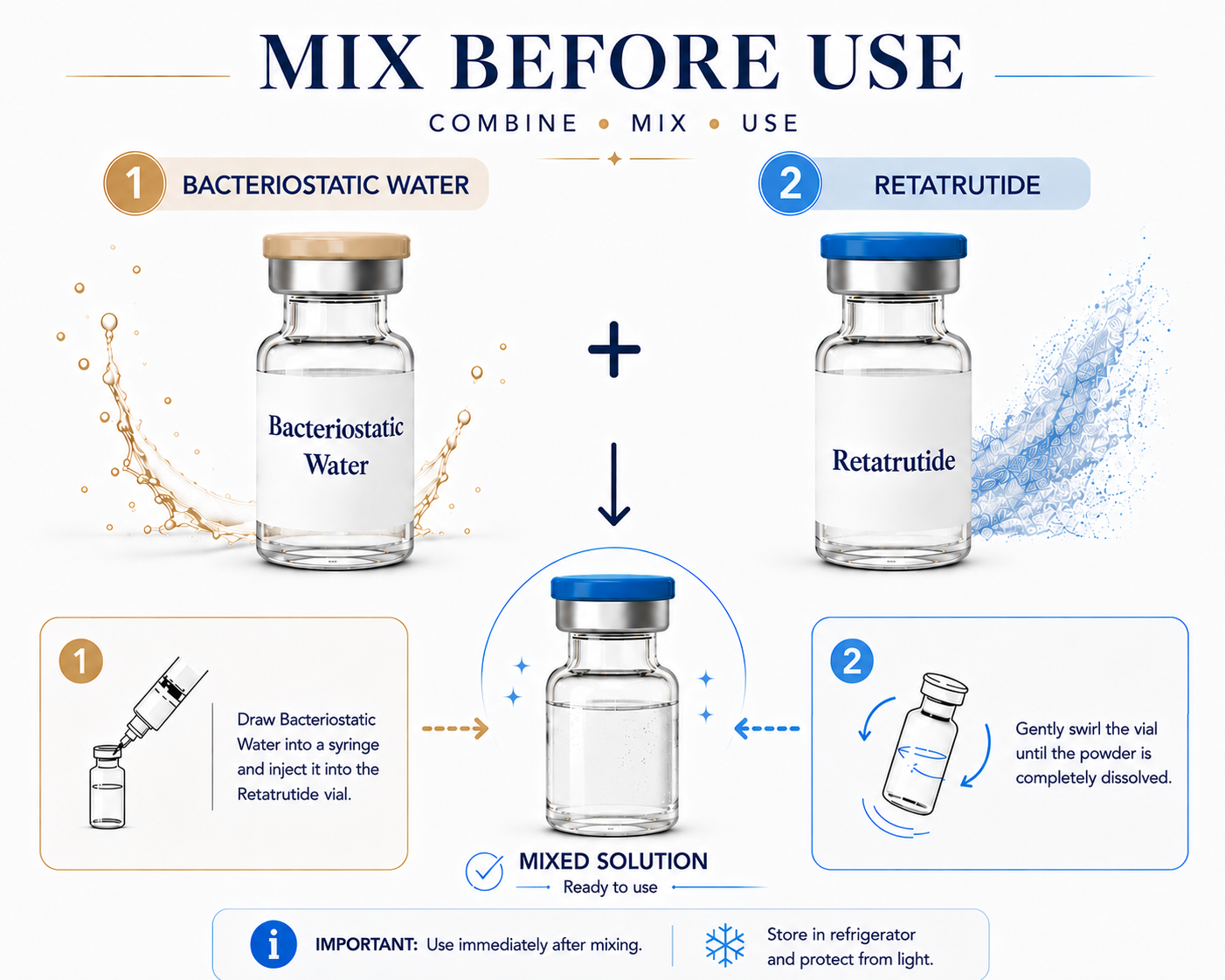
How To Mix Retatrutide
1
CleanUse alcohol swabs to clean the tops of both vials.
2
Draw BAC WaterDraw the selected amount of bacteriostatic water.
3
Inject SlowlyAdd the liquid slowly down the side of the vial.
4
Swirl GentlyDo not shake. Swirl gently until dissolved.
5
Store ProperlyStore as directed and protect from heat and light.
Best Practices & Common Mistakes
Best Practices
- Use sterile technique.
- Protect from light and heat.
- Store refrigerated when appropriate.
- Use clean syringe-unit math before measuring.
Common Mistakes
- Confusing milligrams with milliliters.
- Choosing an option with awkward decimal units.
- Using too little liquid for very small measurements.
- Shaking the vial aggressively.
Retatrutide Storage & Handling
Lyophilized Powder: −20°C (−4°F) for long-term storage (up to 24 months). Refrigeration 2–8°C (36–46°F) for short-term use (up to ~3 months). Original sealed vial in the freezer is safest.
Reconstituted Solution: 2–8°C (36–46°F), use within ~7–14 days. Keep sealed, avoid light, and do not repeat freeze-thaw cycles.
Reconstituted Solution: 2–8°C (36–46°F), use within ~7–14 days. Keep sealed, avoid light, and do not repeat freeze-thaw cycles.
Frequently Asked Questions
For a 4 mg weekly dose at 10 mg/mL, you'd draw 0.4 mL (40 units) — perfectly fine for a 1 mL syringe. At higher doses (8–12 mg), the volume becomes 0.8–1.2 mL, which may require two injection sites. Consider using 2 mL BAC (5 mg/mL) to keep volumes under 1 mL.
Yes. In Phase 2 trials, injection site reactions (erythema, pruritus) occurred in ~10% of participants. Higher concentrations (e.g., 20 mg/mL) may increase local irritation. If your calculator suggests a very concentrated solution, consider diluting further with more BAC water, even if it's not the "Best" mathematical match.
Yes. Steady state is reached after about 4 weeks (5 half‑lives). The calculator’s single‑dose model is accurate for the first injection, but after a month, trough levels are ~50% higher than after the first dose. For long‑term studies, factor in this accumulation if you’re comparing early vs. late effects.
Absolutely. Reconstitute a 10 mg vial with 2 mL BAC (5 mg/mL).
Week 1–4: 2 mg → 0.4 mL (40 units)
Week 5–8: 4 mg → 0.8 mL (80 units)
The calculator handles both doses. No need to remix. Just change the “Desired dose” field.
Week 1–4: 2 mg → 0.4 mL (40 units)
Week 5–8: 4 mg → 0.8 mL (80 units)
The calculator handles both doses. No need to remix. Just change the “Desired dose” field.
Short‑term (1–2 weeks) at 4°C is likely fine, but for long‑term storage, –20°C is strongly recommended. The C18 fatty acid side chain makes Retatrutide more prone to aggregation if stored above freezing for months. Your calculator doesn’t know your storage temperature — err on the side of colder.
Practical takeaway: If your real goal is weight or metabolic health, the most useful next step is discussing approved treatment options with a clinician rather than relying on an unapproved compound.
Important: This tool is for informational and research-reference purposes only. Not intended for human or veterinary use.