Enter the amount you want to measure. The vial buttons will highlight which vial strengths create cleaner syringe-unit measurements.
⚠ Use acetic acid — not bacteriostatic water
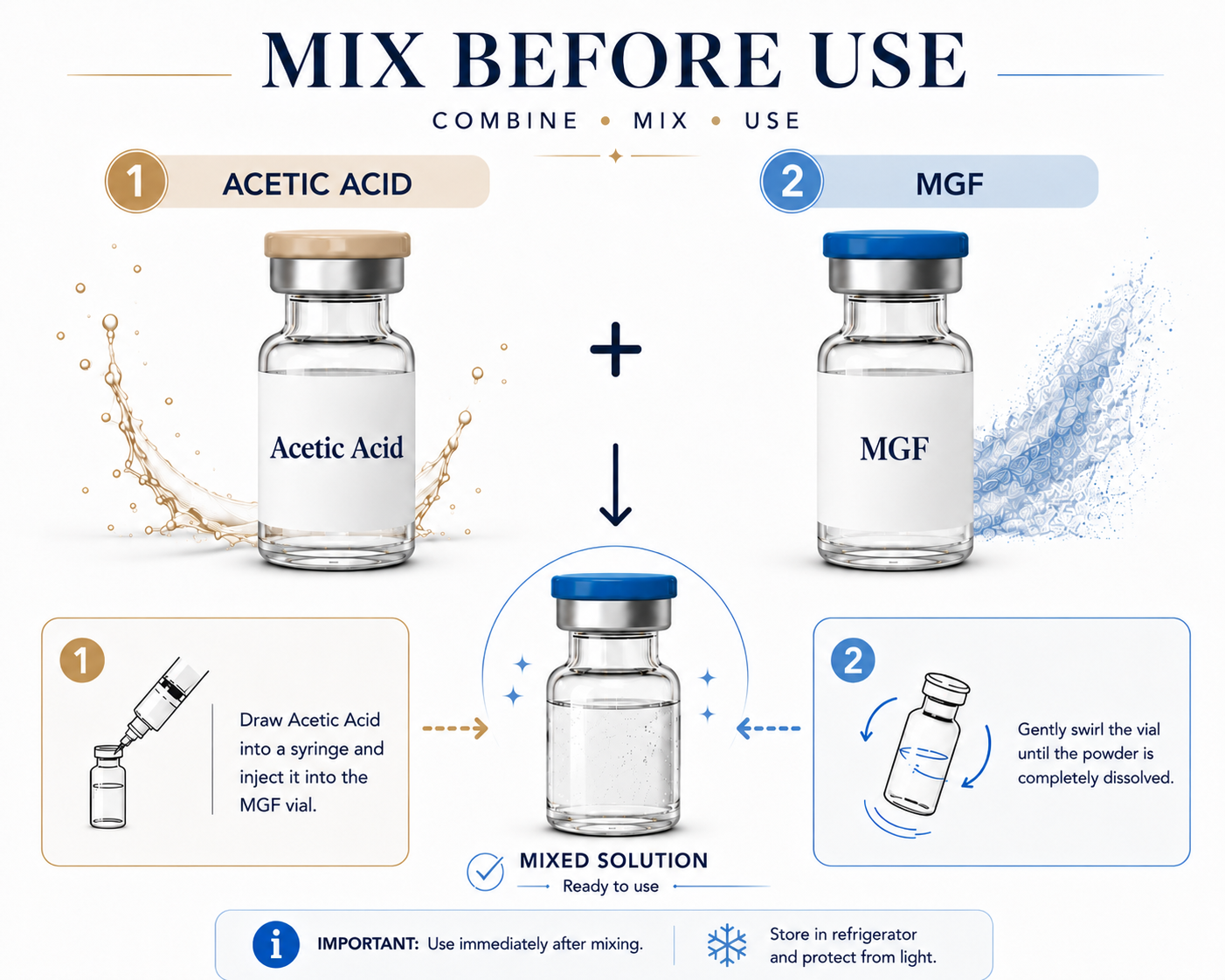
MGF (C-terminal) is insoluble or unstable in standard BAC water. Manufacturer protocols require reconstitution in dilute acetic acid (0.1%) — or, for IGF-1 variants, 50 mM acetic acid. Volumes shown below refer to acetic acid, not water.
What amount do you need?
Type the target amount, then choose mg or mcg. Example: 2mg or 500mcg.
Syringe size:
Possible vial strengths:
Best Match Good Match Usable Harder to Measure
Example MGF (C-terminal) Titration Schedule
Week
Daily Dose (mcg)
Injection Volume (mL / Units)
Week 1
100 mcg (0.10 mg)
0.06 mL (6 units)
Week 2
150 mcg (0.15 mg)
0.09 mL (9 units)
Week 3
200 mcg (0.20 mg)
0.12 mL (12 units)
Week 4
250 mcg (0.25 mg)
0.15 mL (15 units)
Weeks 5–8
300 mcg (0.30 mg)
0.18 mL (18 units)
Possible vial strengths:
What Is It?
MGF (C-terminal)
Mechano growth factor C-terminal peptide.
Acetic Acid (0.1%)
A dilute solution of acetic acid (typically 0.1% for most peptides, or 50 mM for IGF-1 variants) used to reconstitute peptides that are insoluble or unstable in standard bacteriostatic water. MGF (C-terminal) requires an acidic carrier to dissolve fully and remain stable — plain BAC water will not work and may damage the peptide.
How To Mix MGF (C-terminal)
1
Clean
Use alcohol swabs to clean the tops of both vials.
2
Draw Acetic Acid
Draw the selected amount of 0.1% acetic acid.
3
Inject Slowly
Add the liquid slowly down the side of the vial.
4
Swirl Gently
Do not shake. Swirl gently until dissolved.
5
Store Properly
Store as directed and protect from heat and light.
Best Practices & Common Mistakes
Best Practices
Use sterile technique.
Protect from light and heat.
Store refrigerated when appropriate.
Use clean syringe-unit math before measuring.
Common Mistakes
Confusing milligrams with milliliters.
Choosing an option with awkward decimal units.
Using too little liquid for very small measurements.
Shaking the vial aggressively.
MGF (C-terminal) Storage & Handling
Lyophilized Powder: −20°C (−4°F) for long-term storage (up to 24 months). Refrigeration 2–8°C (36–46°F) for short-term use (up to ~3 months). Original sealed vial in the freezer is safest.
Reconstituted Solution: 2–8°C (36–46°F), use within ~7–14 days. Keep sealed, avoid light, and do not repeat freeze-thaw cycles.
Frequently Asked Questions
Your calculator only processes peptide mass, not size or chemical modifications. PEG-MGF is significantly larger and heavier than the same mg dose of a standard peptide because the polyethylene glycol (PEG) chain increases the total molecular mass. For the same entered mg dose, your solution will contain many fewer active peptide molecules compared to an un-pegylated peptide. The PEG moiety also alters viscosity and solubility characteristics, which can affect how easily the solution is drawn.
Data sheets for PEG-MGF explicitly state that reconstitution may require light sonication to fully dissolve the powder in bacteriostatic water, even at moderate concentrations. If you follow the calculator’s recommendation and the powder does not fully go into solution, your syringe will draw an unpredictable, variable concentration. The peptide will not be evenly distributed, and each injection will contain a different amount of active compound. You should visually confirm complete dissolution after every reconstitution.
Natural MGF has a half-life of only about 5–7 minutes, rendering it impractical for systemic research. PEG-MGF is engineered to resist enzymatic degradation and kidney clearance, extending its half-life to several days. The calculator’s “Doses per vial” count is a static maximum. If you reconstitute a PEG-MGF vial for a study longer than 1-2 weeks, the displayed number of doses may be mathematically correct, but you must account for potential degradation and microbial contamination over that extended period. Most suppliers recommend discarding reconstituted peptide after 14-28 days regardless of remaining volume.
The calculator assumes that if you double the entered dose, the response will double proportionally. In reality, full-length MGF activates both the IGF-1 receptor (at high concentrations) and a separate, non-IGF-1 receptor pathway via its C-terminal E-domain, which mediates proliferation and differentiation. Therefore, low doses primarily activate the independent receptor through the C-terminal region. The biological effect will not scale linearly across the entire range. You must identify your specific research outcome and select the dose accordingly; the calculator cannot predict which pathway is dominant.
The calculator provides identical outputs for young and old research subjects, as it only knows mass. However, published data shows MGF-E peptide significantly increases the proliferative lifespan of satellite cells from young subjects but has no such effect on cells from old adult muscle. An identical calculated dose will produce opposite physiological outcomes depending on donor age, which is a variable the calculator cannot consider. A researcher must account for donor age separately, even if the calculator suggests the same dose is appropriate for both.
Practical takeaway: If your real goal is weight or metabolic health, the most useful next step is discussing approved treatment options with a clinician rather than relying on an unapproved compound.