ModGRF 1-29 (CJC-1295 No DAC) Reconstitution Calculator
Enter the amount you want to measure. The vial buttons will highlight which vial strengths create cleaner syringe-unit measurements.
What amount do you need?
Type the target amount, then choose mg or mcg. Example: 2mg or 500mcg.
Syringe size:
Possible vial strengths:
Best Match
Good Match
Usable
Harder to Measure
Example ModGRF 1-29 (CJC-1295 No DAC) Titration Schedule
| Protocol Item | Guidance |
|---|---|
| Dose | 100 mcg per dose |
| Cycling | |
| Timing / Diet Note | |
| Frequency Note | Multiple injections can be given in a day to increase GH secretion (noted in bodybuilding-focused use cases). |
Possible vial strengths:
What Is It?
ModGRF 1-29 (CJC-1295 No DAC)
Short-acting GHRH analogue, pulsatile profile.
Bacteriostatic Water
Sterile water containing a bacteriostatic preservative, commonly used when preparing multi-use research vials.
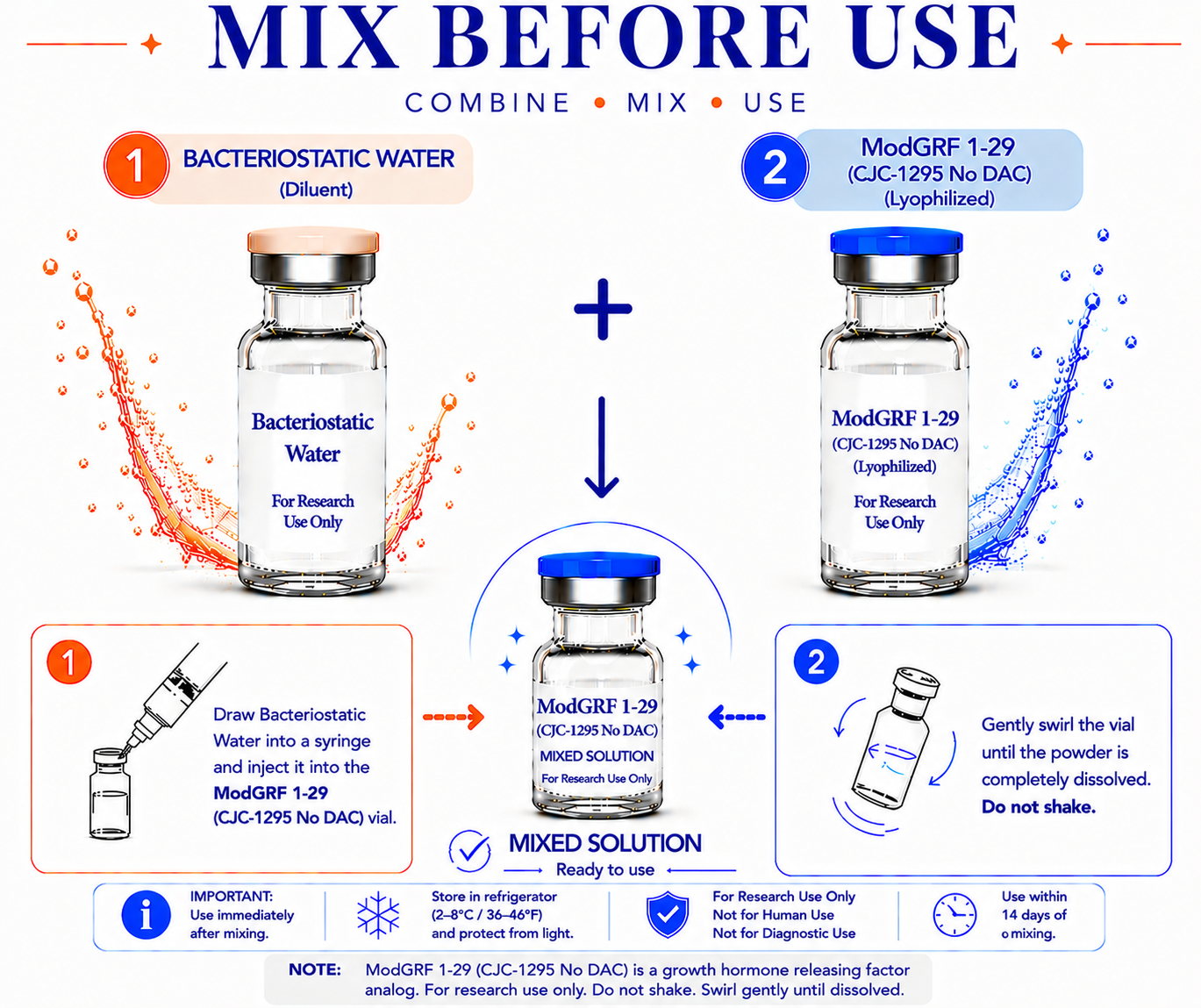
How To Mix ModGRF 1-29 (CJC-1295 No DAC)
1
CleanUse alcohol swabs to clean the tops of both vials.
2
Draw BAC WaterDraw the selected amount of bacteriostatic water.
3
Inject SlowlyAdd the liquid slowly down the side of the vial.
4
Swirl GentlyDo not shake. Swirl gently until dissolved.
5
Store ProperlyStore as directed and protect from heat and light.
Best Practices & Common Mistakes
Best Practices
- Use sterile technique.
- Protect from light and heat.
- Store refrigerated when appropriate.
- Use clean syringe-unit math before measuring.
Common Mistakes
- Confusing milligrams with milliliters.
- Choosing an option with awkward decimal units.
- Using too little liquid for very small measurements.
- Shaking the vial aggressively.
ModGRF 1-29 (CJC-1295 No DAC) Storage & Handling
Lyophilized Powder: −20°C (−4°F) for long-term storage (up to 24 months). Refrigeration 2–8°C (36–46°F) for short-term use (up to ~3 months). Original sealed vial in the freezer is safest.
Reconstituted Solution: 2–8°C (36–46°F), use within ~7–14 days. Keep sealed, avoid light, and do not repeat freeze-thaw cycles.
Reconstituted Solution: 2–8°C (36–46°F), use within ~7–14 days. Keep sealed, avoid light, and do not repeat freeze-thaw cycles.
Frequently Asked Questions
The calculator's output is purely a physical volume (units); it does not account for pharmacokinetics. Mod GRF 1‑29 (a synthetic GHRH analogue lacking the DAC moiety) is reported to have a plasma half‑life of approximately 30 minutes, and is sometimes described as having a short half‑life of around 30 minutes. Because the peptide is cleared from the bloodstream so quickly, a single daily injection may not produce the intended sustained exposure. Researchers often administer Mod GRF 1‑29 1–3 times daily, frequently at night or post‑workout. The calculator will accurately show the units for one dose, but for an 8‑week study, you will need to multiply your vial requirements accordingly.
The calculator assumes all peptides behave the same once dissolved. However, Mod GRF 1‑29 incorporates a D‑Ala substitution at the second amino acid that is specifically engineered to protect the peptide from proteolytic enzymes, potentially increasing its duration of action. Because of this chemical stabilisation, the reconstituted solution may retain measurable activity for longer. Reports indicate that Mod GRF 1‑29 is less stable than GHRPs, but if left reconstituted at room temperature for 7 days it should remain effective, and refrigeration greatly reduces degradation. One account suggests 30 days for Mod GRF (1‑29) in bacteriostatic water should result in minimal degradation. The calculator's Doses per vial count will show a theoretical number based on mass, but in practice, you can probably use the same vial for 3–4 weeks with acceptable potency—much longer than many other peptides.
The calculator assumes that if you add the specified volume of BAC water, the powder will dissolve completely. However, technical information for CJC‑1295 (acetate) states it is only slightly soluble in DMF and slightly soluble in ethanol, with solubility in DMSO listed as 1 mg/ml, and one supplier notes that for best practices you should reconstitute in sterile bacteriostatic water "with light sonication if necessary". If you follow the calculator's recommendation and the powder does not completely dissolve, the peptide will not be evenly distributed in the vial. The calculator will output a mathematically correct volume, but the actual concentration in your syringe will be unpredictable.
The calculator is designed for single‑peptide vials. In a fixed‑ratio blend (e.g., 5 mg Mod GRF + 5 mg GHRP‑2), the total mass is 10 mg. The calculator would accurately display the total concentration after adding, say, 2 mL of BAC water (5 mg/mL total), but it would not break down the contribution of each peptide. For a 100 μg dose of Mod GRF, the volume drawn would also contain 100 μg of the GHRP. This may be acceptable because the two peptides act synergistically—the GHRP releases a GH pulse while the GHRH intensifies it, more than doubling the effect of either peptide alone. However, if you need to adjust the ratio of the two peptides (e.g., more GHRP than GHRH), the calculator cannot help, and you must reconstitute each in separate vials.
The calculator will produce mathematically correct outputs for any vial strength you enter. However, if you have a 2 mg vial of Mod GRF 1‑29 but mistakenly enter 20 mg in the calculator, the calculated concentration will be 10× higher than the actual peptide mass in the vial. As a result, you would draw only one‑tenth of the required volume, drastically under‑dosing your research subject. Many common reconstitution protocols for Mod GRF 1‑29 explicitly instruct the use of 2 mg, 5 mg, or 10 mg vials. Your calculator's interface cannot enforce that you have entered the correct vial strength. You must always verify that the entered mass matches the actual content of your vial, especially when the calculator's presets include far larger options.
Practical takeaway: If your real goal is weight or metabolic health, the most useful next step is discussing approved treatment options with a clinician rather than relying on an unapproved compound.
Important: This tool is for informational and research-reference purposes only. Not intended for human or veterinary use.