GHRP-6 Reconstitution Calculator
Enter the amount you want to measure. The vial buttons will highlight which vial strengths create cleaner syringe-unit measurements.
What amount do you need?
Type the target amount, then choose mg or mcg. Example: 2mg or 500mcg.
Syringe size:
Possible vial strengths:
Best Match
Good Match
Usable
Harder to Measure
Example GHRP-6 Titration Schedule
| Protocol Item | Guidance |
|---|---|
| Dose | 100–500 mcg per dose |
| Cycling | 1–7× weekly, 8–12 weeks on, 4–8 weeks off |
Possible vial strengths:
What Is It?
GHRP-6
Older GH secretagogue with appetite signaling.
Bacteriostatic Water
Sterile water containing a bacteriostatic preservative, commonly used when preparing multi-use research vials.
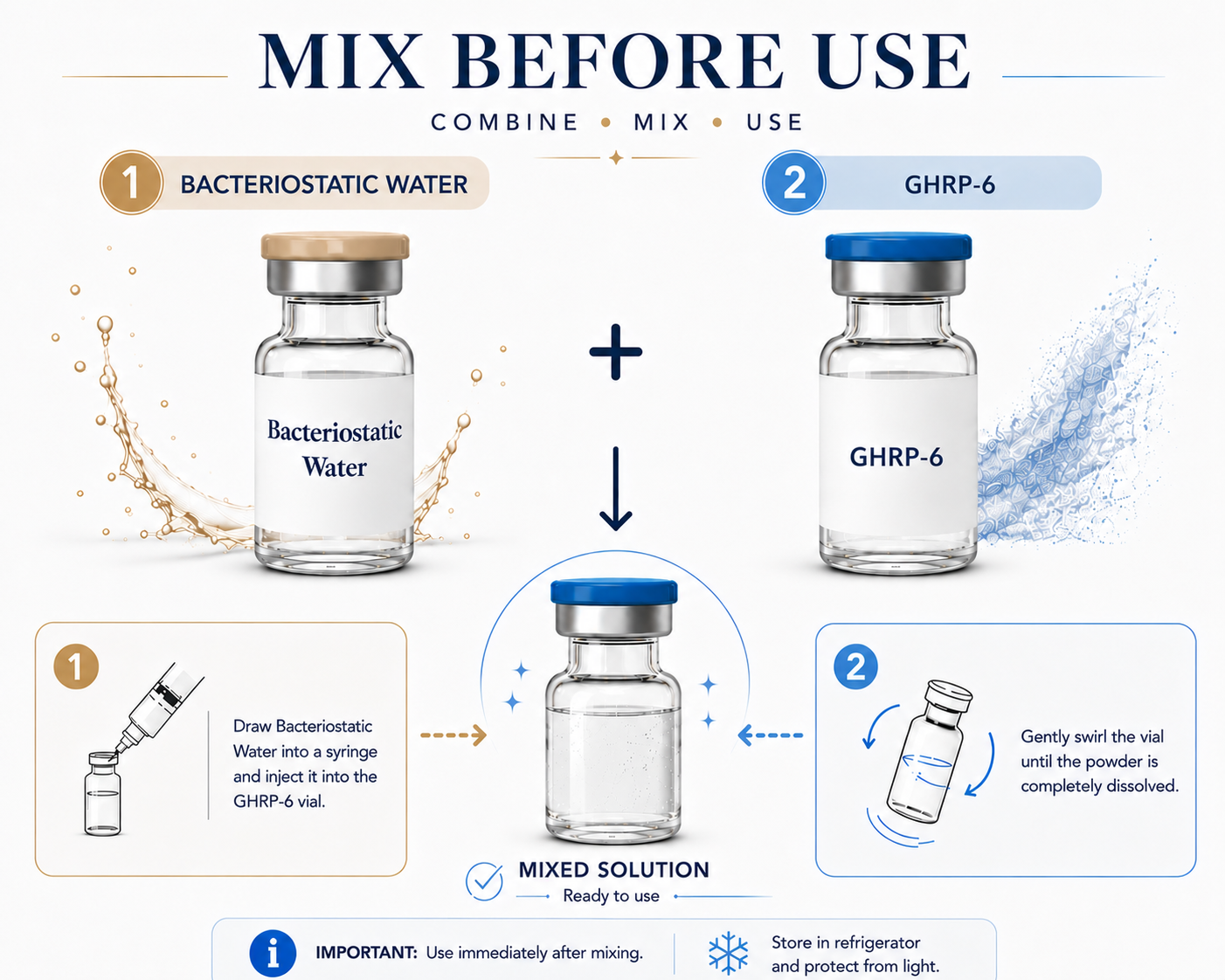
How To Mix GHRP-6
1
CleanUse alcohol swabs to clean the tops of both vials.
2
Draw BAC WaterDraw the selected amount of bacteriostatic water.
3
Inject SlowlyAdd the liquid slowly down the side of the vial.
4
Swirl GentlyDo not shake. Swirl gently until dissolved.
5
Store ProperlyStore as directed and protect from heat and light.
Best Practices & Common Mistakes
Best Practices
- Use sterile technique.
- Protect from light and heat.
- Store refrigerated when appropriate.
- Use clean syringe-unit math before measuring.
Common Mistakes
- Confusing milligrams with milliliters.
- Choosing an option with awkward decimal units.
- Using too little liquid for very small measurements.
- Shaking the vial aggressively.
GHRP-6 Storage & Handling
Lyophilized Powder: −20°C (−4°F) for long-term storage (up to 24 months). Refrigeration 2–8°C (36–46°F) for short-term use (up to ~3 months). Original sealed vial in the freezer is safest.
Reconstituted Solution: 2–8°C (36–46°F), use within ~7–14 days. Keep sealed, avoid light, and do not repeat freeze-thaw cycles.
Reconstituted Solution: 2–8°C (36–46°F), use within ~7–14 days. Keep sealed, avoid light, and do not repeat freeze-thaw cycles.
Frequently Asked Questions
Your calculator simplifies all peptides to a single mathematics, but GHRP-6's unique structure has practical implications. As a met-enkephalin analog, it contains entirely synthetic D‑amino acids (D‑Trp and D‑Phe) and completely lacks opioid activity. More importantly, the sequence His‑D‑Trp‑Ala‑Trp‑D‑Phe‑Lys‑NH₂ tends to aggregate in solution over time. While the calculator will correctly tell you that 5 mg dissolved in 5 mL of BAC water yields 1 mg/mL, after a few days, some molecules may form clumps invisible to the eye, reducing the actual peptide concentration in your draw. For this reason, some researchers add a carrier protein (0.1% HSA or BSA) to stabilize the solution – something the calculator does not account for.
Yes, but only to illustrate a critical quantitative point. Your calculator assumes 100% bioavailability – appropriate for the subcutaneous injections it was designed for. Oral bioavailability of GHRP-6 is below 1% due to rapid destruction in the stomach and intestines. This means an effective oral dose would need to be at least 100 × higher than an injectable dose. For example, if you entered a subcutaneous dose of 0.3 mg (e.g., 15 units at 2 mg/mL), an oral researcher might need 30 mg or more, which would not even fit in a 60 mg vial from your calculator's presets. Your calculator is not designed for this – and that is the key takeaway.
GHRP-6's hunger and gastric motility effects are caused by direct ghrelin receptor activation in the hypothalamus – a unique property not shared by all GHRPs. Your calculator helps you prepare identical, repeatable doses, but timing is crucial. Consider scheduling injections 30–60 minutes before a feeding period to maximize caloric intake for metabolic studies or taking the dose immediately before bedtime to bypass hunger while benefiting from GH release during sleep. The calculator does not suggest injection timing, but its ability to produce consistent, precise units from the same vial allows you to maintain a strict schedule, which is critical when appetite is a dependent variable.
Yes. Your calculator is strictly a dilution tool, not a pharmacological guide. It does not know that GHRP-6 has been shown to bind two distinct receptors – GHS‑R1a (for GH release) and CD36 – that mediate its cyto‑ and cardioprotective properties independent of the GH‑IGF‑1 axis. Research on dilated cardiomyopathy found that GHRP-6 improved left ventricular function without raising plasma GH or IGF‑1 concentrations. This means your research protocol might require GHRP-6 doses optimized for tissue protection, not maximal GH release. Your calculator will accurately reconstitute any dose you enter, but you must determine which pharmacological effect you are targeting – the calculator will not differentiate.
Your calculator's "Doses per vial" assumes full potency for as long as the vial is used. In reality, based on multiple manufacturer data sheets, after reconstitution with bacteriostatic water, GHRP‑6 should be stored at 4°C for between 2 and 7 days. Degradation is inevitable, meaning the tenth dose drawn on day 8 will not have the same activity as the first dose. Therefore, the calculator's displayed number of doses is a mathematical maximum, not a practical recommendation. For example, a 5 mg vial at 0.3 mg per dose gives about 16 doses mathematically, but you would never use all 16 because the peptide would degrade. Instead, plan to reconstitute only the amount you will use within 3–4 days, and discard any remaining solution beyond 7 days regardless of what the calculator says.
Practical takeaway: If your real goal is weight or metabolic health, the most useful next step is discussing approved treatment options with a clinician rather than relying on an unapproved compound.
Important: This tool is for informational and research-reference purposes only. Not intended for human or veterinary use.